Dash: MTG Mechanic Explained
Some creatures don't want to stick around - they want to hit fast, hit hard, and get out before your opponent can answer them. That's the spirit behind Dash, a keyword ability that lets you cast a creature for an alternative cost, send it in swinging with haste, and watch it bounce back to your hand before the dust settles.
It's a mechanic built around tempo and repeated pressure, and once you understand how it works, you'll start seeing why certain Dash creatures punch well above their mana cost.
What is Dash?
Dash is a keyword ability found on creature cards. When you cast a creature using its dash cost instead of its regular mana cost, three things happen:
- The creature enters the battlefield with haste, so it can attack the same turn it arrives.
- At the beginning of the next end step, it returns to your hand - whether you attacked with it or not.
- You get to do it all again next turn, if you want.
Think of it like a recurring punch. Instead of committing a creature to the battlefield where it can be removed, you're renting it for a turn - getting the attack trigger, the combat step, or the enters-the-battlefield effect, then pulling it safely back.
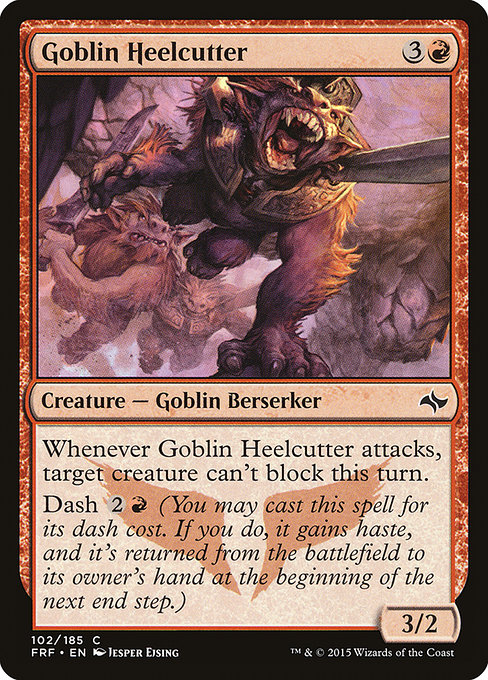
The official rules text on Goblin Heelcutter gives us a clean example of how the reminder text reads:
Dash {cost} (You may cast this spell for its dash cost. If you do, it gains haste, and it's returned from the battlefield to its owner's hand at the beginning of the next end step.)
Important: You're never forced to use the dash cost. You can always pay the regular mana cost and have the creature stay on the battlefield permanently - you just won't get haste. Dash is an alternative cost, not a replacement.
Rules
Dash represents three abilities bundled into one keyword (CR 702.109a):
- A static ability while the card is on the stack, letting you pay the dash cost instead of the mana cost.
- A delayed triggered ability (also while on the stack) that returns the permanent to hand at the beginning of the next end step - but only if the dash cost was paid.
- A static ability while the permanent is on the battlefield that grants haste - again, only if the dash cost was paid.
Here are the key rulings worth knowing:
You're still casting a spell. Paying the dash cost doesn't bypass the stack. The creature can still be countered, and all normal casting rules apply. You can only cast it during your main phase unless something else says otherwise.
The return trigger is conditional on the creature still being on the battlefield. If your dashed creature is removed - destroyed, exiled, bounced - before the end step, the trigger has nothing to return. The creature stays wherever it went; it doesn't come back to your hand automatically.
You don't have to attack. Haste means you can attack, not that you must. Unless a separate ability requires it, you're free to dash a creature in just for its enters-the-battlefield trigger or to hold up a blocker for a turn.
Copies don't inherit dash's haste or return trigger. If a creature becomes or enters as a copy of a dashed creature, the copy doesn't gain haste and won't return to hand. Those effects are tied specifically to whether the original spell's dash cost was paid.
Rules note:
Casting a spell for its dash cost follows the standard rules for alternative costs (CR 601.2b, 601.2f-h). You can't pay an alternative cost and an additional cost at the same time unless a rule or effect explicitly allows it.
Strategy
Playing with Dash
Dash rewards a particular kind of aggression - one that cares more about repeated triggers and resilience than raw board presence.
The bounce-back is a feature, not a bug. In a format full of removal spells, a creature that returns to your hand at end of turn is almost impossible to two-for-one. Your opponent wastes a Fatal Push or a Shock, and the creature is already waiting in your hand to come back next turn.
This makes Dash especially powerful in decks built around enters-the-battlefield effects or attack triggers. If your creature does something relevant the moment it attacks or enters, you can generate that value turn after turn without ever needing to resolve a longer game plan.
Mana efficiency is the trade-off. You're paying the dash cost every single turn you want the creature active, which means you're spending mana repeatedly instead of once. Over a long game, that adds up. Dash is at its best when games end quickly or when the creature's repeated impact outpaces the cumulative mana investment.
Dash as a curve-filler. The typical Dash costs trend toward the 2-3 mana range regardless of a card's printed mana cost. That means a more expensive creature can be dashed in early to fill a gap in your curve, while a cheaper creature can be cast normally when you want it to stick and dashed later when you need a haste attacker on a specific turn.
Playing against Dash
The best answers to Dash creatures are effects that don't care about the return trigger - exile rather than destroy, or effects that trigger in response to the creature attacking rather than trying to remove it before end of turn.
If you're trying to race a Dash deck, keep in mind that they generate consistent damage without ever really overextending. Sweepers and mass removal lose value when there's only ever one or two dashed creatures on the board at a time. Disrupting their hand - so they can't re-cast the creature - is often more effective than targeting the creature itself.
Deck-building considerations
- Dash pairs naturally with cards that reward attacking (go-wide aggressive strategies, Raid synergies).
- Cards that care about creatures entering or leaving the battlefield get extra mileage from Dash's bounce effect.
- In Commander, Dash can be a useful tool for protecting key creatures from sweepers - dash them in for a swing, return them to hand before the board wipe resolves at the next end step.
Notable Cards
Goblin Heelcutter - The example card that Wizards of the Coast uses in the comprehensive rules to illustrate Dash. A 3/2 for {3}{R} that can be dashed in for {2}{R}, preventing target creature from blocking the turn it attacks. Straightforward, and a clean demonstration of how Dash works in practice.
Zurgo Bellstriker - A 2/2 with Dash for {R} that can be cast on turn one for its regular cost. A rare case where the creature has legitimate flexibility between early aggression and repeated dash pressure, and a strong representative of the Mardu identity the mechanic was designed for.
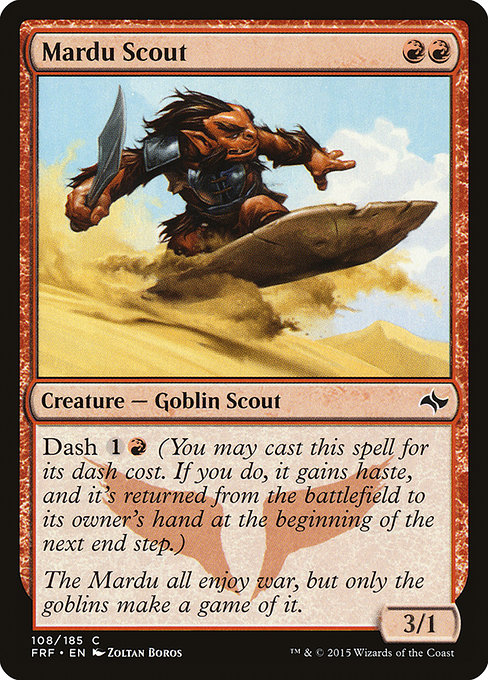
Mardu Scout - A 3/1 with Dash that becomes a repeatable source of haste damage for just {1}{R}. Straightforward but effective in aggressive red strategies.
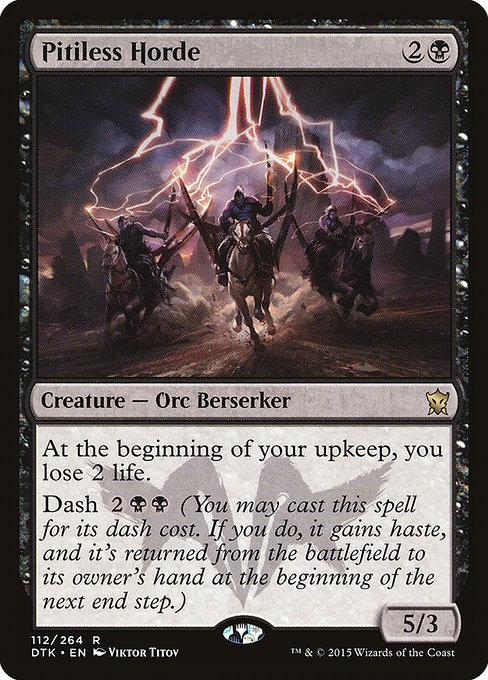
Pitiless Horde - An interesting case where Dash functions as downside mitigation. The creature has a painful drawback when cast for its regular cost; using the Dash cost sidesteps part of that problem while still getting a large, hasty attacker for a turn.
History
Dash was introduced in Fate Reforged (2015), where it served as the mechanical identity of the Mardu Horde - a warrior clan defined by swift, decisive raids. It replaced Raid (the Mardu mechanic from Khans of Tarkir) in the timeline-shifted Fate Reforged set, reflecting the Mardu's evolution under Sarkhan Vol's altered past.
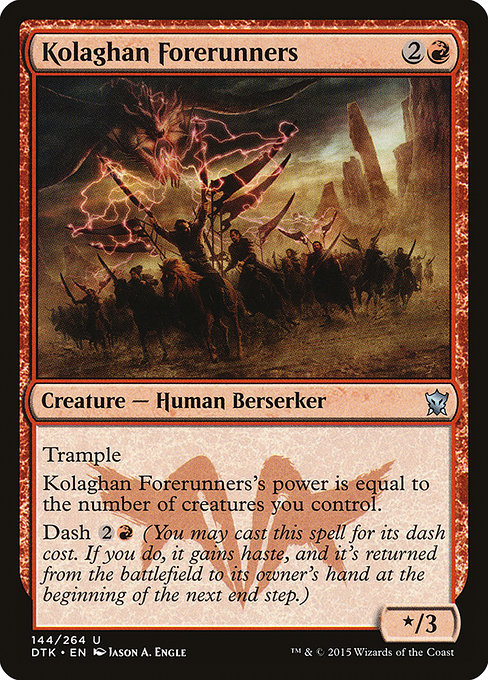
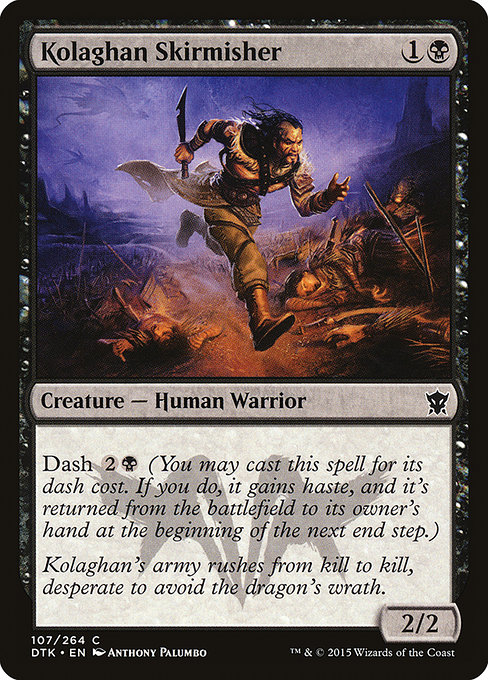
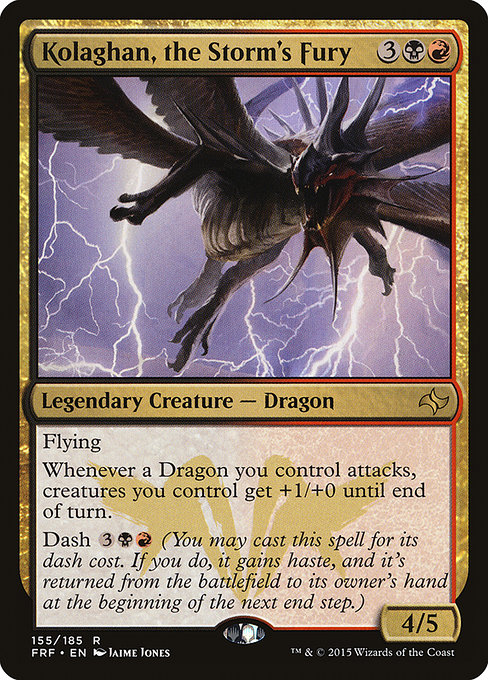
The mechanic continued into Dragons of Tarkir (2015), where it became associated with Clan Kolaghan - the dragon-led faction that inherited the Mardu's aggressive, hit-and-run philosophy.
Lore aside: The nonkeyword version of this concept appeared much earlier in Magic's history. Viashino Sandstalker from Visions (1997) had a non-optional version of the same effect - it returned to its owner's hand at the beginning of the end step regardless, which was framed as a downside rather than a choice. Dash formalised the idea into an optional, strategic tool nearly two decades later.
Dash made a small return appearance in Modern Horizons (2019), notably on the first - and so far only - green card to carry the keyword. It reappeared again in the March of the Machine Commander Decks** (2023), showing that Wizards still reaches for it occasionally when the design space calls for aggressive, temporary creatures.
The typical pattern across all Dash cards holds remarkably consistent: dash costs cluster around the 2-3 mana range, creating a natural pull toward the middle of the curve regardless of the card's printed cost.