Decayed: MTG Mechanic Explained
There's something almost poetic about a Zombie that gets exactly one glorious charge before it collapses into nothing. That's the flavour at the heart of Decayed - a keyword ability introduced in Innistrad: Midnight Hunt (MID) that turns your shambling undead horde into a wave of one-shot attackers.
What is Decayed?
Decayed is a keyword ability that represents two linked limitations on a creature. A creature with decayed can't block, and when it attacks, you sacrifice it at the end of combat.
In practice, this means a Decayed creature has exactly one job: attack, deal its damage, and then crumble. Think of it less like a permanent threat and more like a loaded bullet - you fire it when the moment is right, and then it's gone.
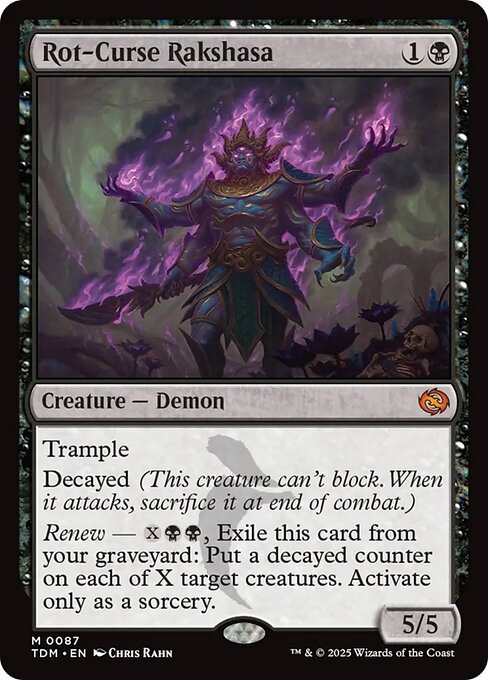
The keyword appears almost exclusively on tokens, specifically the 2/2 black Zombie creature tokens that are the bread and butter of Innistrad's undead army. Only one printed card with the keyword exists (Rot-Curse Rakshasa), making Decayed a mechanic that lives and dies - fittingly - in the token space.
Rules
Decayed represents two separate abilities bundled under one keyword: a static ability and a triggered ability.
"Decayed represents a static ability and a triggered ability. 'Decayed' means 'This creature can't block' and 'When this creature attacks, sacrifice it at end of combat.'" - CR 702.147a
Here are the key rules to keep in mind:
- Decayed does not force you to attack. You choose when (or whether) to send a Decayed creature into battle. The sacrifice only triggers if and when it attacks.
- Decayed does not grant haste. A Decayed token that enters the battlefield on your turn is subject to summoning sickness just like any other creature. You'll have to wait until your next turn to attack with it.
- Once it attacks, it's gone - even if it loses Decayed. If a creature attacks while it has Decayed, the triggered ability is locked in. Even if the creature somehow loses the keyword before end of combat, it will still be sacrificed.
- It can't block. Full stop. There's no way around the static ability while the creature has Decayed. Your Zombie tokens are purely offensive.
Rules note: The sacrifice happens at end of combat, not when the creature deals damage. This matters for things like first strike and combat tricks - the creature survives through the full combat step before being sacrificed.
Strategy
Playing with Decayed
The design intention behind Decayed is elegant: R&D wanted Zombie tokens to feel threatening without making combat math spiral out of control for both players. A board full of 2/2s that can't block and each only get one swing creates a different kind of pressure than a normal token army.
The core tension is timing. Each Decayed token is a resource you spend exactly once. Attack too early into open mana or a board full of blockers, and you've wasted the token. Hold them until you can punch through lethal damage or trade favourably, and they become remarkably efficient.
A few approaches make the most of Decayed creatures:
- Go wide and go wide fast. Cards like Ghoulcaller's Harvest and Tainted Adversary can flood the board with Decayed tokens in a single turn. A wave of six 2/2s is hard to ignore, even if they each only get one swing.
- Exploit the 'dies on command' clause. Because attacking with a Decayed creature guarantees it dies, you can trigger death-based effects reliably. Ghoulish Procession is a great example - attack with your token, sacrifice it at end of combat, create a new token from the trigger, and repeat the cycle.
- Flashback pairs naturally.** Several Decayed-adjacent cards have flashback costs, and MID was built around the graveyard as a resource. Filling your yard while building a Zombie army is the intended play pattern.
Playing against Decayed
Facing down a Decayed army is a puzzle with an unusual shape. Your opponent's tokens can't block, which means your creatures can often attack freely. But you can't just ignore a pile of 2/2s - if they all swing at once, the total damage adds up quickly.
The blocker gap is the biggest thing to remember. If you're racing against a Decayed player, you likely have the blocking advantage. They can't trade their tokens in combat unless you're the one attacking into them. Use that asymmetry.
Board wipes are particularly punishing against Decayed tokens, since the tokens were never going to block anyway. If you clear the board before they attack, you've denied your opponent the only mode those tokens had.
Deck-building considerations
Decayed tokens work best in decks that can:
- Generate multiple tokens at once for a single-turn alpha strike
- Exploit creature deaths (sacrifice synergies, death triggers, aristocrats-style payoffs)
- Use the graveyard as a resource to keep the engine running
- Pair with anthem effects to make each one-shot attack hit harder
Format check: Decayed is primarily relevant in formats where the Innistrad sets are or were legal - Standard at the time of MID's release (2021), Historic, and Commander. In Commander especially, the token-generation cards can produce enormous swings in board presence.
Notable cards
Tainted Adversary
Tainted Adversary is the standout rare that puts Decayed on the map. For '{1}{B}', you get a 2/2 Zombie with deathtouch, and when it enters, you can pay '{2}{B}' as many times as you want. Each payment puts a +1/+1 counter on Tainted Adversary and creates two Decayed tokens. Pay it three times on a big mana turn, and you've dropped a 5/5 deathtouch creature plus six 2/2 tokens onto the table. That's a lot of board presence for one card.
Ghoulish Procession
Ghoulish Procession is the engine that keeps the Zombie army self-sustaining. Whenever one or more nontoken creatures die, you create a Decayed token. Because Decayed tokens die when they attack, you can convert each token into the next one - and if any of your real creatures die in combat or to removal, they fuel the chain too.
Rotten Reunion
Rotten Reunion does double duty at '{B}': it exiles a graveyard card (relevant for disrupting opponents' graveyard strategies) and creates a Decayed token. The flashback cost of '{1}{B}' means you get to do it twice, which is solid value for a one-mana card in a format built around the graveyard.
Ghoulcaller's Harvest
Ghoulcaller's Harvest is the big payoff for a creature-heavy graveyard. For '{B}{G}', you create X Decayed tokens where X is half the number of creature cards in your graveyard, rounded up. In a dedicated self-mill or sacrifice deck, this can produce a genuinely frightening number of tokens in a single turn. It also has flashback, so you can set it up once, fill the yard, and fire it again.
Rot-Curse Rakshasa
The only printed (non-token) card that naturally has the Decayed keyword. While the Decayed tokens are the face of the mechanic, Rot-Curse Rakshasa shows that R&D was willing to put the keyword on a creature with a meaningful body - it just hasn't become a regular pattern yet.
History
Decayed was introduced in Innistrad: Midnight Hunt (MID, 2021) as the primary token mechanic for that set's Zombie tribal themes.
Interestingly, the mechanic's origin story involves a swap between the two Innistrad sets released in close succession. The Decayed Zombie tokens were originally created for Innistrad: Crimson Vow (VOW, 2021). When MID's design needed a low-rarity way to create Zombie tokens without overwhelming combat math, R&D moved Decayed to MID and gave VOW the Spirit mechanic (Disturb) in exchange.
The design goal was specific: create a Zombie-army play pattern that felt flavourful and mechanically distinct from generic token production. R&D liked the idea that each Zombie gets one attack - you're managing a horde of shambling soldiers, each waiting for the right moment to charge. That created a new decision space around when to commit tokens, rather than simply whether to attack.
The mechanic also opened up interesting design space beyond pure Zombie tribal. Because Decayed creatures reliably die when they attack, any effect that cares about creatures dying can treat Decayed tokens as a predictable resource. That intersection with aristocrats-style sacrifice synergies gave the mechanic legs in multiple archetypes.
Decayed also appears in some reanimation contexts - cards like Gisa, Glorious Resurrector return opponents' creatures from the graveyard but give them Decayed, creating a quirky tension where you're getting value from your opponent's best creatures, but only for one attack each.