Epic: The MTG Mechanic Explained
Some cards make you think. Epic makes you commit. Appearing on exactly five cards in all of Magic's history, the Epic keyword asks the most dramatic question a spell has ever posed: what if this effect happened every single turn for the rest of the game - but you never cast another spell again?
It's one of the most all-in mechanics ever designed, and honestly, that's exactly what makes it fascinating.
What is Epic?
Epic is a keyword ability that appears on five sorceries from Saviors of Kamigawa (SOK, 2005). When you cast a spell with Epic and it resolves, two things happen simultaneously:
- You can't cast spells for the rest of the game. Not this turn - forever.
- At the beginning of each of your upkeeps for the rest of the game, you get a copy of that spell (minus the Epic ability itself). If the spell has targets, you may choose new targets for each copy.
The trade-off is about as stark as Magic gets. You fire off one massive effect, and in return, that effect echoes through every upkeep you'll ever have - while you watch the rest of your hand become decorative cardboard.
Lore aside: Epic was designed as Saviors of Kamigawa's answer to a specific creative question: what does it mean for an instant or sorcery to be legendary? The whole Kamigawa block leaned heavily into legendary permanents, and the Epic cycle was the design team's attempt to bring that same sense of mythic singularity to spells. You cast it once, and it defines your game forever.
How Epic works: the rules
The comprehensive rules spell this out clearly in CR 702.50:
"Epic represents two spell abilities, one of which creates a delayed triggered ability. 'Epic' means 'For the rest of the game, you can't cast spells,' and 'At the beginning of each of your upkeeps for the rest of the game, copy this spell except for its epic ability. If the spell has any targets, you may choose new targets for the copy.'" - CR 702.50a
A few things worth unpacking there:
You can't cast spells - but copies still happen
The no-casting restriction is absolute. You can't cast creatures, instants, sorceries, planeswalkers, enchantments - nothing. But here's the crucial distinction: copies aren't cast. The Epic trigger puts copies of the spell directly onto the stack, which means your Epic effect keeps firing every upkeep without technically violating the restriction. The copies bypass the "can't cast spells" rule entirely (CR 702.50b).
This also means your opponents can't use effects that counter or interact with casting to stop your upkeep copies - the copies were never cast in the first place.
Choosing new targets each upkeep
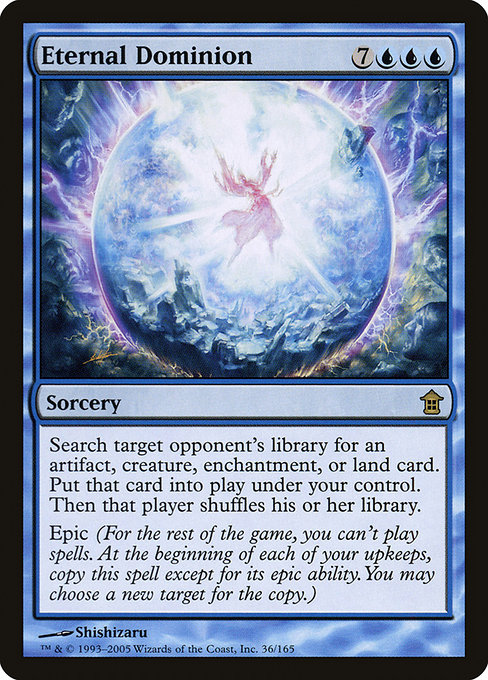
If the original spell had targets, you get to choose fresh ones for each copy. This is what gives Epic spells their real teeth. Eternal Dominion, for example, lets you rip a permanent from a different opponent's library every single upkeep. In a multiplayer game, that's a lot of permanents.
What it doesn't restrict
You can't cast spells, but other game actions are fine. You can activate abilities (including those that put spells onto the stack as copies), attack, block, and use any non-spell effect. The lock is on casting specifically.
Rules note: If you somehow gain control of an opponent's Epic spell mid-resolution - don't try to rules-lawyer this one at your kitchen table - the restriction and the trigger both follow the controller at the time the spell resolved. This is a genuine edge case; check with a judge if it comes up in a competitive setting.
The five Epic spells
All five members of the Epic cycle are sorceries from Saviors of Kamigawa. Each represents a colour's core fantasy taken to an absurd extreme.
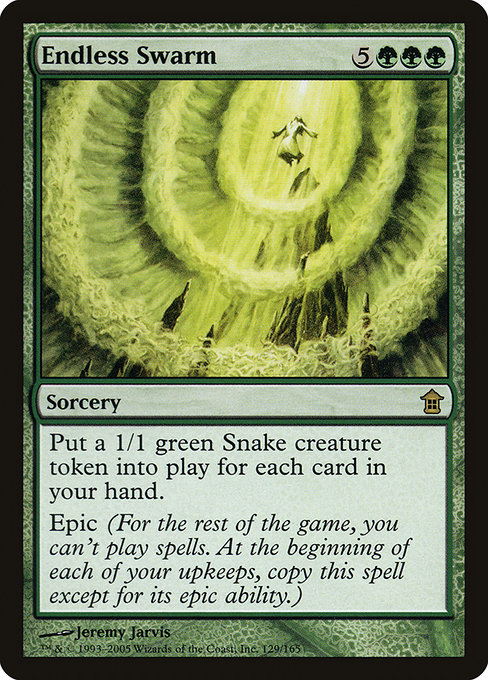
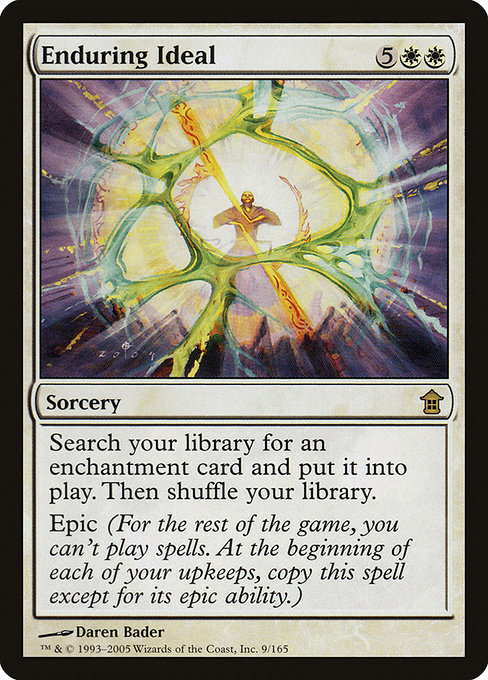
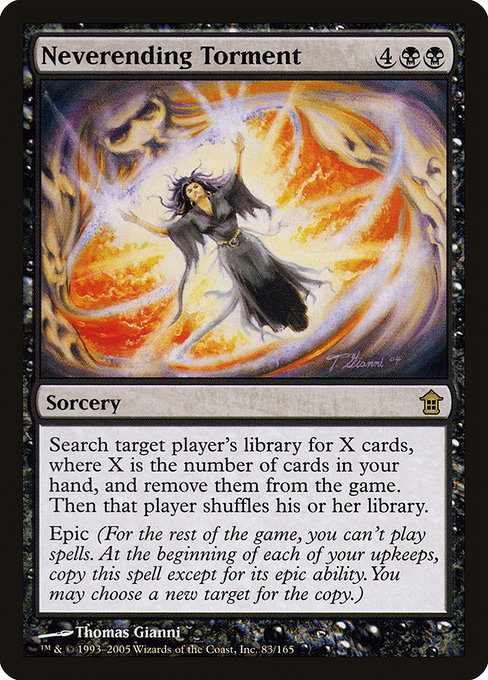
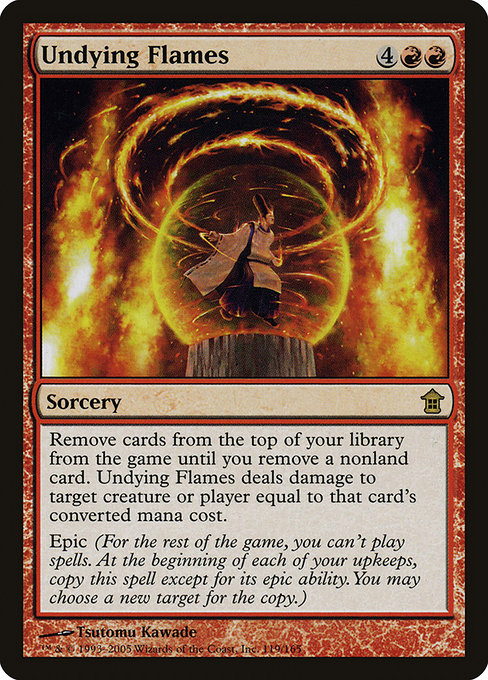
| Card | Colour | Cost | Effect | |---|---|---|---| | Enduring Ideal | White | {5}{W}{W} | Search your library for an enchantment and put it onto the battlefield | | Eternal Dominion | Blue | {7}{U}{U}{U} | Search target opponent's library for an artifact, creature, enchantment, or land and put it onto the battlefield under your control | | Neverending Torment | Black | {4}{B}{B} | Exile cards from target opponent's library equal to the number of cards in your hand | | Undying Flames** | Red | {4}{R}{R} | Deal damage to target creature or player equal to the mana value of the first nonland card exiled from the top of your library | | Endless Swarm | Green | {5}{G}{G}{G} | Create a 1/1 green Snake token for each card in your hand |
Of these, Enduring Ideal is by far the most played. Assembling an enchantment engine - say, Form of the Dragon locked behind an impenetrable wall of Solitary Confinement - and then never needing to cast another spell is actually a coherent game plan. It has seen play in dedicated combo shells in older formats.
Eternal Dominion has had its moments in Commander, where stealing a different player's best card every upkeep is as unfair as it sounds. The mana cost of {7}{U}{U}{U} is brutal, but in a 100-card format with access to plenty of ramp, it's castable.
Endless Swarm is the most intuitive to grasp - make a fistful of Snake tokens, then make that many more every single turn - but it requires you to keep cards in hand after paying for a seven-mana spell, which is a real tension.
Strategy: building around Epic
Playing an Epic spell isn't a mid-game pivot. It's an ending. You need to go in knowing that once that spell resolves, you're playing solitaire with whatever's already on the battlefield.
Before you cast it
Everything you're going to need for the rest of the game has to already be in play. That means:
- Mana sources: lands, mana rocks, creatures with tap abilities - anything that doesn't require casting
- Protection: hexproof or indestructible creatures, enchantments that defend your life total, anything that keeps you alive
- Win conditions: the Epic effect itself, or permanents already on the board that will close the game
Enduring Ideal is the cleanest example of solving this problem by design. The spell is the win condition - it tutors an enchantment every upkeep, so you can chain Dovescape into Privileged Position into Form of the Dragon across successive turns without ever touching your hand again.
Playing against Epic
The best answer to an Epic spell is a counterspell - stop it before it resolves and the restriction never kicks in. Once it's on the stack, your window to interact with it cleanly is right there.
If it does resolve, your opponent's inability to cast spells is itself a resource. They can't play removal, can't cast board wipes, can't refill their hand. Pressure their life total and force them to stabilise with only what's already on the battlefield.
Format check: All five Epic spells are legal in Commander and Legacy. None are currently banned in formats where they're legal, though their mana costs make them largely irrelevant in anything faster than a midrange Commander game.
In Commander specifically
Commander is where Epic spells have the most room to breathe. You have more turns, more mana, and an 100-card singleton deck that can be built specifically to set up one massive spell. The multiplayer angle also amplifies effects like Eternal Dominion significantly - three opponents means three libraries to pillage.
The catch is that you're locking yourself out of interaction for the rest of the game at a table with three people who still have full hands. Make sure your board state is genuinely unassailable before you pull the trigger.
History and design legacy
Epic appeared in Saviors of Kamigawa (2005) as part of the block's final chapter. The entire Kamigawa block struggled in reception, and Epic reflects both its ambition and its awkwardness - the effects are genuinely powerful, but the mana costs are high, the setup requirements are demanding, and the reward is a slow, recurring effect rather than an immediate win.
Mark Rosewater has noted that Epic is probably the mechanic with the least design space of anything Magic has ever printed. That tracks. The concept is elegant but narrow: there are only so many effects worth locking yourself out of the game for, and all five of them were printed in the same set.
Epic has never been revisited. No card since SOK has received the keyword, and given how extreme the cost is - giving up your ability to cast spells permanently is unlike almost anything else in the game - it's hard to imagine a context where it returns without major rethinking.
That said, the question it was designed to answer - what does a legendary instant or sorcery look like? - remains one of the most interesting design problems Magic has posed. Epic's answer was radical and a little strange, which is, in my opinion, exactly right for the Kamigawa block.