Extort: MTG Mechanic Explained
There's something deeply on-brand about the Orzhov Syndicate having a mechanic that bleeds your opponents dry one spell at a time. Extort doesn't win games in one dramatic moment - it wins them through slow, grinding inevitability, nickeling-and-diming everyone at the table until the math finally tips in your favor. It's the kind of mechanic that rewards patience and punishes opponents for not ending the game quickly.
What is Extort?
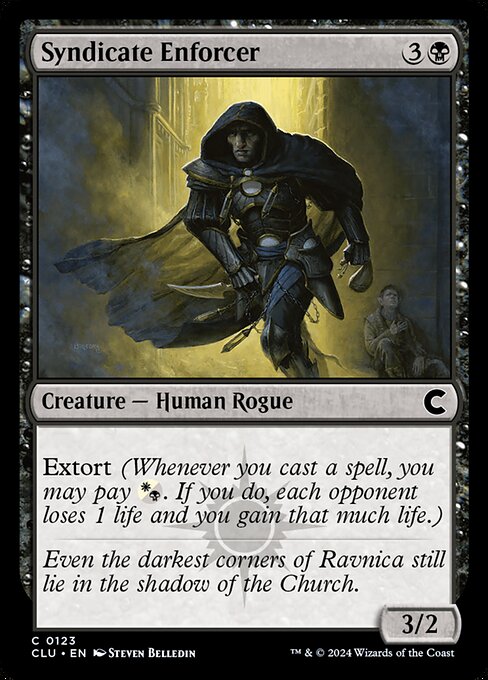
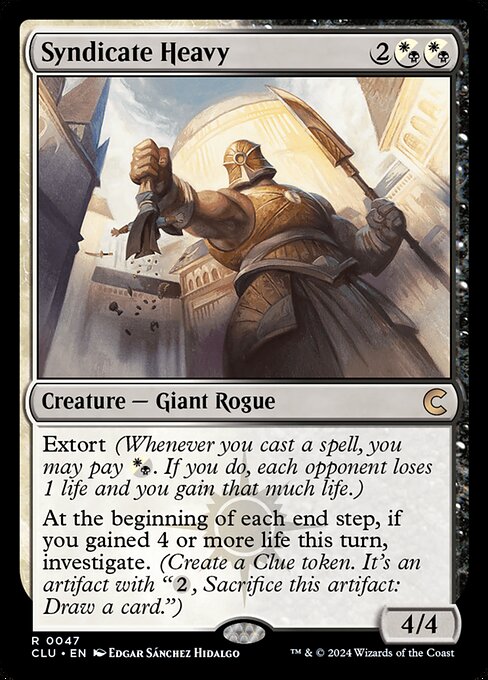
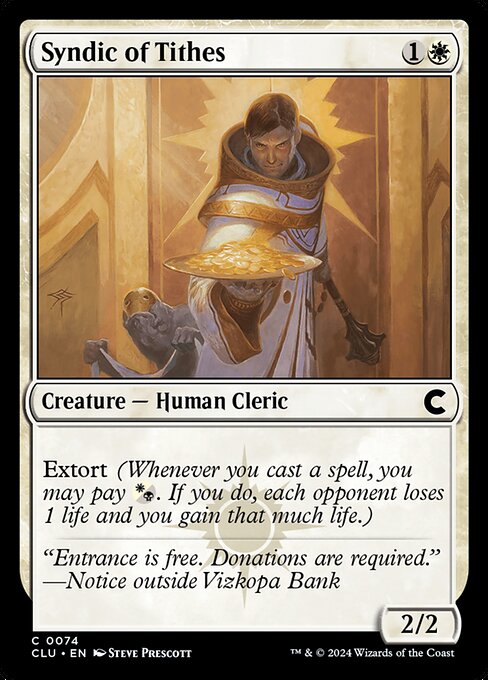
Extort is a triggered keyword ability introduced in Gatecrash (2013) as the signature mechanic of the Orzhov Syndicate. Every spell you cast while you control a permanent with Extort becomes an opportunity to drain your opponents - for a small additional cost, you can chip away at everyone's life total while padding your own.
The reminder text says it best: "Whenever you cast a spell, you may pay {W/B}. If you do, each opponent loses 1 life and you gain that much life."
That hybrid {W/B} symbol is doing a lot of work. It means you can pay with either white or black mana, which fits neatly into Orzhov's two-color identity. Cast a spell, pay one extra mana, and everyone across the table takes a point of damage while you heal up. Do it every turn for ten turns and suddenly you're looking at a 10-life swing or more - and that's before accounting for multiple Extort triggers.
Rules
Extort is governed by CR 702.101. Here's what the Comprehensive Rules actually say:
"Extort is a triggered ability. 'Extort' means 'Whenever you cast a spell, you may pay {W/B}. If you do, each opponent loses 1 life and you gain life equal to the total life lost this way.'"
- CR 702.101a
A few things worth unpacking there.
How multiple Extort instances work
If a permanent has multiple instances of Extort, each triggers separately (CR 702.101b). This is where Extort starts to get genuinely scary - if you control three creatures with Extort and cast a single spell, that's three separate triggers, each asking you to pay {W/B}. Three mana, three drains, three life gained per opponent.
Rules note: You decide whether to pay the {W/B} cost when each individual Extort ability resolves, not when the triggering spell is cast. You can choose to pay for some triggers and skip others.
Common misunderstandings
- You can only pay once per trigger. Each Extort ability lets you pay {W/B} a maximum of one time. You can't pay more to multiply the effect.
- The life you gain scales with opponents. In a four-player Commander game, each opponent loses 1 life, so you gain 3 life total from a single trigger. That's the Commander-sized version of Extort, and it's why the mechanic punches well above its weight in multiplayer.
- Life that can't be lost doesn't count. If an opponent controls something like Platinum Emperion that prevents their life total from changing, they don't lose the 1 life - and you don't gain it either. You gain life equal to the total life lost, not the number of opponents.
- Extort doesn't target anyone. The ability just happens to all opponents simultaneously. You can't choose to exclude someone or focus the drain.
- The {W/B} symbol doesn't change color identity for most Extort cards. This one trips people up in Commander. The hybrid mana symbol appears in reminder text, and the rules explicitly exclude reminder text from color identity calculations. So a mono-black creature with Extort in its reminder text is still mono-black for Commander deckbuilding purposes.
Color identity and Commander
This is worth dwelling on for a moment, because it's genuinely counterintuitive. The {W/B} mana symbol is right there in the reminder text of every Extort card, but it doesn't automatically make those cards two-colored for Commander purposes. Most single-colored Extort cards remain monocolored in identity - only cards with {W/B} actually printed in their rules text (not reminder text) pick up both colors.
Format check: Always check whether an Extort card has {W/B} in its rules text or only in its reminder text before assuming it fits in your mono-black Commander deck.
Strategy
Playing with Extort
The core loop of Extort is simple: land your Extort permanents early, then cast as many spells as possible to trigger them repeatedly. The mechanic doesn't care what you're casting - a one-mana cantrip triggers it just as well as a five-mana bomb. This makes cheap spells particularly valuable in Extort-focused builds, since they let you trigger the ability multiple times in a single turn while still doing other things.
The real power of Extort isn't the damage - it's the life swing. In a heads-up match, each trigger is a 2-life swing (they lose 1, you gain 1). In a four-player Commander game, it's a 4-life swing per trigger. Stack three Extort creatures and a handful of cheap spells and you can reasonably swing 20+ life in a single turn without dealing a single point of combat damage.
Deck-building considerations:
- Cheap spells are your best friends. Each spell you cast is another chance to trigger Extort. Prioritize low-cost interaction, cantrips, and ramp.
- Multiple Extort permanents multiply fast. Two creatures with Extort means two triggers per spell. Three means three. Build toward critical mass.
- Life totals as a resource. Extort naturally gives you a larger life buffer, which you can lean into with cards that let you pay life for effects.
- Go-wide creature strategies help too. Cards like Pontiff of Blight - the only card that grants Extort to your other creatures - can turn an entire board into an Extort engine overnight.
Playing against Extort
Extort rewards doing nothing, which means the best answer is pressure. The longer the game goes, the more triggers your opponent accumulates. Fast decks that close out games before Extort reaches critical mass are naturally strong against it.
If you can't close quickly, prioritize removing Extort permanents before their controller can build up a stack of them. One Extort creature is annoying. Four is a death sentence in multiplayer.
In Commander specifically, be wary of how quickly an Extort player's life total climbs above the table. That buffer becomes very hard to race through in the late game.
Notable cards
Treasury Thrull
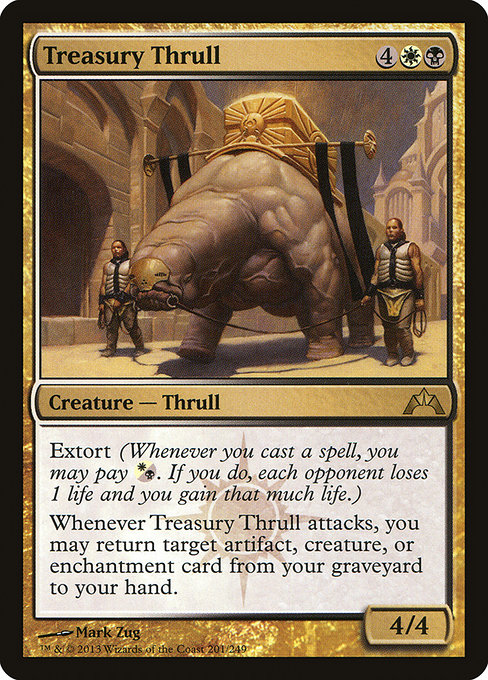
A {4}{W}{B} 4/4 that exemplifies what Extort is going for. Beyond the Extort trigger, its attack ability returns any artifact, creature, or enchantment from your graveyard to your hand - giving you more spells to cast and more Extort triggers to generate. It's a value engine that feeds itself.
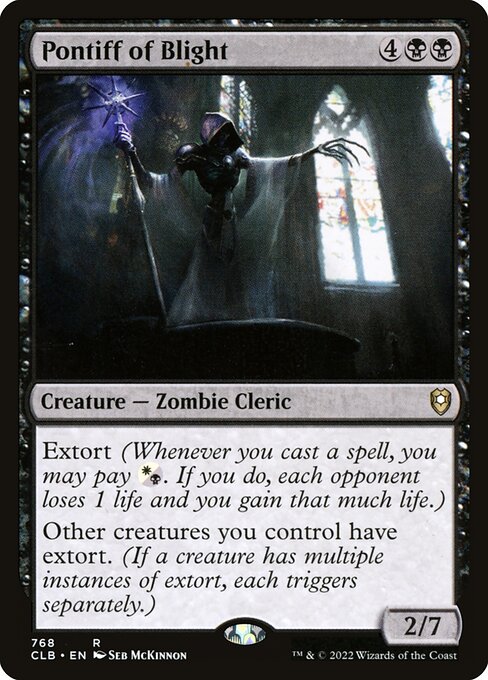
Pontiff of Blight
The most powerful Extort card ever printed, and it's not particularly close. Pontiff grants Extort to all your other creatures, which means a board of five creatures suddenly has five Extort triggers on every spell you cast. In Commander, a single resolved spell with a full board can drain the table for a substantial chunk of life. It's the card that turns a casual Extort subtheme into a genuine win condition.
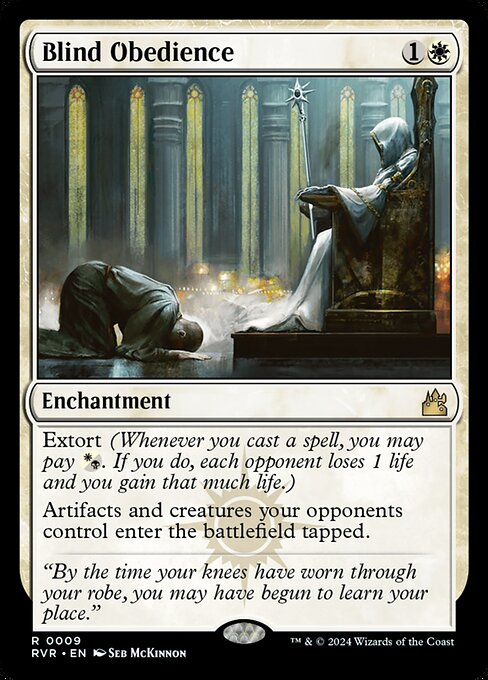
Blind Obedience
This one is notable for a different reason: it demonstrated that Extort doesn't have to live on creatures. Blind Obedience is an enchantment - it enters opponent's artifacts and creatures tapped and carries Extort. It's one of the most Commander-playable Extort cards precisely because enchantments are harder to remove than creatures, and it pulls double duty by slowing down your opponents' boards.
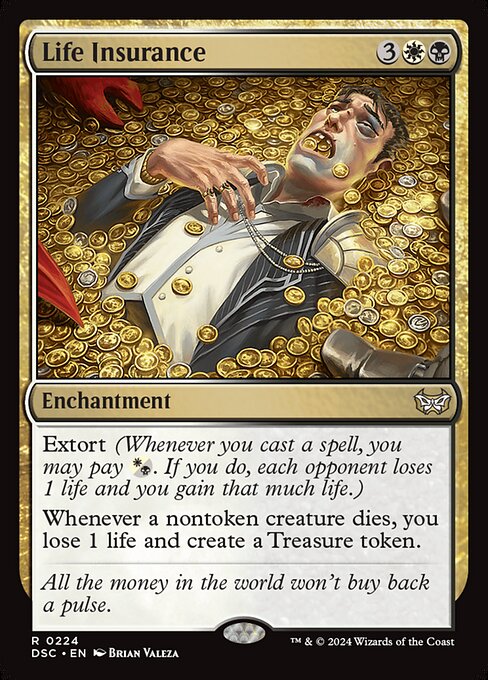
Life Insurance and Sorin, Ravenous Neonate
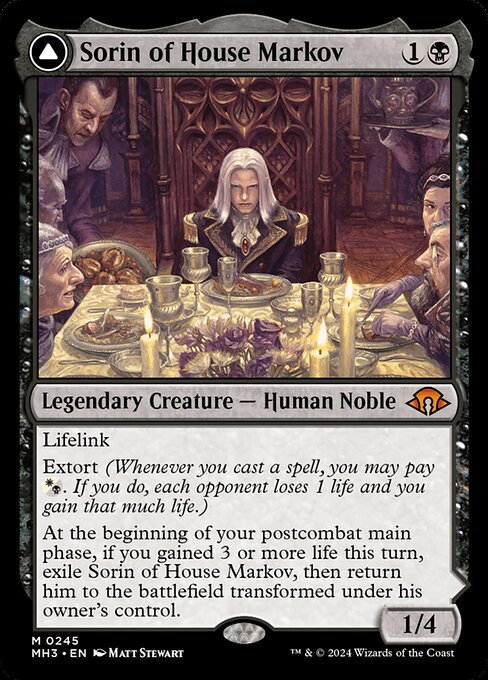
Both from 2024, these expand Extort onto noncreature permanents further. Sorin in particular is notable as the first planeswalker to carry Extort (on his back face), which was genuinely new design space for the mechanic over a decade after its introduction.
History
Extort debuted in Gatecrash (2013) as the Orzhov Syndicate's guild mechanic - designed by Shawn Main, who wasn't formally on the design team for that set. The hybrid {W/B} mana cost was a late addition to the design process.
The mechanic returned briefly in Dragon's Maze (2013) before taking a long hiatus. It reappeared in supplemental sets over the years - Commander 2019, New Capenna Commander, Ravnica: Clue Edition, and Modern Horizons 3 - but never as a primary draft mechanic in a Standard set.
Lore aside: The Orzhov Syndicate in Ravnica is essentially a corrupt church turned crime family, obsessed with wealth, debt, and keeping power concentrated among the guild's leadership - often literally keeping powerful ghost oligarchs alive through sheer accumulation of spiritual debt. Extort is perfect flavor for them.
Where does Extort sit in design space today? According to Magic's own Storm Scale - a measure of how likely a mechanic is to return to a Standard-legal set - Extort sits at a 6 out of 10 (with 10 being least likely to return). The reasons are interconnected: Extort stacks dangerously when multiple instances are in play, and the explosion of Commander's popularity means each trigger is significantly more powerful than it was when the mechanic was designed for two-player matches. The {W/B} color identity reminder text issue also created genuine confusion for players.
That said, the design team clearly hasn't abandoned it entirely. The 2024 appearances on Life Insurance and Sorin, Ravenous Neonate suggest there's still appetite for Extort in supplemental products, even if a full Standard return feels unlikely in the near future.