Gravestorm: MTG Mechanic Guide
Imagine storm, but instead of rewarding you for casting a lot of spells, it rewards you for watching a lot of permanents die. That's gravestorm in a nutshell - a rare and deliberately narrow keyword that turns mass destruction into a force multiplier. There have only ever been two cards printed with gravestorm, which tells you a lot about how carefully Wizards of the Coast handles it.
What is Gravestorm?
Gravestorm is a triggered keyword ability found on spells. When you cast a spell with gravestorm, it creates a copy of itself for each permanent that was put into a graveyard from the battlefield that same turn. If the spell has targets, you can choose new targets for each copy.
It works exactly like its better-known cousin storm - with one crucial difference. Regular storm counts how many spells were cast before it this turn. Gravestorm doesn't care about spells at all. It only cares about permanents - creatures, artifacts, enchantments, lands, planeswalkers - that went from the battlefield into any graveyard this turn.
The payoff scales with destruction. Play it after a board wipe, after a sacrifice chain, or after a land sacrifice loop, and you can generate a large number of copies from a single casting.
Rules
The official rules for gravestorm are in CR 702.69:
"Gravestorm is a triggered ability that functions on the stack. 'Gravestorm' means 'When you cast this spell, copy it for each permanent that was put into a graveyard from the battlefield this turn. If the spell has any targets, you may choose new targets for any of the copies.'" - CR 702.69a
"If a spell has multiple instances of gravestorm, each triggers separately." - CR 702.69b
A few things worth unpacking from that:
It counts all permanents, not just yours
Gravestorm doesn't restrict itself to permanents you control or permanents your opponents control. Any permanent from any battlefield going to any graveyard counts. If your opponent's creatures died, those count too.
Tokens count - then immediately disappear
Tokens that are put into a graveyard from the battlefield are counted by gravestorm, even though state-based actions then immediately remove tokens from the graveyard. The death happened; gravestorm saw it.
The spell itself being on the stack doesn't count
Gravestorm looks back at what happened before you cast the spell. The spell with gravestorm doesn't count itself as going to the graveyard, since it hasn't resolved yet - it's still on the stack when the triggered ability fires.
Timing matters
Gravestorm only counts permanents that died this turn, up to and including the moment you cast the gravestorm spell. Anything that dies after the trigger has already resolved won't retroactively add copies.
Common misunderstanding: it doesn't require your own permanents to die
A new player might assume gravestorm is only relevant if you've been sacrificing your own stuff. That's not true. Opponent's creatures dying to removal, combat damage, and -X/-X effects all feed the count equally.
Strategy
Setting up a high gravestorm count
The whole game with gravestorm is getting as many permanents into graveyards as possible before you cast your gravestorm spell. The classic setup involves some combination of:
- Mass removal - Wrath effects and board wipes are the most efficient way to inflate the count in a single action. Ten creatures dying to a board wipe means ten copies.
- Sacrifice outlets - Repeatedly sacrificing cheap tokens or expendable creatures lets you build the count deliberately, especially if you have access to a loop.
- Fetch lands - Each fetch land activation puts itself into the graveyard from the battlefield. In formats where fetches are legal, a single player cracking several fetches before their gravestorm spell is a meaningful count booster.
- Artifact sacrifice - Eggs and zero-cost artifacts that sacrifice themselves for an effect are a well-established engine for inflating storm counts, and they work equally well for gravestorm.
Playing against gravestorm
The most direct answer to a gravestorm build-up is to keep your own permanents alive and minimise the number of things dying on the turn the gravestorm player goes off. If you see someone setting up a sacrifice chain, disrupting it with a well-timed piece of interaction can dramatically reduce how many copies they generate.
That said, by the time a dedicated gravestorm player is ready to fire off their spell, the count may already be high enough to be back-breaking. Disrupting the setup early - before the graveyard count is already in the double digits - is usually more effective than trying to respond to the gravestorm trigger.
Deck-building considerations
In Commander, gravestorm works best in sacrifice-heavy or aristocrats-style decks, where permanents dying is already central to the gameplan. The two cards with gravestorm are both at least partially black, which fits naturally into those strategies.
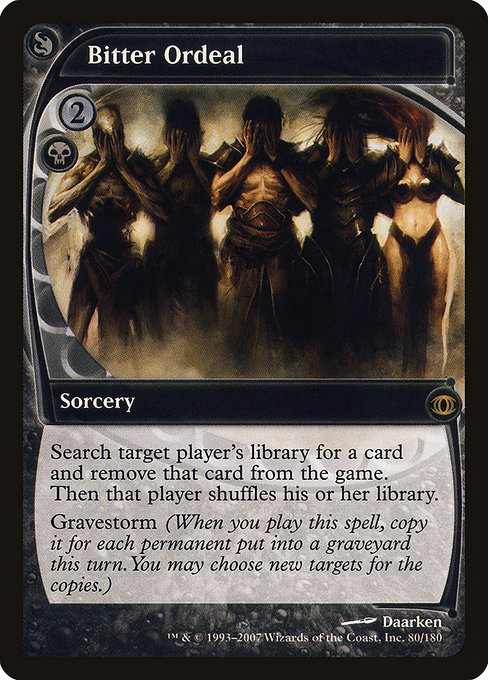
Because both gravestorm cards do something on resolution (not just on copy), you want to make sure the effect itself is worth building around. Copies of Bitter Ordeal exile a card from a library each, which turns a high gravestorm count into a way to strip an opponent's entire library. That's a genuine win condition in Commander, not just a value play.
Notable cards
Bitter Ordeal
Bitter Ordeal ({2}{B}) is the original gravestorm card, introduced in Future Sight (2007). It's a Sorcery that reads: Search target player's library for a card and exile it. Then that player shuffles. Plus gravestorm.
On its own, it's a one-shot piece of targeted exile. With a high gravestorm count, it becomes a way to exile ten, twenty, or even thirty cards from a single player's library in one turn. In Commander, a Bitter Ordeal after a mass sacrifice loop can frequently exile every card in an opponent's library and effectively knock them out of the game.
This is the card that defined what gravestorm is for. The mechanic exists to make Bitter Ordeal into a potential game-ender in the right shell.
Format check: Bitter Ordeal is legal in Legacy, Vintage, and Commander. It's not legal in Modern, Pioneer, or Standard.
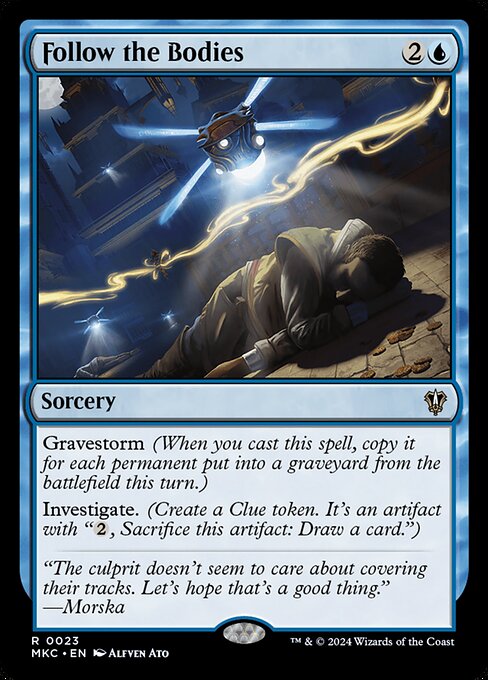
Follow the Bodies
Follow the Bodies is the second and most recent gravestorm card, printed in the Murders at Karlov Manor Commander (MKC) product in 2024. It's the mechanic's only other appearance to date, and it marks gravestorm's return after seventeen years on a single card.
The fact that it appeared in a preconstructed Commander product rather than a main set suggests Wizards is still treating gravestorm as a high-complexity keyword best kept at arm's length from mass play - but they haven't fully retired it either.
History
Gravestorm was introduced in Future Sight (2007), a set explicitly designed to showcase cards that felt like they came from a possible future of Magic. Many Future Sight cards carried experimental or deliberately parasitic mechanics that Wizards might or might not revisit. Gravestorm was one of those.
During design, the mechanic went by the name Deathstorm before it was renamed for print.
For a long time, Bitter Ordeal was the only gravestorm card in existence - a single timeshifted card carrying an entire keyword alone. Mark Rosewater has noted publicly that gravestorm shares the same fundamental design problem as storm itself: when the count gets high, the spell becomes nearly unstoppable, and the ceiling on power level is difficult to manage safely. That's why both mechanics are handled very carefully in terms of how often they appear.
The mechanic sat dormant for seventeen years before Follow the Bodies in MKC (2024) gave it a second card. Whether that signals a slow return or remains a one-off is, honestly, anyone's guess - but I wouldn't hold your breath for a gravestorm card in a Standard-legal set anytime soon.