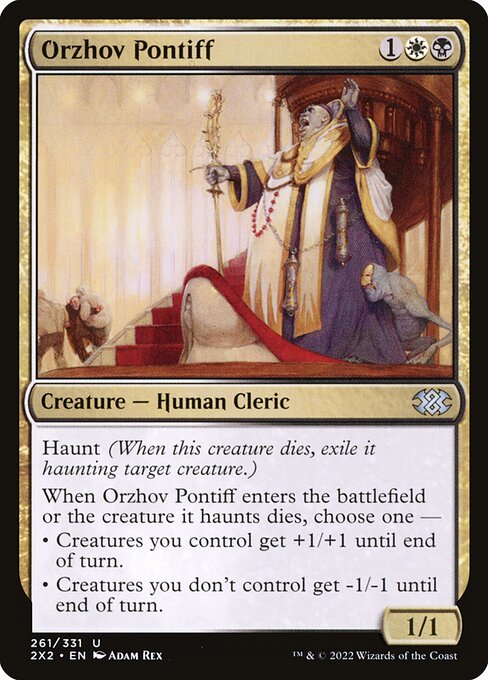
Haunt: The MTG Mechanic Explained
Some mechanics leave a lasting mark on Magic's history by being beloved and enduring. Haunt leaves a mark for a different reason - it's one of the game's most openly acknowledged design mistakes, a mechanic that looked interesting on paper but turned out to be fiddly, slow, and genuinely confusing at the table. That said, understanding how haunt works is worth your time, both for playing with the cards that carry it and for appreciating how it shaped later designs that tried to do the same thing better.
What is Haunt?
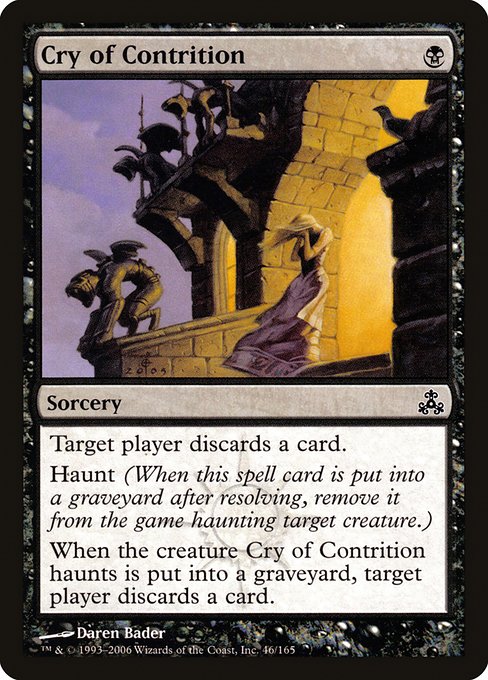
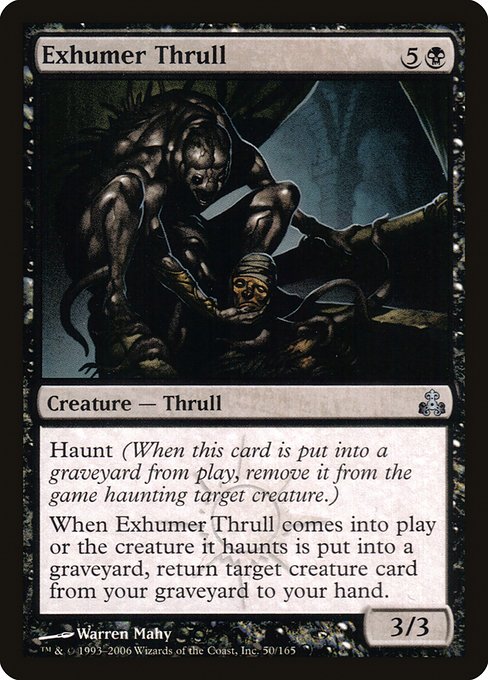
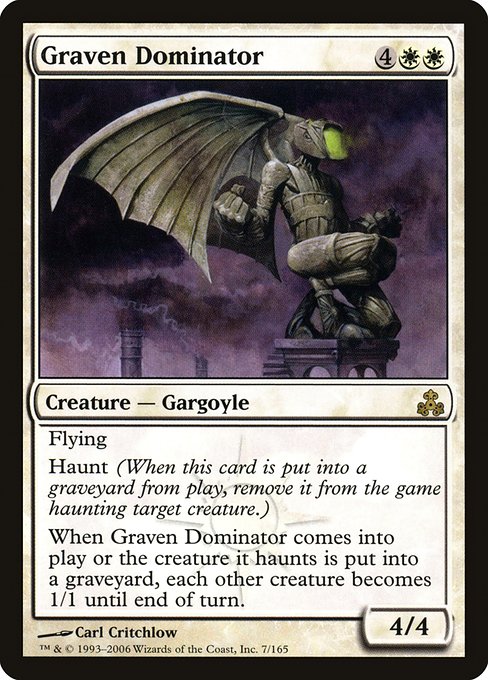
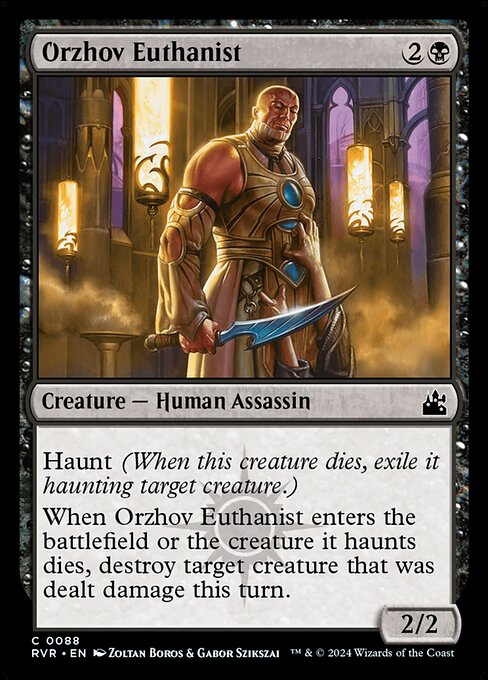
Haunt is a keyword ability introduced in Guildpact (2006), associated with the Orzhov Syndicate guild. Mechanically, it lets a card's effect go off twice - once when the card first does its thing, and again when a specific creature later dies.
Here's the core idea: a card with haunt either enters the battlefield, resolves as a spell, or dies - and then gets exiled "haunting" a creature on the battlefield. When that haunted creature eventually dies, the card's triggered ability fires again from exile, repeating its effect.
So haunt is essentially a delayed echo. You pay for an effect once, and if the haunted creature dies, you get a second copy of that effect for free.
Haunt appears only on black and/or white cards, which fits the Orzhov flavour neatly - spirits clinging to the living, refusing to let go.
How Haunt works: the rules
Haunt behaves slightly differently depending on whether it appears on a permanent or a spell.
Rules note: The comprehensive rules cover haunt under CR 702.55. Here's the precise language:
"Haunt" on a permanent means "When this permanent is put into a graveyard from the battlefield, exile it haunting target creature." "Haunt" on an instant or sorcery spell means "When this spell is put into a graveyard during its resolution, exile it haunting target creature." - CR 702.55a
Haunt on creatures
When a creature with haunt dies, its haunt ability triggers: exile it from the graveyard, targeting a creature on the battlefield. While that creature is in exile haunting its target, the creature's ETB (enters the battlefield) ability becomes a death trigger - it fires again when the haunted creature dies.
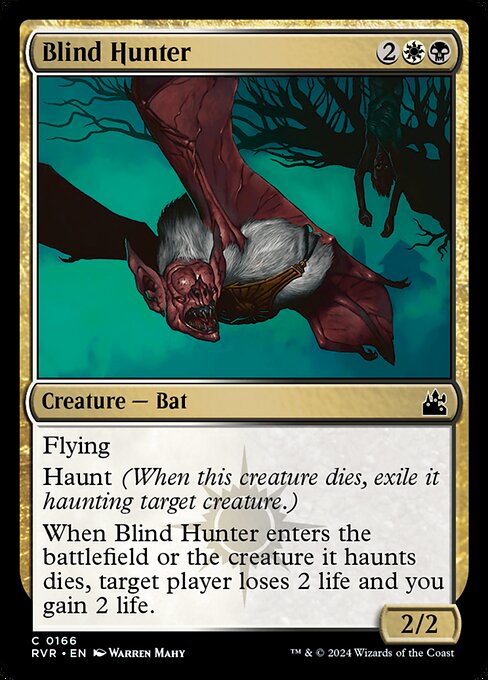
Blind Hunter is the cleanest example. When it enters the battlefield, a target player loses 2 life and you gain 2 life. When Blind Hunter dies, you exile it haunting a creature. When that creature dies, the same drain effect happens again.
Haunt on instants and sorceries
When a spell with haunt resolves and then hits the graveyard, it triggers its haunt ability from the graveyard: exile it haunting a target creature. When the haunted creature dies, the spell's effect repeats.
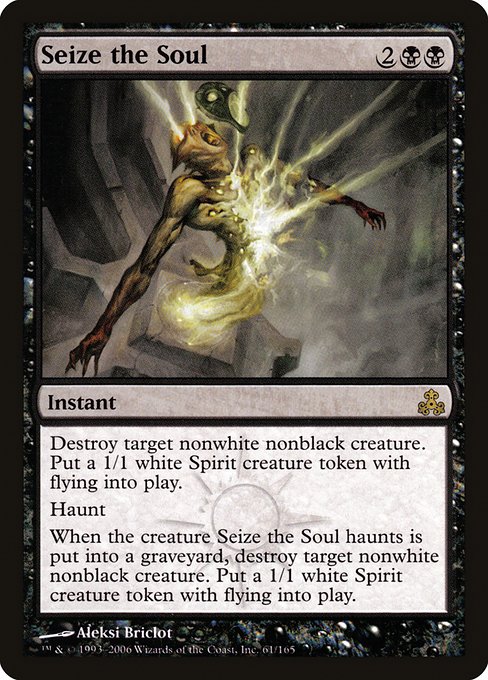
Seize the Soul illustrates this. Cast it, destroy a nonwhite/nonblack creature and make a Spirit token. Then exile Seize the Soul haunting something. When that something dies - destroy another nonwhite/nonblack creature and make another Spirit token.
Where the ability comes from in exile
This is the part that trips people up. The triggered ability that fires when the haunted creature dies originates from the card sitting in exile - not from the battlefield, not from the graveyard. CR 702.55c explicitly confirms that triggered abilities of haunt cards can trigger from the exile zone.
This matters for control of the ability. The player who owns the haunt card controls the ability when it triggers in exile - even if someone else controlled the creature when it died.
Rules and edge cases
Haunt generates a lot of questions at the table. Here are the most important rulings to know:
- Countered spells don't haunt. If an instant or sorcery with haunt is countered, it never resolves and never goes to the graveyard through resolution - so the haunt ability never triggers.
- You can haunt any creature, including opponents' creatures. Haunting an opponent's creature you're about to kill is a legitimate line.
- Multiple cards can haunt the same creature. One unfortunate creature can carry several haunting cards at once, turning its death into a cascade of triggers.
- The haunting card stays in exile permanently. When the haunted creature dies, the haunt card's ability triggers and resolves - but the card itself remains in exile. It does not return to hand, graveyard, or anywhere else.
- No legal target means no exile. If there are no creatures to target when the haunt ability triggers, the card stays in the graveyard rather than being exiled. This can matter in edge cases.
- The card can be removed from the graveyard in response. If someone removes the haunt card from your graveyard before the haunt trigger resolves, the ability still resolves - but since the card isn't there to exile, it won't haunt anything. Tokens and copies of spells work the same way: the trigger fires, but there's nothing to exile, so no haunting occurs.
- If the haunting card leaves exile, through something like Pull from Eternity, the haunt effect ends. The creature is no longer haunted.
- Ownership determines control of the exile trigger. If you're controlling a creature owned by another player (through something like Act of Treason) and it dies with haunt, you choose the haunt target. But when the haunted creature eventually dies, the owner of the haunt card controls that second trigger.
Strategy
Haunt rewards patient play and punishes opponents who don't have an answer to the haunted creature. The core strategic loop is simple: get the effect once now, set up the effect again for later.
Playing with haunt
Choose your haunt target carefully. The best target is a creature that's likely to die anyway - either through combat, removal, or sacrifice. If you haunt a creature that your opponent has no interest in attacking with and you have no way to kill it yourself, that second trigger might never arrive.
Conversely, haunting your own creatures can be powerful if you have sacrifice outlets or if you're planning aggressive combat. You control when the creature dies, so you control when the second trigger fires.
Timing matters for instants. When a sorcery or instant with haunt resolves, the haunt ability triggers immediately after - but you still need a valid creature target on the battlefield at that moment. Don't cast your haunt spell into an empty board if you want to bank that second effect.
The effect needs to be worth banking. Haunt is worst on effects that are time-sensitive. An effect that deals 3 damage is great right now; it might be irrelevant in four turns when the haunted creature finally dies. Lifegain and creature destruction tend to age better than direct damage in this respect.
Playing against haunt
The cleanest line against haunt is to never give the ability a target. If the haunted creature dies with no creatures on the battlefield to haunt, the card stays in the graveyard. Graveyard hate that removes the card before the haunt trigger resolves can also strand it.
If a haunted creature is threatening to die and trigger a nasty effect, consider whether you can blink, bounce, or otherwise remove it from the battlefield without it dying. Haunt triggers only on death - a bounced creature doesn't set it off.
Deck-building considerations
Haunt cards tend to fit best in decks that already want to interact with the graveyard or that have reliable sacrifice engines. White-black Orzhov strategies in formats where Guildpact-era cards are legal can chain haunt triggers through sacrifice outlets for real value.
Honestly though, the mechanic's overall power level is low enough that haunt is rarely the reason you'd build a deck - it's more of an incidental bonus on cards you'd consider for other reasons.
Notable cards with Haunt
Seize the Soul
Seize the Soul ({2}{B}{B}) is probably the most impactful haunt card printed. Destroying a creature and making a Spirit token is already reasonable for four mana; doing it twice against the right target can completely flip a game. It's restrictive - no white or black creatures - but in the right matchup, this card does serious work.
Blind Hunter
Blind Hunter ({2}{W}{B}) is the cleanest teaching example for haunt. A 2/2 flyer with a drain effect on ETB, then the same drain when it dies and when the haunted creature dies. Nothing flashy, but it demonstrates exactly how the mechanic is supposed to feel.
Benediction of Moons
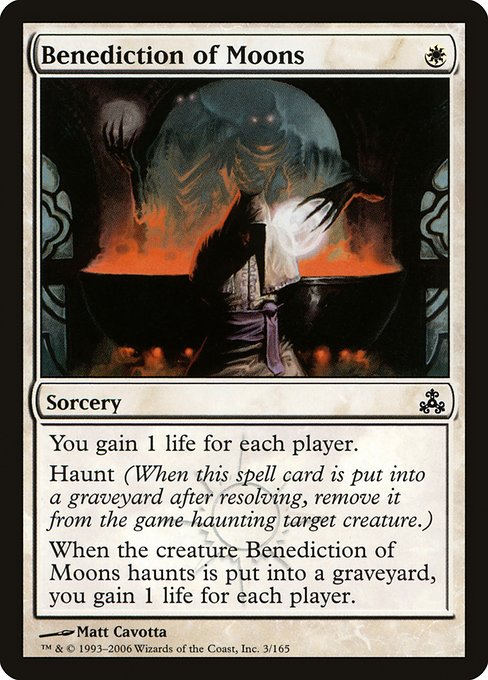
Benediction of Moons ({W}) is a one-mana haunt sorcery that gains you life equal to the number of players - so 4 life in a Commander game, typically. Haunting a creature effectively doubles that gain when it dies. It's a fringe card, but it shows how haunt can generate real value in multiplayer formats where the math on "number of players" gets interesting.
History and design legacy
Haunt debuted in Guildpact (January 2006) as the signature mechanic of the Orzhov Syndicate - flavourfully, it captured the idea of spirits clinging to the world of the living and haunting those who wronged them (or just happened to be nearby). The flavour was spot-on.
The execution, though, was troubled from the start. The mechanic asks players to track exiled cards, remember which creature each one haunts, and watch for death triggers that fire from exile - a zone players rarely need to monitor for triggers. It slowed down games, caused confusion about who controlled what, and the payoff rarely felt worth the bookkeeping.
Head designer Mark Rosewater has been candid about this. He considers haunt a mistake and has stated there are no plans to bring it back. The mechanic became something of a cautionary tale in Magic design circles: a mechanic that's conceptually interesting but practically frustrating.
That said, the idea behind haunt - doubling an effect by exiling through death - didn't disappear. Disturb, introduced in Innistrad: Crimson Vow (2021), revisits similar thematic territory using double-faced card technology. Instead of exile-and-trigger bookkeeping, a creature with disturb simply transforms into an Aura with a related ability when it dies. It's cleaner, more intuitive, and captures some of the same "haunting" feel without the tracking overhead.
The connection is explicit: Rosewater's team considered a fixed version of haunt for Crimson Vow, and the "haunting" status was even nodded to on the Mystery Booster test card Kaya, Ghost Haunter - a playful acknowledgment that there was always wider design space in the concept, if only the base mechanic had landed better.
Haunt is a fascinating piece of Magic history - not because it was great, but because of what it taught the design team about the gap between a clever idea and a mechanic players actually enjoy using.