Melee: MTG Mechanic Explained
There's something satisfying about a mechanic that rewards aggression - not just for attacking, but for how broadly you attack. Melee is a keyword ability that grows your creatures based on how many opponents you sent creatures at that combat. The wider you spread your assault, the bigger your attackers become. In a multiplayer game, that's a genuinely interesting design problem: do you focus one player down, or spread the pressure to make your creatures massive?
What is Melee?
Melee is a triggered keyword ability that makes a creature temporarily larger when it attacks, scaling with how many opponents you attacked that combat.
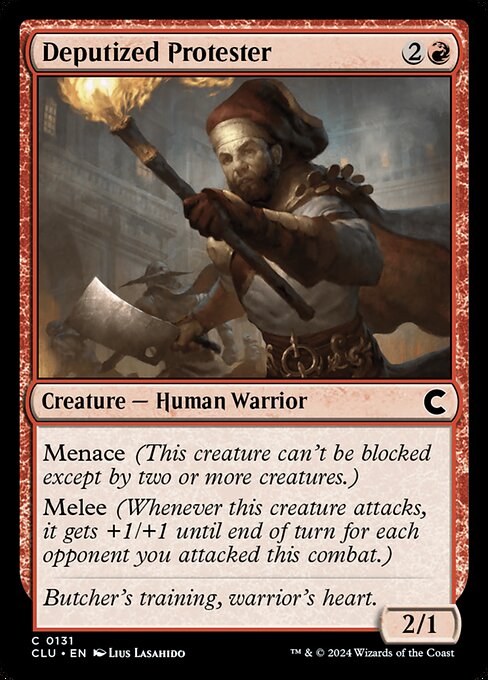
Deputized Protester is the showcase example: a 2/1 with menace and melee. In a two-player game, it's a 3/2 when it swings in. In a four-player Commander pod, where you could theoretically attack all three opponents, it becomes a 5/4 until end of turn - all while requiring blockers from multiple players thanks to menace.
The crucial detail is that melee cares about opponents you attacked with a creature, not just opponents your melee creature attacked. You spread your creatures across multiple opponents, and each one with melee benefits from that entire spread.
Rules
The official rules text, straight from the Comprehensive Rules (November 14, 2025 - Edge of Eternities):
"Melee is a triggered ability. 'Melee' means 'Whenever this creature attacks, it gets +1/+1 until end of turn for each opponent you attacked with a creature this combat.'" - CR 702.121a
A few things worth unpacking here:
The trigger fires when the creature attacks. That means the +1/+1 bonus applies during that same combat - you'll see the power and toughness change before blockers are declared, which matters for combat math.
The bonus is based on total opponents attacked, not which opponent your creature attacked. If you send one creature at Player A and your melee creature at Player B, your melee creature still counts Player A. The whole board is the battlefield, not just one lane.
The bonus is until end of turn. It doesn't stick around permanently, and it doesn't add +1/+1 counters. Once the turn ends, the creature returns to its printed stats.
Multiple instances of melee each trigger separately. Per CR 702.121b, if a creature somehow has two instances of melee, you get two separate +1/+1 bonuses per opponent attacked - so double the scaling.
Common misunderstandings
- Melee counts opponents attacked, not creatures you attacked with. Sending five creatures at one opponent gives your melee creature +1/+1, not +5/+5. You need to spread across opponents for bigger bonuses.
- You don't need to attack every opponent to get some bonus. Even in a two-player game, melee gives a flat +1/+1 whenever the creature attacks - it's still a real upside in heads-up games, just less explosive than in multiplayer.
- The creature must itself be attacking. Melee doesn't care about other attackers in your combat; the melee creature still needs to be declared as an attacker for its own trigger to fire.
Rules note: In a two-player game, melee is effectively 'Whenever this creature attacks, it gets +1/+1 until end of turn.' Simple and clean. It only becomes strategically interesting - and mechanically complicated - in multiplayer.
Strategy
Playing with Melee
Melee is fundamentally a multiplayer mechanic. In Commander, where three opponents sit across from you, a single melee creature can grow by up to +3/+3 in a single attack step - provided you have enough creatures to spread across all three. That means building a wide board is the natural home for melee. You want enough attackers that you can threaten every player while your melee creatures grow large.
The mechanic also creates a political dimension. In Commander, attacking multiple opponents in one turn can spread threat across the table, which is sometimes more socially palatable than focusing one player. Melee essentially gives you a mechanical incentive to do what multiplayer etiquette sometimes encourages anyway.
In a two-player format - Standard, Modern, Legacy - melee is more modest. It's a reliable +1/+1 on every attack, which isn't nothing, but you're not building around it. Think of it as a small bonus on an already playable creature rather than a core strategy.
Playing against Melee
The cleanest answer to melee creatures is blocking early, before the board gets wide enough for your opponent to spread attackers. A melee creature that can't attack safely is just a creature at its base stats.
In Commander, pillowfort effects - cards that tax attacks or prevent creatures from being declared as attackers against you - can strip away melee value. If your opponents can't send a creature at you, that's one fewer opponent counted, shrinking any melee bonuses.
Also worth noting: the bonus is only until end of turn. Removal that survives until after combat, or effects that tap melee creatures in response to attacks, can remove the creature at its inflated stats - though the bonus is already applied when it attacks, so this mostly matters for killing it before it deals damage.
Deck-building considerations
If you're building around melee in Commander, you want:
- Wide token production - more creatures means more flexibility in spreading attackers
- Haste enablers** - getting creatures into combat immediately avoids giving opponents time to set up blockers
- Attack triggers - melee pairs naturally with other combat abilities, since you're already attacking every turn
- Evasion - melee creatures that can't be blocked easily are much more threatening
Notable Cards
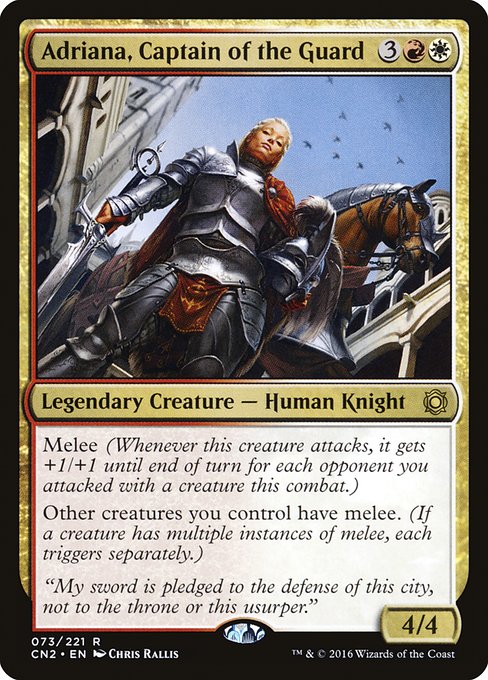
Adriana, Captain of the Guard is the centrepiece of any melee-themed Commander deck. As a Legendary Creature, she grants melee to all your attacking creatures - not just herself. In a four-player pod with a wide board, every attacker can grow by up to +3/+3 until end of turn. She's the card that turns melee from a single-creature bonus into a battlefield-wide threat.
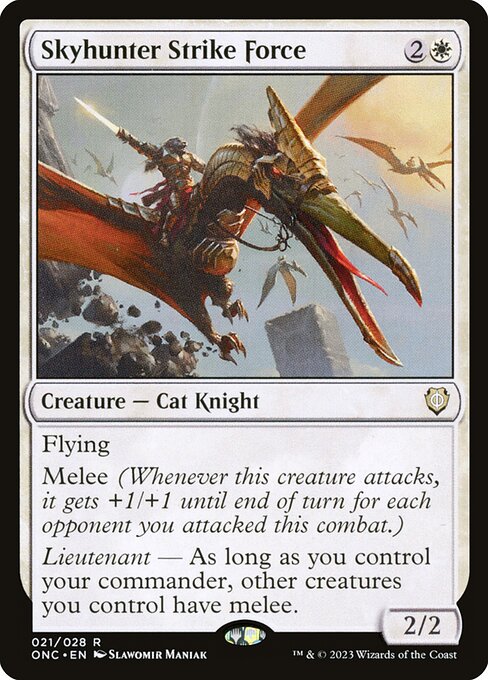
Skyhunter Strike Force gives melee to your other attacking creatures (not itself), meaning your entire attacking squad scales based on how broadly you've attacked. The combination of multiple grant-melee effects in one deck can produce some genuinely scary combat steps.
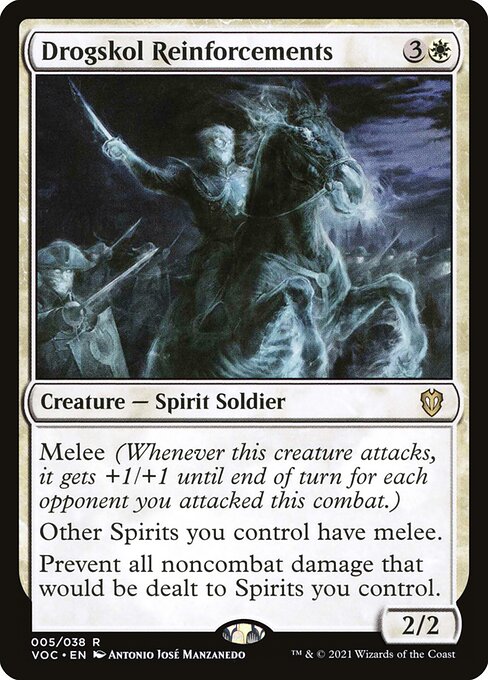
Drogskol Reinforcements similarly grants melee to your attacking creatures, adding redundancy if you're building a dedicated combat-focused Commander list.
Deputized Protester is the cleanest textbook example - the card literally has the melee keyword reminder text printed on it, and the combination of menace and melee is intuitive. Requiring multiple blockers while growing based on how many opponents you've threatened is good card design.
History
Melee debuted in Conspiracy: Take the Crown (2016), a draft set specifically designed for multiplayer games. The set's core design philosophy was politics, power grabs, and multi-player dynamics - melee fits that context perfectly, rewarding players who engage the whole table rather than tunnelling on one opponent.
Lore aside: Conspiracy: Take the Crown's flavour revolved around the struggle for control of the plane of Fiora, a scheming, politically charged setting where no one trusts anyone. Mechanics like melee and the 'monarch' mechanic were designed to create shifting alliances and encourage players to engage with the whole table, which is exactly what melee does mechanically.
After its debut, melee appeared in several products in the Commander series - fitting, since Commander is the most popular multiplayer format and melee's value scales directly with the number of opponents at the table. It's stayed a relatively niche keyword, appearing on a small number of cards, but each melee card is clearly designed with the chaos of a four-player pod in mind.
Melee has never been evergreen or parasitic enough to define a format, but that's arguably by design. It's a clean, flavourful mechanic that rewards aggressive multiplayer play without being complicated to understand - and in a game with hundreds of keywords, sometimes simple and effective in its context is exactly the right call.