Rampage: MTG Keyword Mechanic Explained
Rampage is one of Magic's oldest keyword abilities - and, honestly, one of its most instructive design failures. The idea is compelling on the surface: an attacking creature that grows more dangerous the more blockers you throw at it, punishing defenders for swarming it with small creatures. In practice, the mechanic almost never fired. Understanding why tells you a lot about how Magic design has evolved over the decades.
What is Rampage?
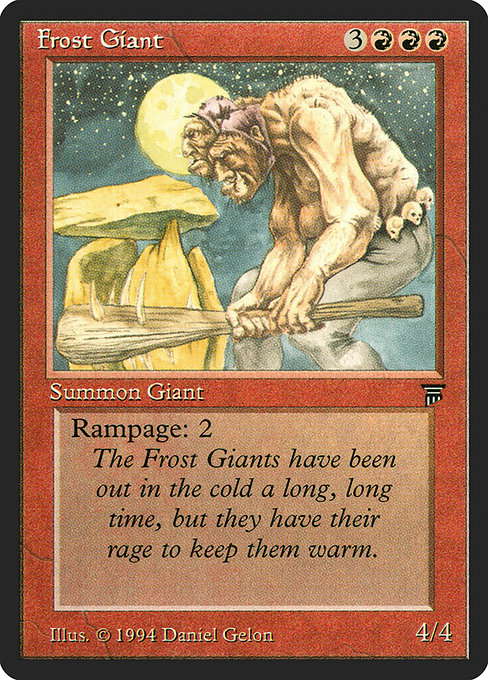
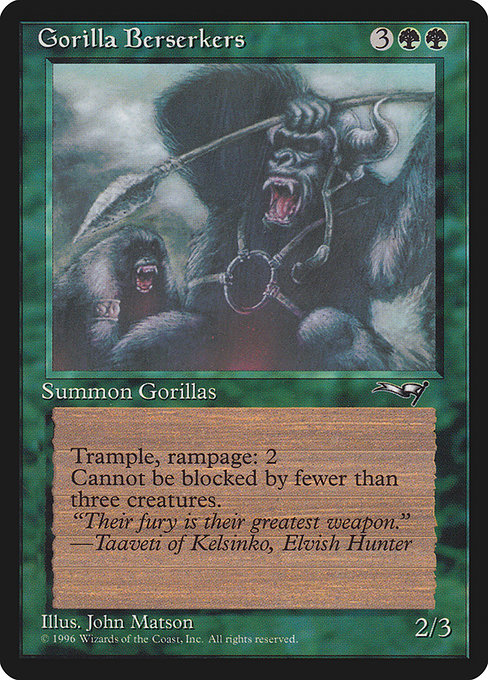
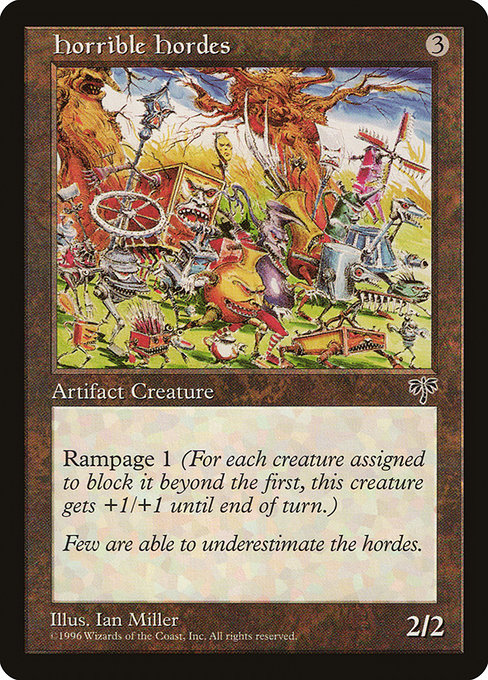
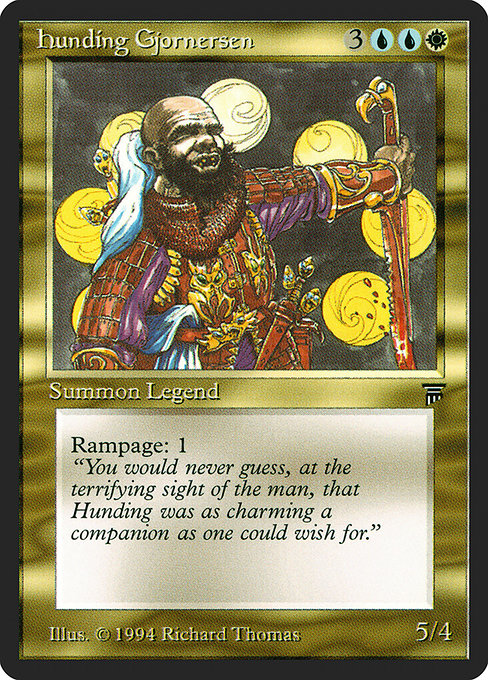
Rampage is a triggered ability that rewards an attacking creature for being blocked by multiple creatures at once. Specifically, when a creature with rampage N becomes blocked, it gets +N/+N until end of turn for each creature blocking it beyond the first.
So if your creature has rampage 2 and your opponent blocks it with three creatures, it gets +4/+4 (two blockers beyond the first × 2). Block it with just one creature, and nothing happens - the trigger fires, but there's nothing beyond the first blocker to count.
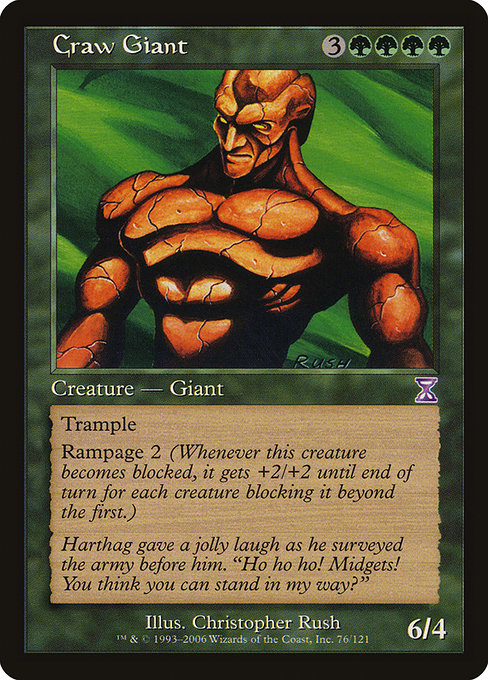
The most recognisable card with the keyword is Craw Giant, a 6/4 with trample and rampage 2. In theory, a defending player who throws three creatures at it suddenly faces an 10/8 trampling Giant. In practice, they usually just... didn't block it with three creatures.
Rules
Rampage is covered under CR 702.23. Here's the full breakdown of how it works:
How the trigger works
Rampage is a triggered ability. The trigger condition is becoming blocked - specifically, the moment the creature is declared blocked in the Declare Blockers Step (CR 509).
"Rampage N means 'Whenever this creature becomes blocked, it gets +N/+N until end of turn for each creature blocking it beyond the first.'" - CR 702.23a
The bonus is calculated once, when the triggered ability resolves. Adding or removing blockers after the trigger has resolved won't change the bonus - so your opponent can't try to game it by assigning fewer blockers after seeing the trigger go on the stack (CR 702.23b).
Multiple instances of rampage
If a creature has multiple instances of rampage, each instance triggers separately (CR 702.23c). A creature with rampage 1 and rampage 2 blocked by three creatures would get +1/+1 and +2/+2 for each blocker beyond the first - so +6/+6 total in that scenario.
Common misunderstandings
- Rampage does nothing when blocked by exactly one creature. The first blocker is excluded from the count; you need at least two blockers for the trigger to matter.
- The bonus lasts until end of turn, not just for combat. This is rarely relevant, but worth knowing.
- Rampage only triggers when the creature becomes blocked, not on any subsequent change to the number of blockers during combat.
Rules note: If a rampage creature becomes blocked and then all blockers are removed before the trigger resolves, the creature is still considered blocked for damage-assignment purposes - but the rampage count would be based on zero blockers beyond the first, so the bonus would be +0/+0.
Strategy
Let's be direct: in a modern deck-building context, you're unlikely to build around the rampage keyword itself. But understanding the mechanic's logic - and its failure mode - is useful for thinking about combat math more broadly.
Playing with rampage
The core promise of rampage is deterrence. A creature with a high rampage N threatens to become enormous if your opponent over-blocks. But there are two problems:
-
The threat only works if your creature is worth multi-blocking in the first place. If the creature is a 3/3 with rampage 2, your opponent can simply block it with one 3/3 of their own and trade evenly. There's no incentive to ever assign a second blocker - and therefore no incentive to ever respect the rampage ability.
-
Trample is the keyword that actually makes rampage matter.** Without trample, your opponent can just chump-block with one creature every turn. With trample, multi-blocking becomes more tempting - and that's where rampage starts doing something. Craw Giant pairs the two for exactly this reason.
In formats where rampage-carrying cards are legal (older formats, casual play), the best approach is to pair them with effects that force blocks, or to play them as large enough threats that your opponent genuinely wants to throw multiple creatures at them.
Playing against rampage
The correct answer is almost always: don't multi-block. Assign one blocker and trade, or use removal, or let the damage through and race. Never give a rampage creature the two-plus-blocker scenario it's hoping for unless you have no other option.
The irony is that this correct play pattern is exactly what made rampage a design failure - the opponent always had an obvious line that completely neutralised the ability.
Deck-building considerations
If you're playing something like a Legends-era cube or a set-themed Commander deck and you want to lean into rampage, look for:
- Cards that force your opponents' creatures to block (these are rare but exist)
- Trample enablers to make the threat of large rampage bonuses more credible
- Other ways to make your creatures large enough that multi-blocking feels necessary to your opponent
Format check: Rampage as a keyword essentially disappeared after Fifth Edition (1997), aside from a single timeshifted reprint of Craw Giant in Time Spiral (2006). You'll encounter it primarily in older formats, cubes, and Commander with vintage-card access.
Notable cards
Craw Giant
A 6/4 with trample and rampage 2 for six mana. This is the card most associated with the keyword, and it illustrates both rampage's appeal and its flaw. A 6/4 trampler is a fine attacker - but opponents can usually handle it with a single large blocker or removal. The rampage almost never changes the calculus.
Gabriel Angelfire
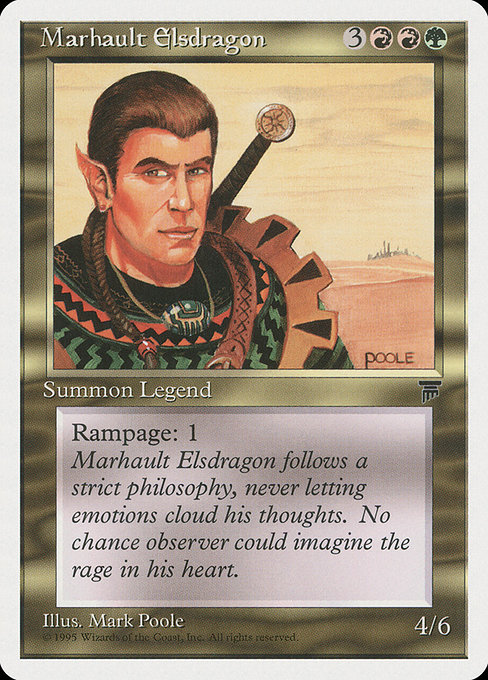
A Legendary Creature from Legends with a rotating suite of abilities including rampage 1. Notable as one of the original showcase cards for the keyword, and a good example of how early Magic design stacked keyword abilities without necessarily making any one of them particularly functional.
History and design legacy
Rampage first appeared in Legends (1994), Magic's third expansion, and was present through Fifth Edition (1997) before effectively disappearing from new card design.
Why it didn't work
The core issue, acknowledged by Magic's design team, was a mismatch between the ability's cost assumption and reality. Cards with rampage were costed and sized as though the bonus would frequently activate - as though opponents would regularly throw multiple blockers at them. But the creatures with rampage weren't large enough to demand that response.
Double-blocking is a tool defenders use when a single blocker can't survive trading with a large attacker. If the rampage creature isn't large enough to force that trade-off, a defender will simply block with one creature and move on. The rampage trigger sits there, technically live, but never firing.
An ability with no realistic chance of activating is a tax on the card text and nothing else.
"New rampage" - an attempted fix
Later in Magic's history, design experimented with what Mark Rosewater has called "new rampage" - a non-keyworded variant that activates against any block, not just multiple blocks. Cards like Gang of Elk get +2/+2 for each creature blocking it, including the first. This makes the ability live in virtually every combat.
Cards in this category include:
- Gang of Elk
- Cave Tiger
- Elvish Berserker
- Rabid Elephant
- Rabid Wolverines
- Pygmy Troll
- Sparring Golem
- Viashino Weaponsmith
- Berserk Murlodont (grants the effect to all Beasts)
- Spined Sliver (grants it to all Slivers)
Cards that grant new rampage include Beastmaster's Magemark, Retaliation, and Barreling Attack.
But new rampage had its own problem. The variable stats during combat added complexity, and while these creatures were more accurately costed for the ability, they ended up smaller for their mana cost than comparable creatures without it. Opponents were discouraged from blocking - so the creatures often sat in races where their lower base stats hurt them.
The final evolution
After Beastmaster's Magemark, the design team concluded that both versions of the mechanic were pointing at the same goal - punishing or discouraging multi-blocking - but reaching it awkwardly. The cleaner solution was already in the game: stalking, which simply prevents opponents from assigning multiple blockers in the first place. No bonus to calculate, no variable stats, no trigger timing to track.
Rampage in both its original and "new" form is now considered a retired design. It won't return in its original keyword form, according to Magic's design team. It lives on as a piece of Magic history - a fascinating look at how hard it is to make "gets bigger when you try to stop it" into a mechanic that actually plays out that way at the table.