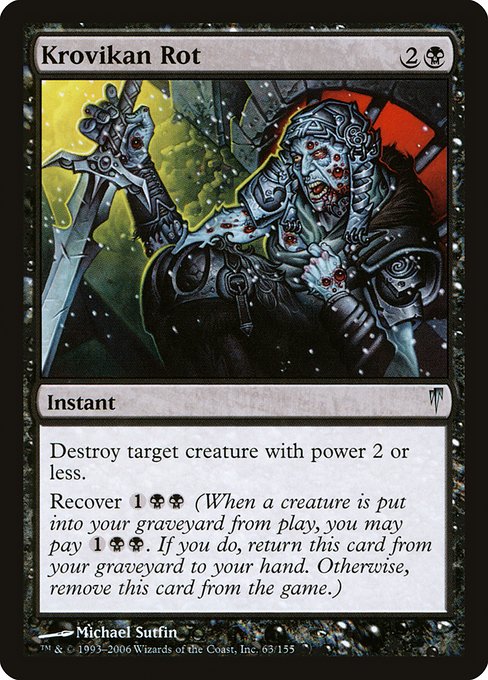
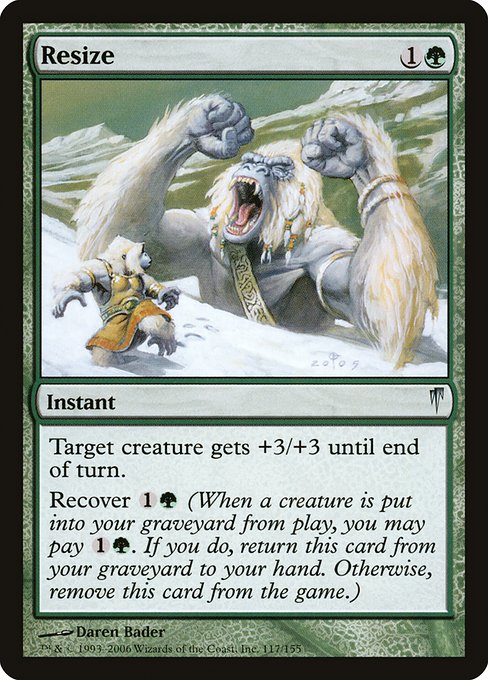
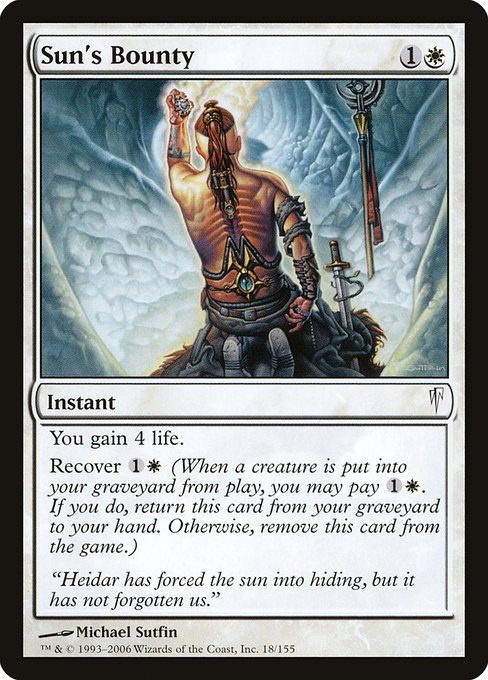
Recover: MTG Mechanic Explained
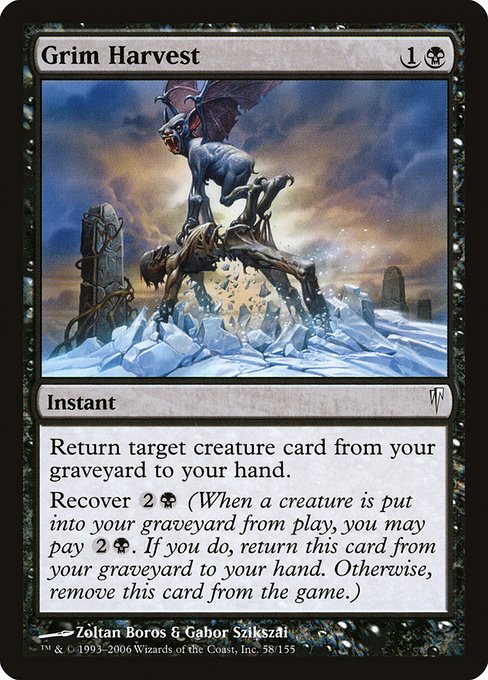
There's a quiet kind of dread that sets in when your opponent has a Grim Harvest sitting in their graveyard. Every creature that dies becomes a trigger, every mana they leave open a potential recursion. That tension - that constant arithmetic around when to trade and when to hold - is exactly what Recover was designed to produce.
What is Recover?
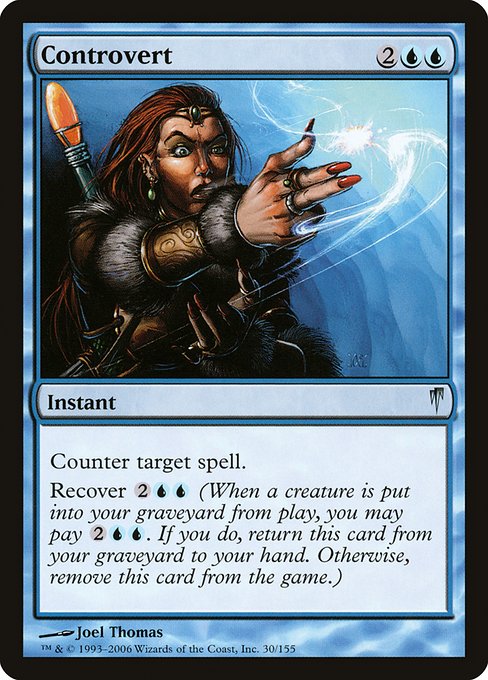
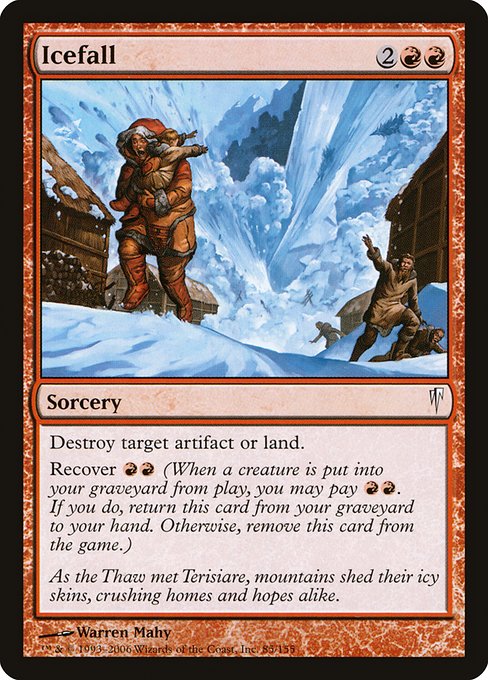
Recover is a keyword ability that debuted in Coldsnap (2006). It sits on a card in your graveyard and watches for creatures dying. When a creature you control goes from the battlefield to your graveyard, Recover triggers and gives you a choice: pay the Recover cost to return the card to your hand, or don't - and exile it instead.
That exile clause is the whole soul of the mechanic. Recover isn't free recursion; it's a one-time offer. Miss your window, or choose not to pay, and the card is gone for good. It creates a constant low-level negotiation between both players about when to spend mana and when to let creatures die.
Rules
Recover is governed by Comprehensive Rules 702.59. Here's the exact rule:
"Recover is a triggered ability that functions only while the card with recover is in a player's graveyard. 'Recover [cost]' means 'When a creature is put into your graveyard from the battlefield, you may pay [cost]. If you do, return this card from your graveyard to your hand. Otherwise, exile this card.'" - CR 702.59a
Key rulings to know
You only get one shot. Each creature death triggers the Recover ability again, but once the card leaves the graveyard - whether returned to your hand or exiled - subsequent triggers fizzle. You can still pay the cost if multiple triggers are on the stack, but nothing additional happens once the card has already moved.
A creature can't trigger its own Recover. If the card with Recover happens to be a creature (more on that below), it doesn't trigger itself when it dies. Similarly, if a creature dies at the same moment a Recover card enters your graveyard, that simultaneous death doesn't trigger the ability - the card wasn't already there.
Multiple simultaneous deaths create multiple triggers. If three creatures die at once from a Wrath of God, and you already have a Recover card in your graveyard, you get three triggers. Only the first one to resolve actually matters, though - the card moves somewhere on the first resolution, so the remaining triggers find nothing to act on. You can still choose to pay the cost on those later triggers, but you won't get anything for it.
Rules note: Recover only functions from the graveyard. The ability doesn't do anything while the card is in your hand, on the battlefield, or anywhere else.
Strategy
Playing with Recover
The core play pattern with Recover cards is managing your mana across two timelines: when you're casting spells normally, and when you're trying to recur them. Most Recover cards cost mana to bring back, which means you need to plan for both expenditures simultaneously.
The ideal setup is a self-sustaining loop. If you can keep trading creatures and recovering the same spell turn after turn, you're generating card advantage without spending additional cards from your hand. Recover cards that generate tempo or card advantage on the initial cast - like Grim Harvest, which returns a creature for {B} and then costs {1}{B} to recover - can snowball quickly in creature-heavy matchups.
That said, the Recover trigger only fires when your creatures die. This makes the mechanic inherently reactive, and it rewards playing a reasonable creature count to ensure consistent triggers. If you're in a creatureless control shell, Recover cards rarely find their window.
Playing against Recover
The opposing player's decision space is where things get interesting. The opponent can attack your Recover engine in two ways: deny you creatures to trigger it (avoid trading, or use exile-based removal that doesn't put creatures in your graveyard), or force you to burn through your mana at an inopportune moment.
For example, killing a creature during your opponent's end step forces them to choose between paying the Recover cost - tapping mana they planned to use on their turn - or losing the card permanently. This kind of timing pressure is the primary tool for disrupting Recover.
Deck-building considerations
- Recover pairs naturally with sacrifice effects and recursive creatures, since you control the timing of deaths.
- Cards with small Recover costs (particularly {B} for Grim Harvest) are the most dangerous engines to let resolve repeatedly.
- In Limited, Recover cards tend to be stronger than they look, because creature trading is frequent and every death becomes value.
- In Constructed, the mechanic's all-in nature (one shot to recur, then exile) limits how reliably you can build around it.
Notable cards
Grim Harvest - The canonical Recover card and the clearest showcase of the mechanic. An Instant that returns a creature from your graveyard to your hand, with Recover {1}{B}. The Instant speed matters: you can cast it after a combat trick fails, or in response to removal, and then recover it the next time something dies. In Coldsnap Limited, this card was a known signal that you were in for a long game.
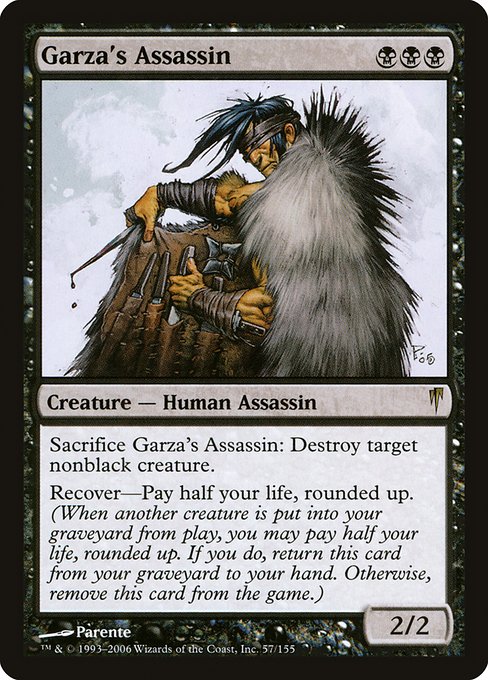
Garza's Assassin - The only creature in Coldsnap with Recover, and a notable rules oddity because of it. As mentioned above, Garza's Assassin dying doesn't trigger its own Recover ability, which is worth remembering when you're planning your turn. It also has Recover {B}{B}{B}, one of the steeper costs, which keeps the creature-with-Recover design from being trivially broken.
Recover (the card) - Yes, there's a Sorcery in the game named Recover ({2}{B}). It returns a creature card from your graveyard to your hand and draws you a card, but it does not have the Recover keyword ability. Worth knowing just to avoid confusion when searching for cards by mechanic name.
History
Recover debuted in Coldsnap (July 2006), a set that revisited the abandoned Ice Age block with modern design sensibilities.
The mechanic was directly inspired by Death Spark from Ice Age (1995), a card that functioned by tracking graveyard order - specifically, it could return to your hand if it was directly underneath a creature card in your graveyard. That interaction depended on the old rule that graveyards had to maintain a fixed order, a complexity that Magic's rules had already moved away from by 2006.
Recover was designed to preserve that same gameplay tension - both players watching the graveyard, both players trying to control when deaths happen - without requiring graveyard ordering. By replacing a positional mechanic with a triggered cost-payment mechanic, the Coldsnap design team kept the feel of Death Spark while making it practical to track at the table.
The mechanic has not appeared in any set since Coldsnap, making it one of Magic's more historically specific designs - a one-set mechanic tied directly to a thematic revisit of a particular corner of Magic's history.