Ripple MTG: Complete Mechanic Guide
There are very few mechanics in Magic that let you cast spells completely for free - and Ripple is one of them. The dream is simple: cast one spell, reveal your library, and suddenly you have three or four more copies landing on the stack without spending a single mana. When it works, it's one of the most spectacular snowball effects the game has ever produced.
Ripple first appeared in Coldsnap (2006), and it's a keyword that rewards you for running multiples of the same card. The more copies in your deck, the more likely you are to chain them together and bury your opponent under an avalanche of free spells.
What is Ripple?
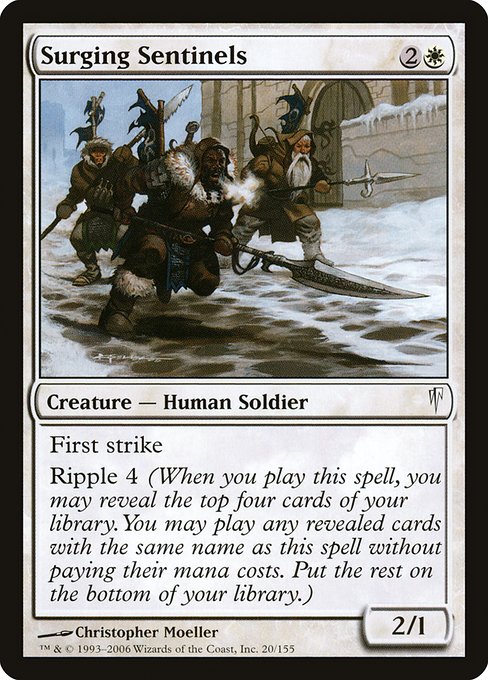
Ripple is a triggered ability that fires when you cast a spell that has it. When the trigger resolves, you reveal a number of cards from the top of your library - all printed Ripple cards so far use a value of four - and you may cast any of the revealed cards that share a name with the original spell without paying their mana costs. Everything else goes to the bottom of your library in any order.
The key word there is triggered. Ripple doesn't happen as the spell resolves; it goes on the stack separately and resolves before the original spell does. And here's where it gets interesting: each spell you cast off a Ripple trigger has its own Ripple ability, which also triggers. Cast a chain of four copies of the same card and you've got four separate Ripple triggers stacking on top of each other.
It's less of a keyword and more of a runaway train - once it gets moving, it's very hard to stop.
Ripple Rules
Here's the official definition from the Comprehensive Rules (November 14, 2025 - Edge of Eternities):
"Ripple N" means "When you cast this spell, you may reveal the top N cards of your library, or, if there are fewer than N cards in your library, you may reveal all the cards in your library. If you reveal cards from your library this way, you may cast any of those cards with the same name as this spell without paying their mana costs, then put all revealed cards not cast this way on the bottom of your library in any order."
- CR 702.60a
A few rules details worth knowing:
The stack order matters
When you cast the original Ripple spell, its triggered ability goes on the stack. You receive priority after casting that original spell, so you can respond before the trigger resolves. However, when you cast additional spells during a Ripple trigger's resolution, you do not receive priority after each one - only the active player receives priority after the entire trigger finishes resolving.
Ripple triggers chain
Every card you cast via a Ripple trigger has its own Ripple ability, and each of those triggers separately. If you reveal and cast three additional copies off one trigger, you now have three new Ripple triggers waiting on the stack, each ready to reveal four more cards. The chain feeds itself.
Rules note: CR 702.60b states that if a single spell has multiple instances of Ripple, each triggers independently. This is mostly relevant with Thrumming Stone (more on that below), but it's good to know the rule exists.
Additional costs still apply
Ripple lets you skip the mana cost, but it doesn't waive additional costs. If a spell with Ripple required you to pay life or sacrifice a permanent as an additional cost, you'd still need to do that for each copy you cast off the chain.
You can choose not to cast revealed copies
You're never forced to cast a revealed card with a matching name. Any revealed card - whether it shares a name or not, whether you choose to cast it or not - goes to the bottom of your library if you don't cast it. You can't keep anything "in hand" from a Ripple reveal.
Common misunderstandings
| Misunderstanding | What actually happens | |---|---| | "Ripple triggers after the spell resolves" | No - Ripple triggers when you cast the spell and resolves before it does | | "I get priority between each chain cast" | No - priority returns to the active player only after the whole Ripple trigger finishes resolving | | "All revealed cards go to the bottom" | Yes - only the ones you don't cast, but yes, they all go to the bottom | | "I can cast any revealed spell for free" | No - only cards with the same name as the original spell |
Strategy
Building around Ripple
Ripple is essentially useless in a typical 60-card deck running one or two copies of a card. The mechanic only does anything interesting when your deck is packed with copies of the same spell - four copies minimum, and ideally with a way to put copies back into the library rather than having them sit in hand.
The classic build is a near-mono-card deck. In older Legacy and Casual formats, players have built decks running 20 or more copies of the same Ripple spell (using Relentless Rats-style rules workarounds, or just a high density of one card) to maximise chain probability. The fewer non-matching cards between your Ripple triggers, the more likely each reveal hits another copy.
Thrumming Stone is the engine
Thrumming Stone is a colorless artifact that gives every spell you control Ripple 4. This is the card that makes Ripple a real archetype rather than a curiosity. Pair it with any card you can run in high quantities - Relentless Rats, for example, which has no copy limit - and a single cast can cascade into an army.
The Thrumming Stone / Relentless Rats combo has been a known casual and Commander archetype for years. It's the primary reason Ripple has any lasting deckbuilding presence despite being a mechanic from a single set.
Format check: This strategy is most commonly seen in Commander and Casual formats. Thrumming Stone is legal in Commander, Legacy, and Vintage. Always check your specific format's rules before building.
Playing against Ripple
The most effective answer to a Ripple chain is to counter or remove the first spell before its Ripple trigger resolves. Once the chain starts cascading, each new spell is cast during an existing trigger's resolution, which means interaction windows are narrow. A well-timed counterspell aimed at the original spell cuts off everything downstream.
If the chain has already started, remember that each new Ripple trigger still goes on the stack separately - you can interact in between them, you just don't get a window mid-resolution of a single trigger.
Deck-building considerations
- Density is everything. Four copies isn't really enough to chain consistently. Ripple shines at eight or more copies of the same card.
- Curve low. Ripple lets you cast revealed cards for free, but you still pay for the first one. Low-cost spells mean you can trigger Ripple early and often.
- Watch your library size. A long Ripple chain can eat through your deck quickly. In Commander, running out of cards is a real concern.
- Consider what happens after the chain. Spells cast via Ripple still resolve and need to do something useful. Ripple on a weak spell is still a weak engine.
Notable Cards
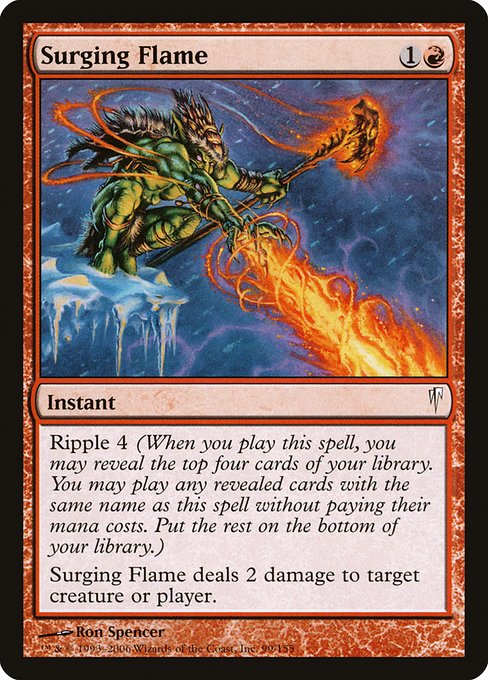
Surging Flame
The most iconic Ripple card from Coldsnap. It deals 2 damage to any target for {R}, with Ripple 4. The low mana cost means a chain of four copies deals 8 damage split however you like - all to the face, all to creatures, or anywhere in between - for the cost of a single {R}. It's a clean demonstration of what Ripple is designed to do: turn one cheap spell into a torrent of free copies.
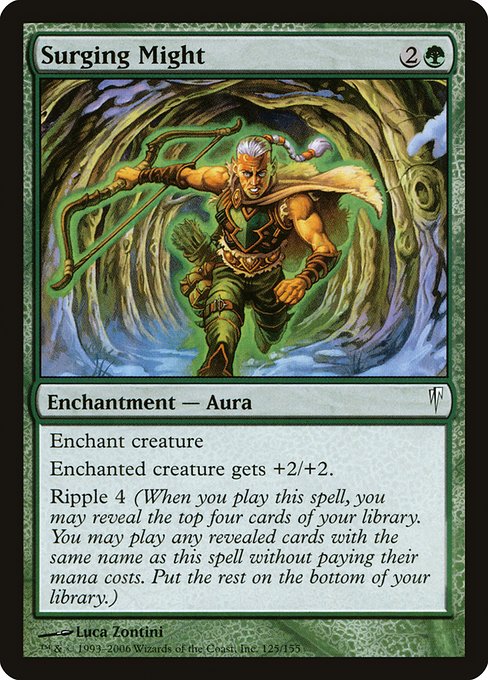
Surging Might
An Aura - {2}{G} - that gives enchanted creature +2/+2, with Ripple 4. Running multiple copies in a creature-heavy deck means one resolved Surging Might can stack enormous bonuses onto your board for free. It's less explosive than Surging Flame, but it illustrates that Ripple can work on non-damage spells too.
Thrumming Stone (Not a Ripple card, but the Ripple enabler)
This artifact from Coldsnap gives all your spells Ripple 4. It's the cornerstone of every serious Ripple deck. Without it, Ripple is a fun curiosity. With it, decks built around cards with no copy limit (like Relentless Rats or Shadowborn Apostle) become genuine combo machines.
History
Ripple debuted in Coldsnap (July 2006), Magic's belated third set in the original Ice Age block - released a full decade after Alliances (1996). Coldsnap was designed to fill the "missing" third set of that storyline, and it was drafted as a standalone triple-set experience using only Coldsnap packs, which meant higher-than-usual density of individual commons.
That density is exactly what Ripple was designed for. In a Coldsnap draft, you'd see multiple copies of Surging Flame or Surging Might moving around the table, and picking them up rewarded you with a deck where the mechanic could actually fire. It was a clever use of the format's structure - the mechanic and the draft experience were genuinely linked.
Outside of Limited, Ripple found a niche in Casual and Legacy as a combo-enabler, primarily through Thrumming Stone. The Relentless Rats / Thrumming Stone deck became a well-known Commander archetype over the following years.
The honest prognosis for Ripple returning is not great. Magic has moved away from small-set-only draft environments, and Ripple's power depends almost entirely on card density - something that's hard to guarantee in a modern large-set context. It's also close to useless in Commander's singleton format without the assistance of Thrumming Stone or an "ignore the copy limit" card. I wouldn't say never, but it would need a thoughtful home to land well.