Splice: MTG Mechanic Guide
Imagine holding a spell in your hand that you never have to cast - it just quietly upgrades every other spell you cast, for a small additional fee. That's the fantasy behind Splice, one of Magic's most unusual keyword abilities. Rather than spending a card to get an effect, you keep the card and bolt its text onto something else entirely.
What is Splice?
Splice is a static keyword ability that functions while the card is in your hand. Specifically, it reads: "Splice onto [quality] [cost]" - and what that means in practice is that as you cast a spell matching the stated quality, you may reveal the splice card from your hand and pay its splice cost as an additional cost. If you do, the spell you're casting gains the rules text of the spliced card.
The key part that makes Splice genuinely unusual: the card with splice stays in your hand. You don't cast it, you don't exile it, you don't discard it. It just... goes back to waiting. Ready to do it all again next turn.
The quality in question has historically been "Arcane" - a subtype from the Kamigawa block - but more recent printings have used "instant or sorcery" as the trigger condition instead.
Rules
How splice works, step by step
When you cast a spell that matches the splice quality, before you finish casting that spell you may reveal any number of splice cards from your hand and pay their splice costs as additional costs. The spell then gains the rules text of each spliced card, appended after its own text.
A few important things follow from this:
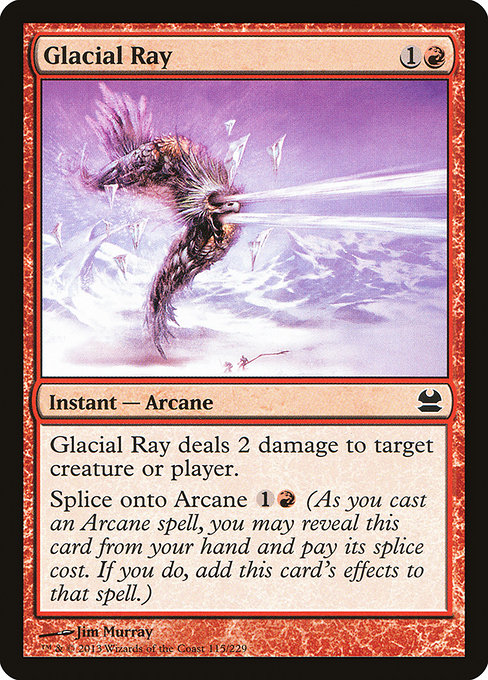
- The spell keeps its own characteristics. It doesn't gain the name, mana cost, colour, card types, or subtypes of the spliced cards - only their rules text. A blue spell with Glacial Ray spliced onto it still deals 2 damage to a target, but it deals that damage as a blue spell. This means it can hit a creature with protection from red.
- Targets for spliced text are chosen normally. When you splice a card that requires a target, you pick that target as part of casting the spell. If all targets become illegal by the time the spell would resolve, the entire spell fails to resolve - including the main effect.
- You can splice multiple cards onto one spell at once. Reveal them all simultaneously and choose the order in which their effects will happen. The main spell's effects always happen first.
- You can't splice the same card onto the same spell more than once.
- You can't use a splice ability if you can't make the required choices for it. If the spliced text requires a target and there are no legal targets, you simply can't choose to splice that card.
Rules note: CR 702.47c is the one that trips players up most often. The spell inheriting splice text doesn't become a different spell - it's still the original spell, just with extra text added as a text-changing effect under CR 612. The spliced card's name in its own text gets treated as referring to the spell on the stack, not the physical card.
Can the splice card be discarded?
Yes - and this is a genuinely weird corner case. If the spell you're splicing onto has a cost that requires you to discard a card (say, the spell itself asks you to "discard a card" as part of resolution), you can discard the card you just spliced onto it. It's already done its job - its text is already on the spell.
Once the spell leaves the stack
The splice changes are gone. Whatever text was added disappears the moment the spell resolves, is countered, or leaves the stack for any other reason. This is standard for text-changing effects.
Strategy
The core value proposition
Splice is fundamentally about card efficiency, not card advantage in the traditional sense. You're spending additional mana on a card you already hold, turning one spell into two effects. The card in hand becomes a reusable module rather than a one-shot resource.
This works best when you have a reliable stream of spells matching the splice quality. In Kamigawa, that meant building around Arcane spells - the mechanic's biggest limitation, which we'll get to in the history section. With "splice onto instant or sorcery," the trigger condition is far more permissive, which is part of why R&D eventually went that direction.
Building around Arcane splice
If you're building a deck around Arcane splice cards, the formula is roughly:
- Run enough cheap Arcane spells to give yourself frequent opportunities to splice
- Use splice cards whose effects are worth the additional mana investment
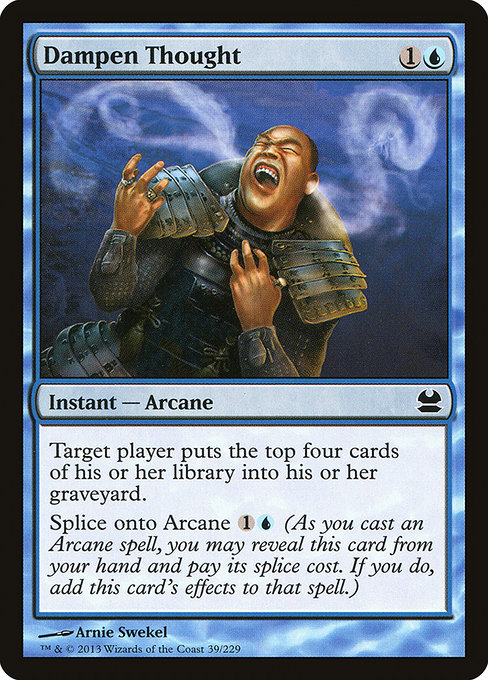
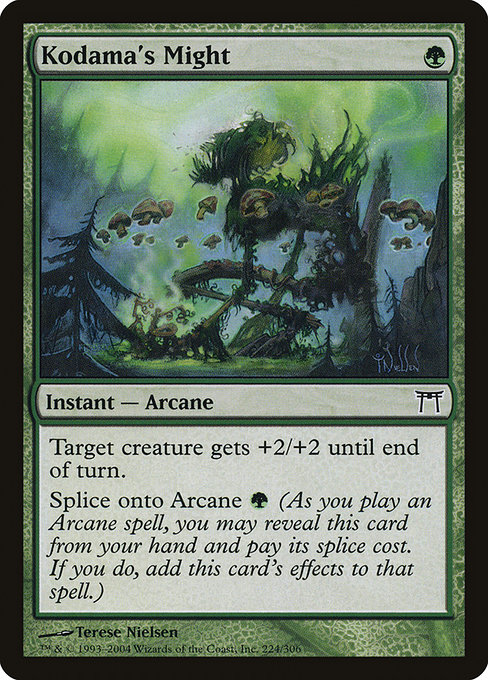
- Prioritise splice cards with cheap or alternative splice costs - Dampen Thought ({1}{U}) splice cost and Kodama's Might ({G}) splice cost are both low enough to combine with other effects in a single turn
One of the more playable Arcane splice strategies historically centred on Dampen Thought - milling four cards for {1}{U}, which you can keep splicing onto every subsequent Arcane spell you cast. Each splice activation is essentially a fresh mill-four trigger for just {1}{U} extra, and since the card stays in hand, an active Arcane spell engine can mill an opponent surprisingly fast.
Splice costs aren't always mana
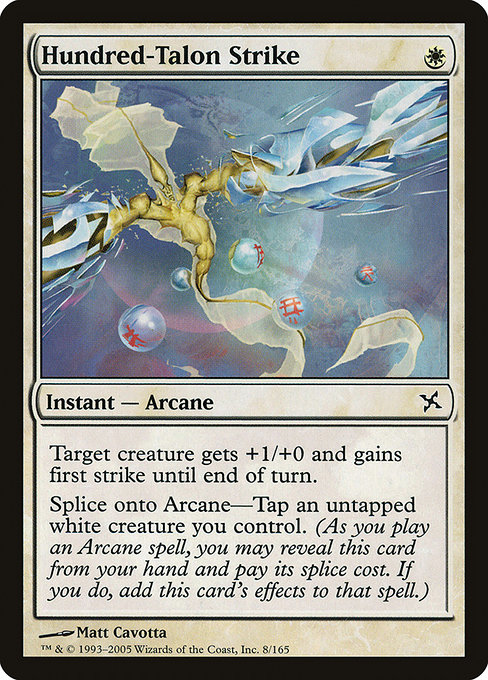
A few splice cards use alternative costs rather than generic mana. Torrent of Stone splices by sacrificing two Mountains. Hundred-Talon Strike splices by tapping an untapped white creature. These alternative costs can be easier or harder to pay depending on your board state, which changes the calculus of when to use them.
Playing against splice
Countering the base spell counters everything - including all the spliced text. Since the splice changes are part of the spell on the stack, a well-timed counter is a clean answer to an overloaded splice turn. Your opponent has paid extra mana, possibly revealed cards from their hand, and gets nothing back.
If you suspect your opponent is setting up a big splice turn, it's sometimes correct to counter a cheap Arcane spell they're clearly using as a vehicle - even if the spell itself is harmless - just to deny the splice effects riding on it.
Notable cards
Glacial Ray is probably the most recognisable splice card, and the one that appears in the reminder text example in the comprehensive rules. Dealing 2 damage for {1}{R} with an Arcane splice cost of {1}{R} made it a recurring damage source in Kamigawa Limited, and it appears in famous combo interactions involving Arcane spell chains.
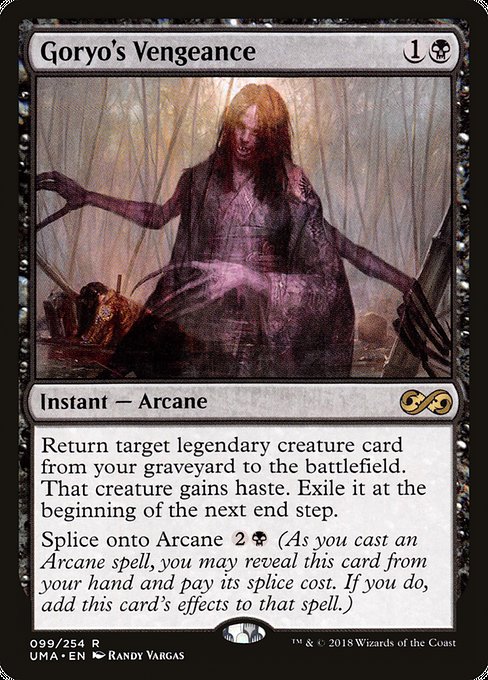
Through the Breach ({4}{R}) is notable for a different reason: it's one of the most powerful Arcane cards ever printed, seeing competitive play in Modern as a way to cheat large creatures into play with haste. The fact that it has a splice cost - {2}{R}{R} to add "put a creature from your hand onto the battlefield with haste, sacrifice it at the next end step" to another Arcane spell - makes it a flexible, if expensive, option in dedicated Arcane builds.
Dampen Thought ({1}{U}) is the engine card for mill-focused Arcane decks. Two mana to mill four cards, with a {1}{U} splice cost, means each subsequent Arcane spell mills four more for a modest investment. It's genuinely synergistic in a way many Kamigawa cards weren't.
Splicer's Skill ({2}{W}) from Modern Horizons (2019) is historically significant as the card that introduced "splice onto instant or sorcery" to the game. It creates a 3/3 Phyrexian Golem token - not the flashiest effect, but stapled to any instant or sorcery you cast for {3}{W}, it starts to generate real value over multiple turns.
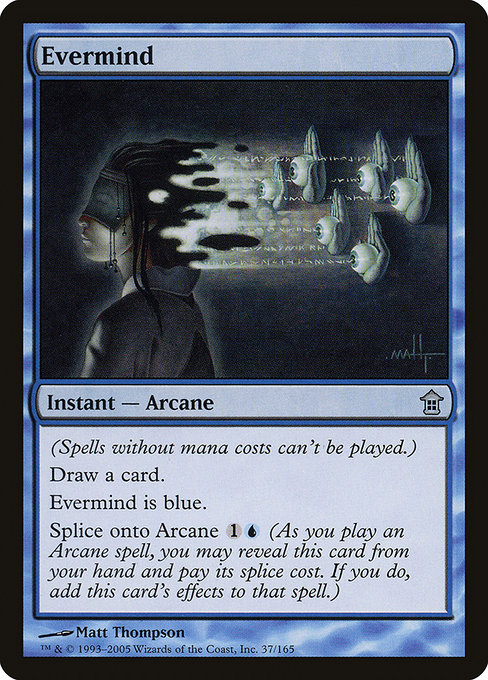
Evermind is worth a mention for its strange design: it has no mana cost at all, meaning you can never cast it normally. It exists only to be spliced, which is one of the more unusual things a Magic card has ever done.
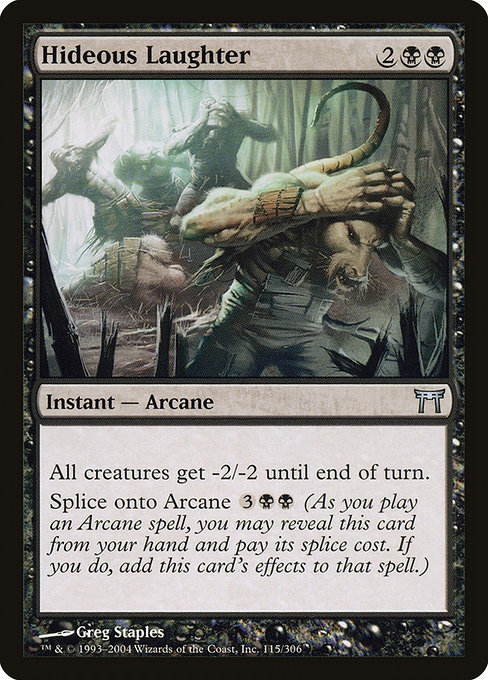
Hideous Laughter ({2}{B}{B}) offers a board wipe effect - all creatures get -2/-2 until end of turn - with a splice cost of {3}{B}{B}. Expensive, but stapling a near-wrath onto another Arcane spell is a meaningful threat in longer games.
History
Splice onto Arcane (Kamigawa block, 2004-2005)
Splice arrived in Champions of Kamigawa (2004), one of Magic's most mechanically ambitious - and, at the time, commercially difficult - sets. The original design came from Mark Rosewater, who conceived it as "Piggyback": a portable kicker effect that lived in the graveyard rather than the hand. You'd cast a spell once, then use it to augment future spells from the graveyard. Flashback with a twist.
That original version never made it to print. By the time Champions of Kamigawa was deep in development, the mechanic had shifted to working from the hand instead, and it was tied to Arcane - a new subtype applied to many of Kamigawa's instants and sorceries.
Rosewater later noted that he realised too late it should have been "splice onto instant" rather than "splice onto Arcane." The Arcane requirement made the mechanic deeply parasitic - you could only trigger splice by casting other cards from the same block. It didn't interact with the rest of Magic's history, and it didn't play nicely with cards outside Kamigawa. For players who weren't already bought into the Arcane ecosystem, splice might as well not exist.
Splice onto Arcane has since become one of the canonical examples R&D uses when discussing parasitic mechanics - mechanics that only work within themselves rather than engaging with the broader card pool.
The long road back (2012-2019)
For years after Kamigawa, R&D discussed bringing splice back with a less restrictive quality. "Splice onto instant or sorcery" was considered during Return to Ravnica (2012), but that set was dedicated to guild keywords and there was no room for it. The conversation continued through subsequent sets.
Guilds of Ravnica (2018) seemed like another opportunity - especially for the Izzet League, whose identity overlaps naturally with instant and sorcery payoffs. R&D explored it seriously but ultimately felt it didn't live up to what they'd built it up to be in their own heads, and moved on.
Splice onto instant or sorcery (Modern Horizons, 2019)
Splicer's Skill and Evermind finally brought the broader version of splice to print in Modern Horizons (2019). By changing the quality from a subtype ("Arcane") to card types ("instant or sorcery"), the mechanic opened up dramatically. Any instant or sorcery in your deck could serve as a splice vehicle, which is the version of the mechanic the original designers had arguably wanted all along.
The rules had to be updated to reflect this - the original rules only allowed splice onto a subtype, so supporting card types required revising both the rules text and the reminder text.
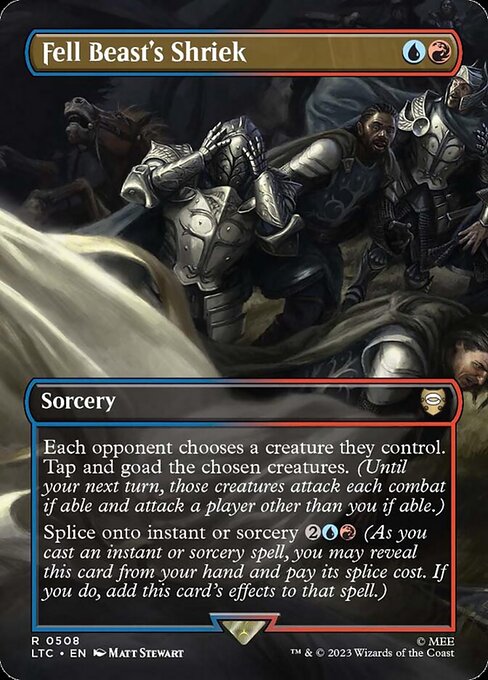
Splice onto instant or sorcery appeared again as a one-off on Fell Beast's Shriek from the Lord of the Rings Holiday Release, suggesting R&D continues to keep it in the toolkit for specific applications even if it hasn't become a returning evergreen keyword.