Unleash: MTG Mechanic Explained
Unleash is one of those mechanics that tells you everything about the guild it belongs to in a single line of reminder text. The Rakdos don't defend. They perform, they attack, and they don't stop until the show is over.
What is Unleash?
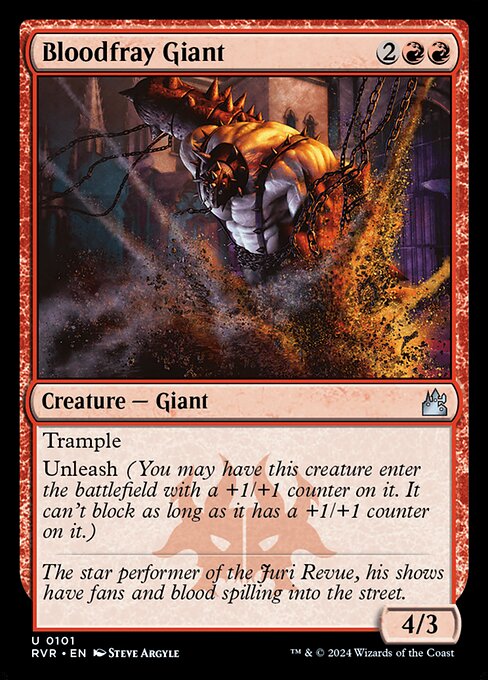
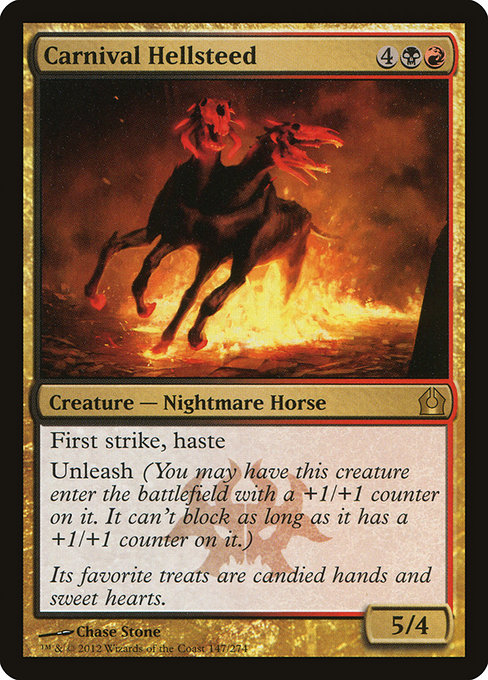
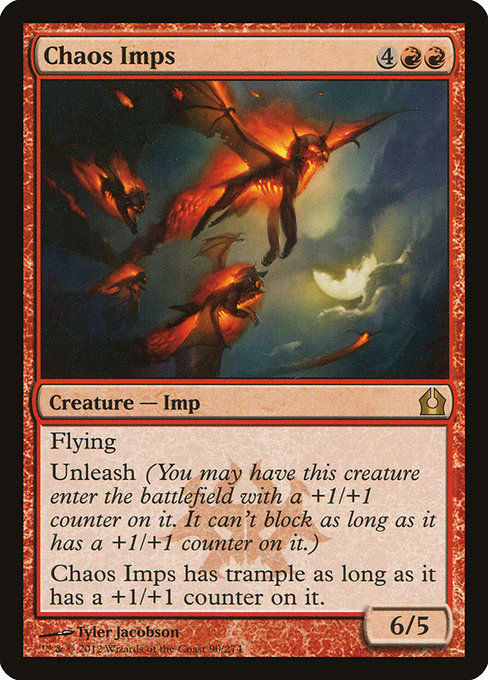
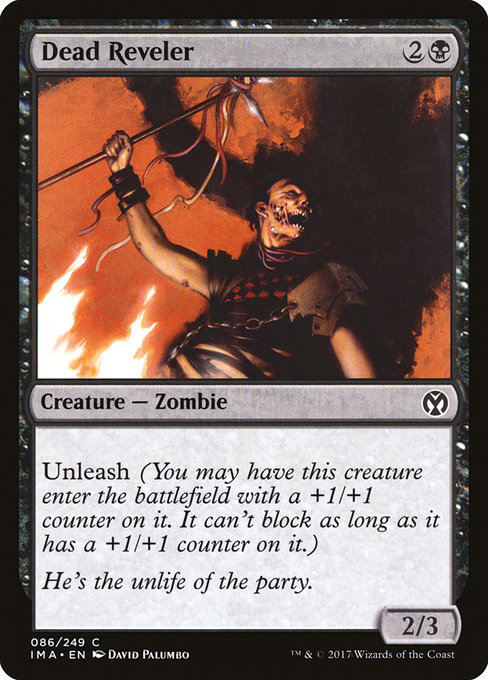
Unleash is a keyword ability introduced in Return to Ravnica (2012) as the signature mechanic of the Rakdos guild - Magic's chaotic, bloodthirsty circus of demons and performers. Every creature with unleash offers you a choice the moment it enters the battlefield: play it safe and keep it at its printed stats, or pump it up with a +1/+1 counter and commit to an aggressive, all-in strategy.
The trade-off is built right into the mechanic. A bigger creature that can never block. That tension - more power, less protection - is pure Rakdos philosophy made into a game rule.
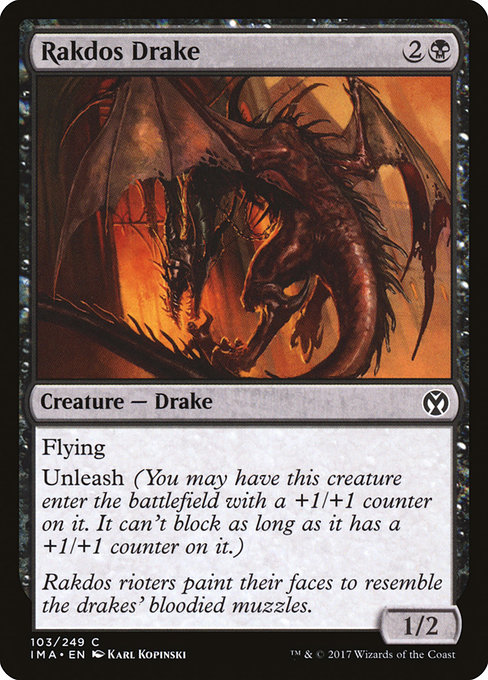
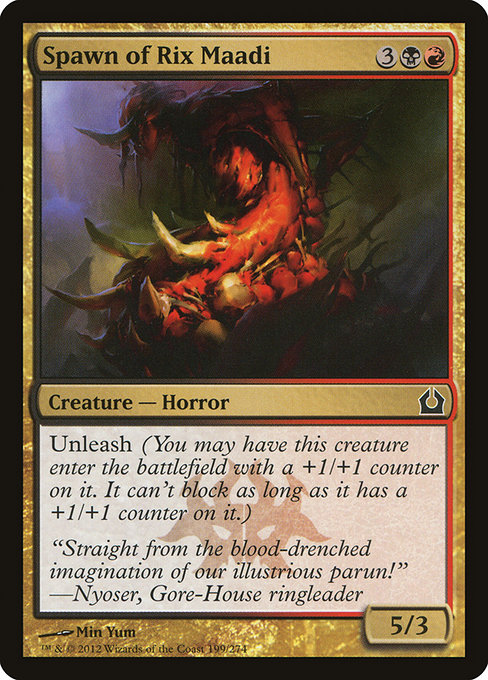
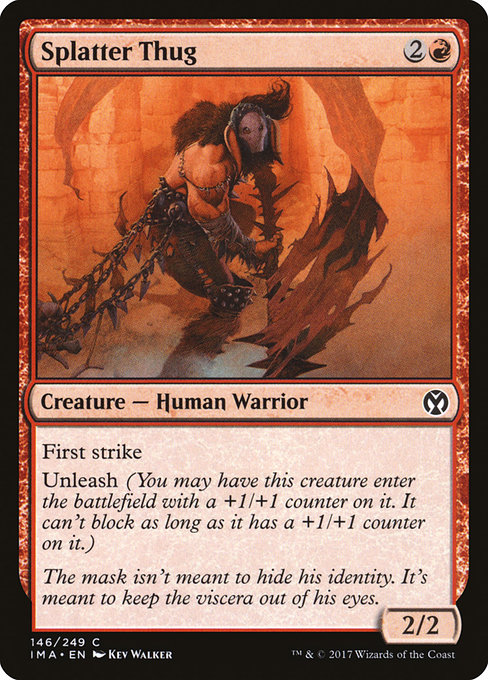
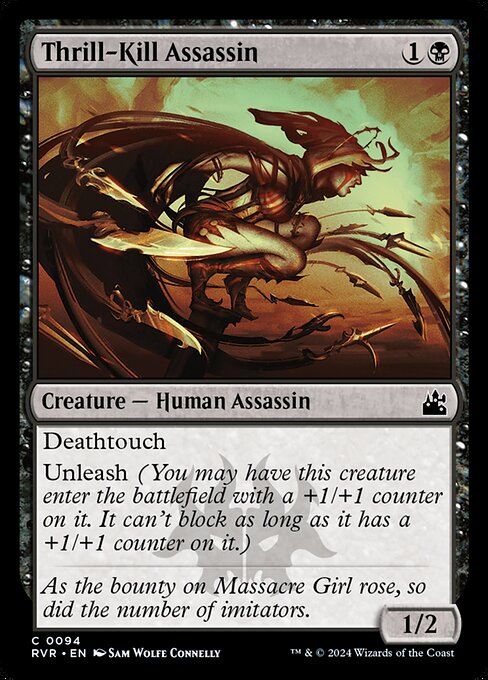
The reminder text puts it plainly: "You may have this creature enter the battlefield with a +1/+1 counter on it. It can't block as long as it has a +1/+1 counter on it."
How Unleash works: the rules
Unleash actually represents two static abilities bundled into one keyword (CR 702.98a):
- An entry choice - you may have the creature enter with an additional +1/+1 counter on it.
- A blocking restriction - the creature can't block as long as it has a +1/+1 counter on it.
That's it. Clean and simple. But a few rulings are worth knowing before you sleeve these up.
Key rulings
- The choice happens as the creature enters the battlefield - not when you cast the spell, not while it's on the stack. By the time you're deciding whether to unleash, it's too late for your opponent to respond by countering the spell. The creature is already arriving; you're just choosing how.
- The ability applies regardless of where the creature enters from. Reanimating an unleash creature from your graveyard? Putting it onto the battlefield with a tutor effect? You still get the choice.
- Any +1/+1 counter locks out blocking - not just one placed by unleash itself. If your unleash creature entered without a counter but later received one from a different source (say, a proliferate effect or a counter-doubling ability), it loses the ability to block all the same.
- Counters added while blocking don't pull a creature out of combat. If your creature is already declared as a blocker and then receives a +1/+1 counter, it stays in combat and continues blocking normally. The restriction only prevents it from being declared as a blocker in the first place.
"This permanent can't block as long as it has a +1/+1 counter on it."
- CR 702.98a
Rules note: The blocking restriction is a static ability, not a triggered one. There's no window to respond to it - if the counter is there when blockers are declared, the creature simply isn't a legal blocker.
Strategy: playing with and against Unleash
Playing with Unleash
Unleash is a mechanic built for aggro decks, and it rewards commitment. The core question every time you cast an unleash creature is: do I need this creature to trade in combat defensively, or do I need it to hit harder and end the game faster?
In most Rakdos aggro builds, the answer is almost always "hit harder." A 2/2 that blocks occasionally is fine. A 3/3 that only attacks is often better, because you're trying to close out the game before blocking matters. If your plan is to win before your opponent stabilises, unleash almost every creature.
The calculus shifts in longer games or attrition matchups. Sometimes you need a body on defence - a creature to chump block an enormous threat and buy another turn. In those situations, entering without the counter keeps your options open.
A few deck-building notes:
- Proliferate and counter synergies are secretly strong with unleash creatures. Adding counters from outside sources (without giving you the choice to decline) locks your creature out of blocking permanently - plan around this if you're mixing unleash into a counter-heavy shell.
- Removing counters can restore blocking. If you have a way to remove +1/+1 counters, you can get an unleashed creature back on defence in a pinch.
- Unleash pairs naturally with haste. A creature that enters with a +1/+1 counter and attacks immediately gets the size benefit with zero downside on the turn it arrives.
Playing against Unleash
The restriction cuts both ways. If your opponent has committed to unleashing their creatures, they've handed you something valuable: a guaranteed opening to attack into an empty defence. An opponent with a board full of unleash creatures carrying +1/+1 counters cannot block. You can swing with creatures they'd normally never let through.
The flip side: those creatures are bigger than their base stats suggest. Don't assume you can race them on size alone. Do the math on combat before you attack.
Notable cards with Unleash
Unleash appeared primarily in Return to Ravnica (RTR) and briefly returned in Dragon's Maze (DGM) before going quiet for nearly a decade.
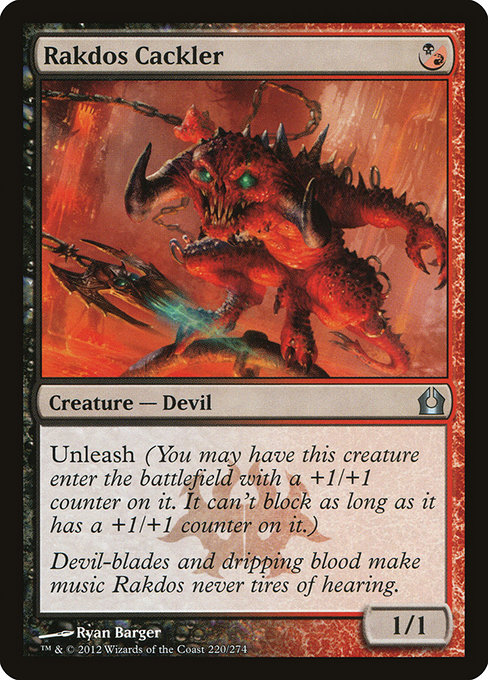
- Rakdos Cackler - A one-mana 1/1 that becomes a 2/2 with unleash. One of the most efficient one-drops the mechanic produced, and a classic example of the trade-off at its starkest: a 1/1 can block in a pinch; a 2/2 that never blocks is a much more threatening two turns of damage.
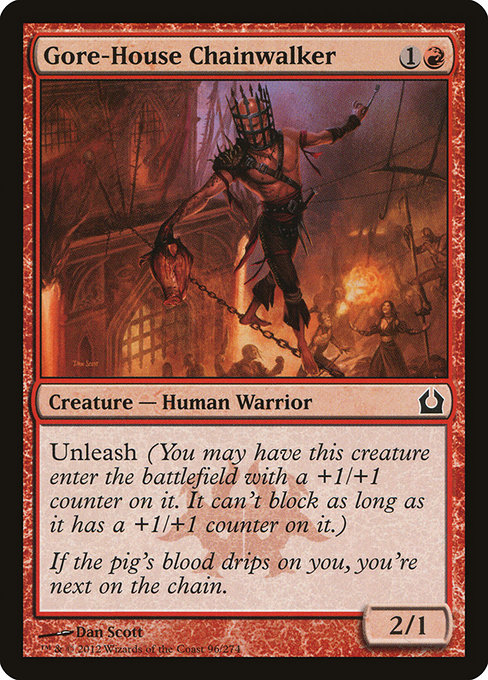
- Gore-House Chainwalker - A two-mana 2/1 that becomes a 3/2. Straightforward, efficient, and exactly what a Rakdos curve wants.
- Rix Maadi Guildmage - Worth mentioning as a piece of Rakdos support from the same block, even outside the keyword itself.
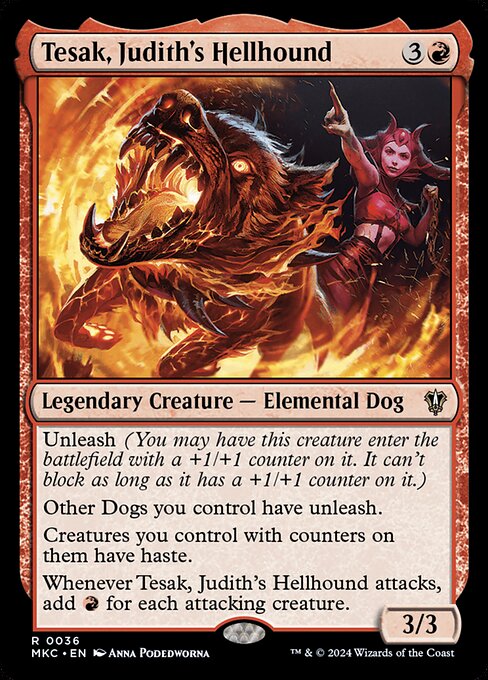
- Tesak, Judith's Hellhound - The most recent appearance of unleash in a printed card (as of 2024). This Murders at Karlov Manor Commander card doesn't have unleash itself - it grants unleash to other Dogs you control, which is a neat piece of design that expands the mechanic beyond its original Rakdos home.
Format check: If you're looking to build around unleash specifically, Return to Ravnica block is the primary hunting ground. Tesak is the only recent card to interact directly with the keyword as a granter, not a bearer.
History of Unleash
Unleash debuted in Return to Ravnica in October 2012, representing the Rakdos guild's philosophy of pure aggression. The Rakdos are a demonic cult-slash-performance troupe who exist to entertain - violently - and their mechanic reflects that: everything forward, nothing held in reserve.
The mechanic made a small return appearance in Dragon's Maze (2013), the third set of the Ravnica block, where it appeared alongside the other guilds' mechanics as the block concluded.
After Dragon's Maze, unleash disappeared from competitive-legal sets for over a decade. It resurfaced in a limited way in Murders at Karlov Manor Commander (2024) through Tesak, Judith's Hellhound, which grants the keyword to Dogs rather than bearing it natively - a clever callback to Ravnica's history in a set that leans heavily into Ravnica's world.
Lore aside: The Rakdos guild on Ravnica is led by the demon Rakdos himself, a being so powerful and dangerous that the other guilds maintain a careful (and uneasy) peace with him. The unleash mechanic isn't just flavourful - it's a mechanical argument that the Rakdos have no interest in defence. They're not worried about what's coming at them. They're only thinking about what they're about to do to you.
One small piece of trivia: one variant of the acorn (non-tournament-legal) card Garbage Elemental also carries unleash - a fun nod to the mechanic in Magic's silver-bordered and acorn space. 😄