Streets of New Capenna (SNC): Set Guide
Crime families, art deco glamour, and a city hiding ancient secrets beneath its glittering surface - Streets of New Capenna arrived in April 2022 as one of Magic's more distinctive settings. If you've ever wanted to play a mobster mage in a 1920s-flavoured metropolis, this was the set for you.
With 469 cards spread across five rival crime families, SNC brought a distinctive multicolour-forward identity that made deckbuilding feel genuinely flavourful. Whether it landed for you or not probably depends a lot on how attached you are to Magic's more traditional fantasy settings - and we'll get into that.
What is Streets of New Capenna?
Streets of New Capenna (set code: SNC) was released in April 2022. It's a standalone set - not part of a multi-set block - and introduced the plane of Capenna and its last surviving city, New Capenna, to Magic's multiverse for the first time.
The 469-card set is built around five three-colour factions, each controlling a different slice of the city. Think of it as a five-way gang war where everyone has a signature style, a signature crime, and a signature wedge or arc colour combination. The entire design - mechanics, flavour, card names - flows outward from that central conceit.
Themes and mechanics
The set's mechanical identity is inseparable from its flavour. Every major mechanic ties back to the city's criminal underworld in some way.
Blitz
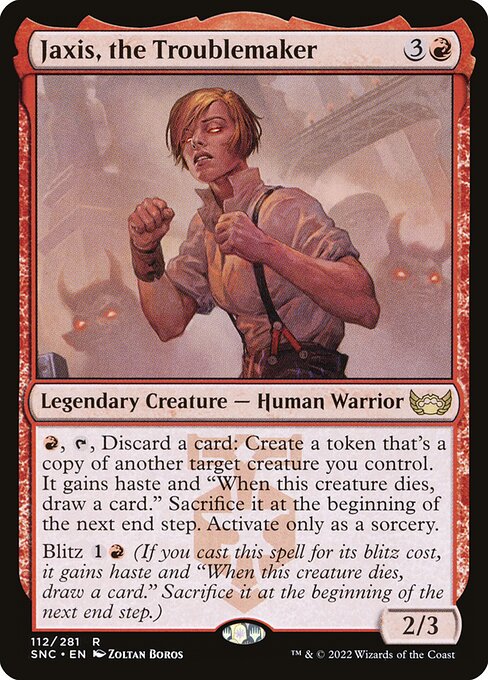
Blitz is an alternative casting cost that lets you play a creature cheaper - but it only sticks around for one turn. When it dies at the end of turn (which it's forced to do), you draw a card. It's a fast, aggressive mechanic that rewards you for moving quickly and accepting short-term trades for card advantage.
Casualty
Casualty N appears on Instants and Sorceries. Pay the cost and sacrifice a creature with power N or greater, and you copy the spell. It's a sacrifice-matters payoff that asks you to treat your own creatures as expendable resources - very on-brand for a crime syndicate.
Connive
Connive lets a creature loot (draw then discard) and then get a +1/+1 counter if you discarded a nonland card. It rewards you for cycling through your hand while growing your threats - elegant and flexible.
Shield counters
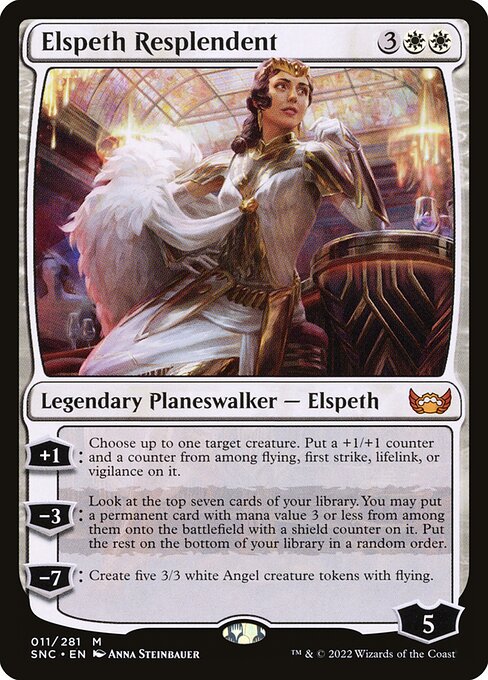
Instead of traditional indestructible or hexproof, SNC introduced shield counters. When a permanent with a shield counter would be damaged or destroyed, you remove the counter instead. It's a clean, visible way to track a single layer of protection, and it opened up interesting interactions with counter-removal effects.
Alliance
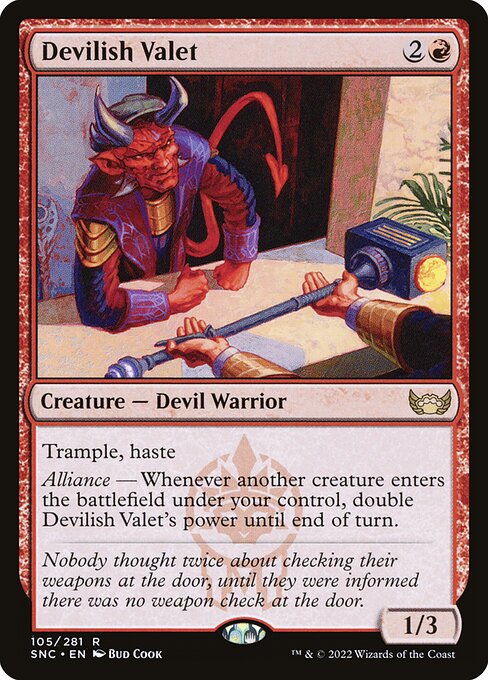
Alliance triggers whenever another creature enters the battlefield under your control. It's a token-and-go-wide payoff that rewards flooding the board, which fits the set's aggressive multicolour themes.
The five families
Each family occupies one three-colour combination and has its own mechanical emphasis:
| Family | Colours | Flavour | |---|---|---| | Obscura | White/Blue/Black | Information brokers, control | | Maestros | Blue/Black/Red | Assassins, treasure-sacrifice | | Riveteers | Black/Red/Green | Muscle, blitz aggression | | Cabaretti | Red/Green/White | Entertainers, token swarms | | Brokers | Green/White/Blue | Lawyers, shield counters |
The tricolour structure pushed players toward creative mana bases and rewarded drafters who committed to a single family's game plan.
Limited and draft
SNC draft was a format where committing early paid off. Each family had a clear identity, and the best decks were usually the ones that leaned hard into one faction rather than trying to bridge two.
The format had a reputation for being relatively fast, with Blitz and Alliance both incentivising putting creatures on the board early and often. Casualty added a layer of decision-making around which creatures were worth sacrificing - new players sometimes found this a little punishing when they were still learning the format's rhythms.
The tricolour mana requirements meant fixing was at a premium, and the set included a cycle of uncommon dual-land-adjacent cards to help. Knowing which fixing cards to prioritise early in a draft pack was one of the key skills that separated experienced drafters from newcomers in this format.
Lore and setting
New Capenna is the last known surviving city on the plane of Capenna - and it holds its secrets close.
The city is stratified across three distinct levels, each with its own culture and flavour, and each inspired by a real American city from the 1920s:
- The Caldaia (lower city) draws from Chicago - industrial, rough, and unglamorous
- The Mezzio (middle city) takes its cues from Manhattan - fast-moving, commercial, and tightly packed
- Park Heights (upper city) channels Hollywood - glittering, aspirational, and carefully curated
The city's name may derive from the Italian word capanna, meaning shelter - which fits a city that is, at its core, the last refuge on a dying plane.
Lore aside: The set touches on some thoughtful worldbuilding details. Despite the world's overall social conservatism, New Capenna has figures called "body-men" who can medically transition individuals - a small but notable piece of inclusive lore woven into the setting.
The story centres on the five families, ancient magic, and the question of what really happened to the plane of Capenna before the city became all that was left. It's a noir mystery wearing an art deco coat, and at its best, the flavour text and card art carry that atmosphere well.
Set legacy
Honestly, Streets of New Capenna had a complicated reception.
The world of New Capenna wasn't widely embraced by players, and that reaction coloured how the set is remembered. Magic's fanbase tends to connect most strongly with planes that feel rooted in traditional fantasy - elves, dragons, gothic horror, ancient ruins. A 1920s crime city is a genuine departure, and not everyone came along for the ride.
That said, the mechanics themselves were largely well-designed. Shield counters in particular were a clever piece of rules engineering - giving protection a physical, trackable representation on the battlefield. Connive and Casualty both showed up in competitive play across multiple formats after release.
The five-family tricolour structure also gave the set a strong Limited identity, even if the wider reception was muted. For players who did connect with the setting, SNC offered something genuinely different: a Magic set where the flavour and mechanics felt like they were designed together rather than bolted on to each other.
Whether New Capenna returns in future sets remains to be seen - but it left enough open story threads, and enough distinctive mechanical DNA, that it hasn't been forgotten.