Stronghold (STH): Set Guide for Magic: The Gathering
Some sets introduce new mechanics. Some sets expand a world. Stronghold (1998) does both, and it does them in a place that genuinely feels like the centre of something terrible - a Phyrexian fortress built on a manufactured plane, humming with flowstone and dread. It's the second set in the Tempest block, slotting between Tempest (1997) and Exodus (1998), and it carries the middle chapter's job well: deepening what came before while pushing toward a conclusion that won't arrive until later.
What is Stronghold?
Stronghold is a 143-card Magic: The Gathering expansion released in February 1998, designed by Wizards of the Coast as the second set in the Tempest block. Like Tempest before it, the set is small by modern standards - 143 cards across common, uncommon, and rare - and was designed to be drafted alongside Tempest in the Limited environment of the time.
The set takes its name directly from the location at the heart of the Tempest block's story: the Stronghold itself, a massive Phyrexian fortress on the artificial plane of Rath. Everything in this set is filtered through that place - the cards, the flavour text, the mechanical identity. You are not visiting somewhere interesting. You are inside the enemy's house.
Format check: As a 1998 set, Stronghold is legal in Legacy and Vintage, but not in Modern, Pioneer, or Standard. Several of its most powerful cards have shaped Legacy and Vintage play significantly.
Themes and mechanics
Stronghold's mechanical identity is shaped by its setting. This is a place of control, exploitation, and overwhelming force - and the cards reflect that.
Pitch spells and free effects
One of Stronghold's most impactful contributions to Magic is a cycle of spells that can be cast for free by exiling a card of the matching colour from your hand instead of paying their mana cost. This mechanic - now often called "pitch" spells - has had an outsized effect on eternal formats. The idea is simple and vicious: you can always threaten these effects, even with no mana open, as long as you have cards in hand. That threat changes how games are played at a fundamental level.
Buyback
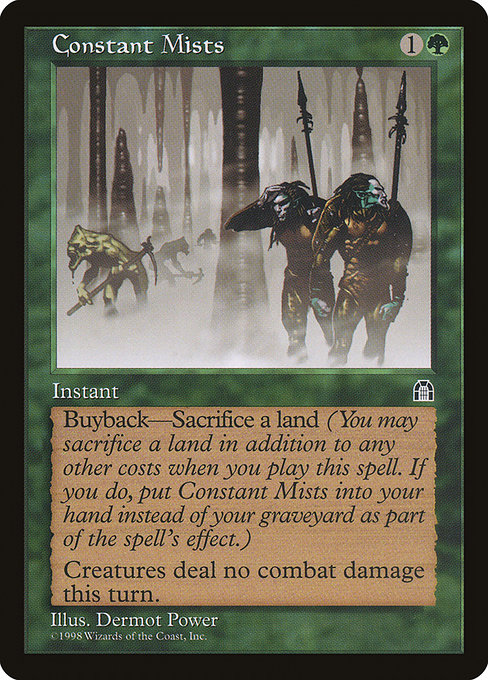
Buyback is a returning mechanic from Tempest that appears again here. Spells with buyback let you pay an additional cost when casting them to return the spell to your hand instead of sending it to the graveyard. It's a slow, grinding value engine - the kind of thing that wins wars of attrition while your opponent runs out of answers. Buyback fits the Stronghold's theme of Phyrexian endurance: these machines don't stop, and neither do your spells.
Flowstone
Flowstone is a nano-robotic material central to the lore of Rath, and it shows up mechanically across the set. Several cards let you pump and adjust creatures using flowstone-flavoured activated abilities, reflecting the plane's malleable, manufactured nature. The flavour and function are unusually well aligned here - the stuff that builds the plane is also the stuff that reshapes your creatures in combat.
Laccolith
A creature type and associated ability unique to this set, Laccoliths can redirect their combat damage to target creatures when blocked. Instead of dealing damage to the blocker, the Laccolith sends it somewhere else. It's an unusual combat mechanic that rewards careful attack decisions and punishes opponents who try to chump-block their way to safety.
Limited and Draft
Stronghold was designed to be drafted in the Tempest block format, which means it was opened alongside Tempest packs. Judging it purely as a standalone draft environment misses the context - the two sets were meant to work together.
Within that context, Stronghold cards tend to reward controlling strategies. Buyback spells give you inevitability in longer games. The flowstone creatures reward tight combat math and punish passive play. The set has a reputation for rewarding players who understand how to use recursive and incremental advantages, rather than simply curving out with the biggest creatures.
The format overall is generally considered slower and more deliberate than modern Limited environments, with more emphasis on card advantage engines and grinding your opponent out over time.
Notable cards and impact
Stronghold contains some of Magic's most format-defining cards, particularly for eternal formats.
The cycle of free pitch spells - cards that can be cast at zero mana cost by exiling a same-coloured card - has been especially significant. Misdirection and Contagion are part of this cycle, alongside others that have seen serious Legacy and Vintage play over the decades. Free interaction is inherently dangerous in competitive Magic, and Wizards has been careful with this design space ever since.
Ensnaring Bridge is perhaps the set's most enduring card. An artifact that prevents creatures from attacking if their controller has more cards in hand than the attacking creature's power, it became a cornerstone of prison strategies in Modern, Legacy, and Vintage. Decks built around emptying their hand and hiding behind Bridge have been part of the competitive landscape for years. It's one of those designs that looks harmless until you understand how it warps the game around it.
Volrath's Stronghold - the land that shares its name with the location - lets you pay {1}{B} and put a creature card from your graveyard on top of your library at the beginning of your upkeep. In Commander especially, this became a beloved piece of recursive recursion, quietly rescuing your best creatures turn after turn.
Dream Halls lets any player cast spells for free by discarding a card that shares a colour instead of paying the mana cost. Predictably, this has been the engine of several degenerate combo decks in older formats.
Grindstone, combined with Painter's Servant from a later set, forms one of Legacy's most famous two-card combo kills - milling an opponent's entire library in a single activation. Grindstone itself is from Tempest, but its interaction with Stronghold's design philosophy of "things that seem fair until they aren't" is emblematic of the set's legacy.
Lore and setting
The Stronghold in the lore is the centre of Phyrexian power on Rath - a massive fortified structure that serves two grim purposes simultaneously. First, it functions as the primary Phyrexian military base on the plane. Second, it is the production hub for flowstone, the nano-robotic material used to expand Rath's mass in preparation for the Rathi Overlay: a world-altering event that would eventually merge Rath with Dominaria, importing Phyrexia's army directly onto Magic's central plane.
For the people of Rath - the Skyshroud elves, the Vec, the Dal, and others struggling to survive under Phyrexian rule - the Stronghold is not a location. It's a fact of life, a symbol of everything holding them down.
At this point in the story, the planeswalker Gerrard and the crew of the Weatherlight are deep in hostile territory, trying to rescue their captured captain Sisay. Volrath, Rath's evincar (a kind of Phyrexian-appointed overlord), rules from the Stronghold. The set's art and flavour text put you inside that structure - in its dungeons, its gardens, its laboratories, and its furnaces.
Lore aside: The Stronghold's internal locations are represented as cards in their own right. Dream Halls, Ensnaring Bridge, Furnace of Rath, and Volrath's Dungeon all depict real rooms within the fortress. Walking through this set's cards is, in a small way, walking through the building.
Set legacy
Stronghold is remembered fondly by players who lived through the Tempest block era, and with respect by competitive players who've encountered its most powerful cards across thirty-plus years of Legacy and Vintage. It's a tight, flavourful set that does exactly what a middle chapter should: deepen the world, escalate the stakes, and leave a few mechanics behind that the game will spend years reckoning with.
Ensnaring Bridge alone would secure Stronghold's legacy. But the pitch spell cycle, Dream Halls, Volrath's Stronghold, and a handful of other cards ensure this is a set that serious eternal-format players have reason to know well.
For newer players, Stronghold is a beautiful window into late-1990s Magic design sensibility - smaller sets, tighter flavour integration, and a willingness to print cards with genuinely strange power profiles. It doesn't have the overwhelming mechanical variety of a modern set, but what it does, it does with intention. ✨