Afflict: MTG Mechanic Explained
Blocking has always been the defender's great equalizer. You attack, I block, your creature trades off or gets stonewalled. Afflict is what happens when the attacker refuses to let you have that for free.
What is Afflict?
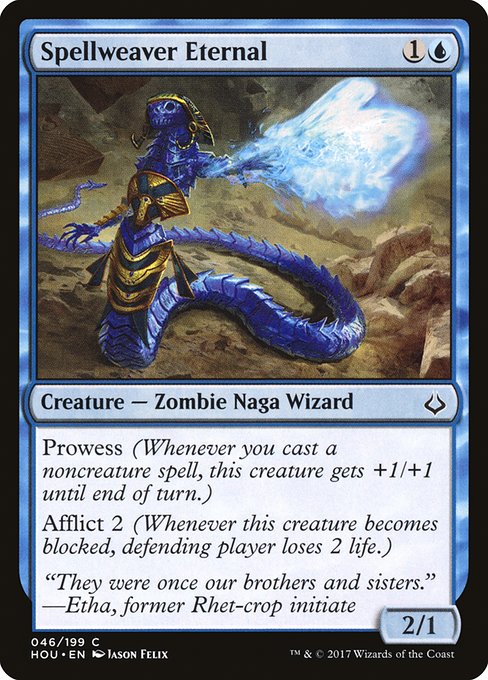
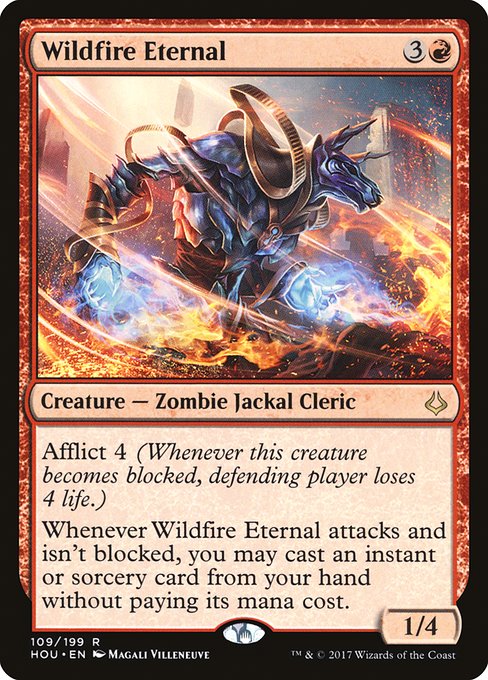
Afflict is a keyword ability introduced in Hour of Devastation (HOU, 2017) that punishes the defending player for blocking. Whenever a creature with Afflict becomes blocked, the defending player loses life equal to the Afflict value - no matter what happens to the creature itself.
So even if you block an Afflict creature with your biggest, meanest blocker and trade it off, the life loss still happens. The attacker is guaranteed something from the attack.
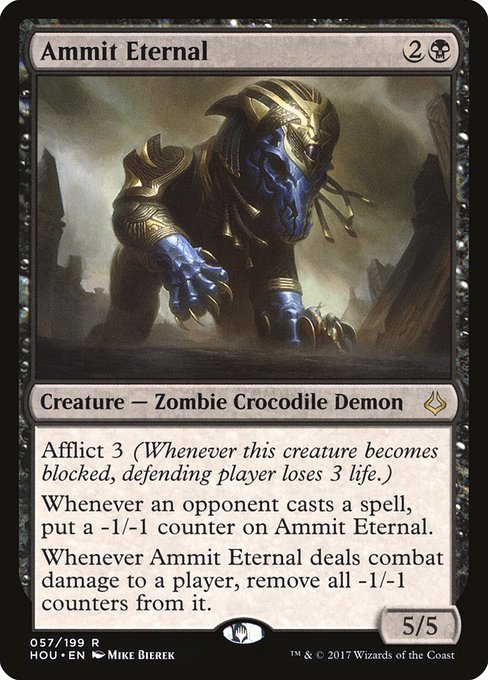
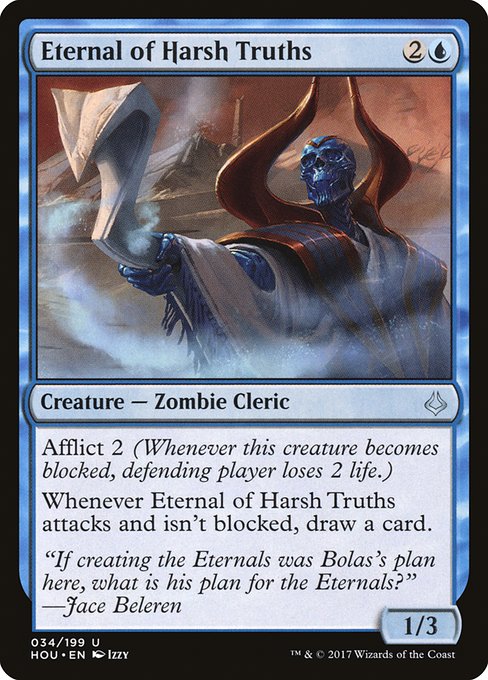
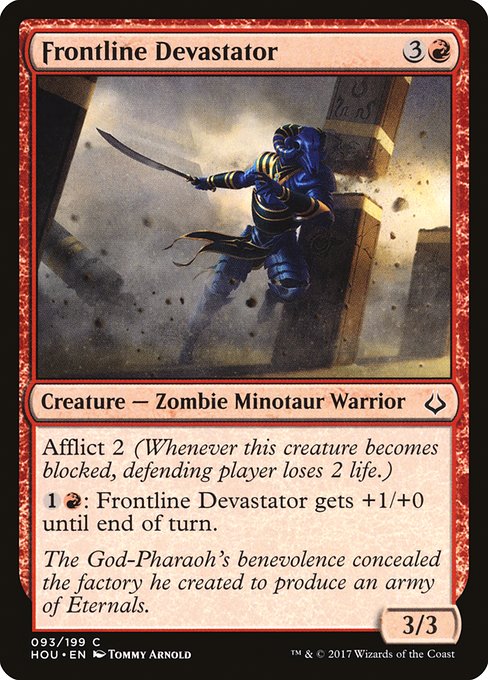
The design intent was flavor-first: the mechanic was created to represent the Eternals, the God-Pharaoh Nicol Bolas's undying army of embalmed warriors on the plane of Amonkhet. These were unstoppable, relentless soldiers, and Afflict made that feel true at the table. Blocking them hurts. Not blocking them hurts more.
How Afflict works - the rules
The official rules text is clean and precise:
"Afflict N" means "Whenever this creature becomes blocked, defending player loses N life."
- CR 702.130a
A few things worth unpacking there:
It triggers on becoming blocked, not on dealing damage. This is the key distinction. The life loss happens the moment a blocker is declared - it doesn't matter whether the Afflict creature survives combat, gets killed before damage, or gets bounced at instant speed. Once it's blocked, the trigger is on the stack.
It hits the defending player, not a planeswalker. If your opponent is attacking a planeswalker you control, Afflict still targets you, the defending player. The planeswalker itself doesn't absorb the life loss.
Multiple instances of Afflict each trigger separately. If a creature somehow had Afflict 2 and Afflict 3 on it (from two different sources), both triggers go on the stack independently, and the defending player loses 5 life total. (CR 702.130b)
The life loss isn't damage. It's life loss, which means it won't be affected by damage prevention effects or cards that redirect damage. It just happens.
Common misunderstandings
- Afflict doesn't trigger if the creature isn't blocked. If your opponent lets it through, there's no life loss from Afflict - just the combat damage.
- The blocker assignment doesn't matter. The trigger fires when any blocker is assigned to the creature. Whether the blocker is a 1/1 token or a 10/10 doesn't change the Afflict trigger.
- Afflict isn't an "unblockable" effect. Your opponent can still block - they'll just pay a life tax for doing so.
Strategy
Afflict creates a genuine dilemma every time you attack with it. Your opponent faces a choice between two bad options: take combat damage by not blocking, or lose life from the Afflict trigger by blocking. Either way, their life total drops. This is what the design team meant when they called it "unstoppable" in concept.
Playing with Afflict
Afflict creatures are at their best in aggressive red and black decks that are already pressuring life totals from multiple angles. When your opponent is at 12 life and staring down an Afflict 2 creature, both options feel bad - and that's exactly where you want them.
The real pressure is psychological. A player who keeps blocking Afflict creatures is bleeding life even when they "win" combat. Over several turns, that adds up fast.
Afflict also pairs naturally with effects that give your creatures evasion or make them harder to block profitably - first strike, deathtouch, and power boosts all make the "don't block" math worse for your opponent, while the Afflict tax keeps the "do block" math painful too.
Playing against Afflict
The most honest answer is: sometimes you take the combat damage, sometimes you take the Afflict trigger, and you're always choosing the lesser evil. A few things help:
- Don't let aggressive Afflict decks get ahead on tempo. If they're already whittling your life total with burn and direct damage, the Afflict tax on top becomes backbreaking. Stabilize early.
- Tokens and chump blockers are less punishing to use. You're going to lose the life from Afflict either way, but if you're blocking with a token you were going to lose anyway, at least you stopped the combat damage.
- Removal before blocks. Killing an Afflict creature before you declare blockers sidesteps the trigger entirely, since the creature never becomes blocked.
Deck-building considerations
Afflict has a narrow design space - the mechanic snowballs in terms of life pressure, but doesn't generate card advantage or board presence on its own. It's a damage amplifier, not a value engine. That means Afflict creatures fit best in shells that already close games quickly, rather than slower midrange or control strategies looking for long-term advantage.
Format check: Afflict cards from Hour of Devastation have long rotated out of Standard. They're available in older formats like Modern, Legacy, and Vintage, though they're not commonly seen in high-level competitive play in those formats either. The mechanic appears in Limited environments where it was introduced, and occasionally in Commander.
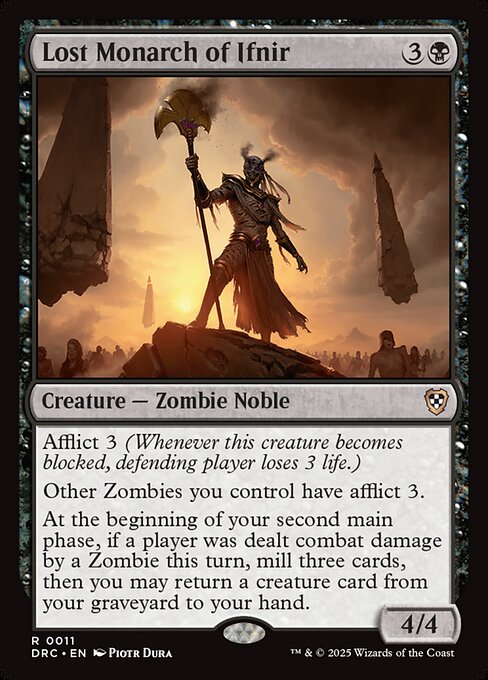
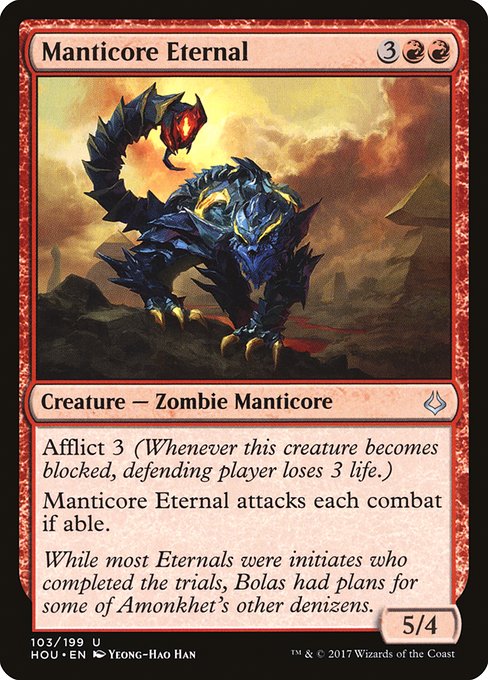
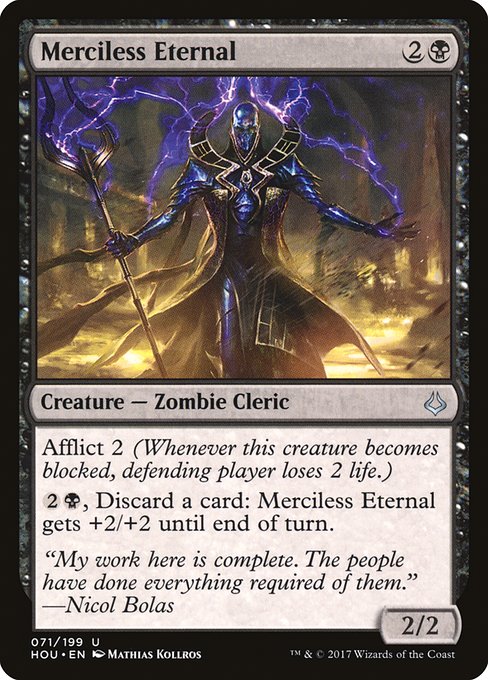
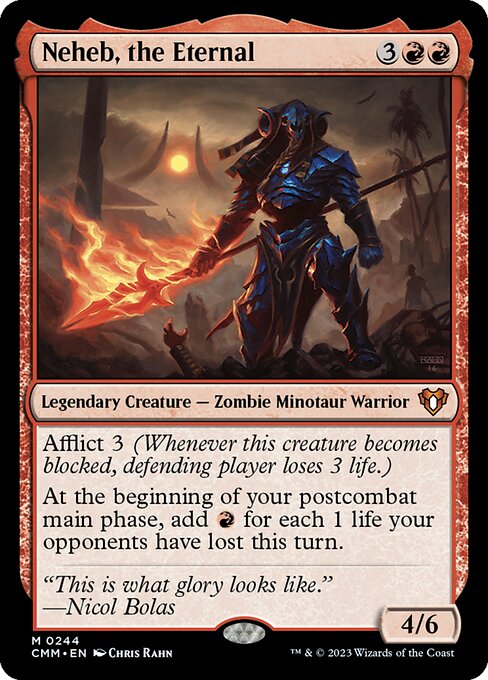
Notable cards with Afflict
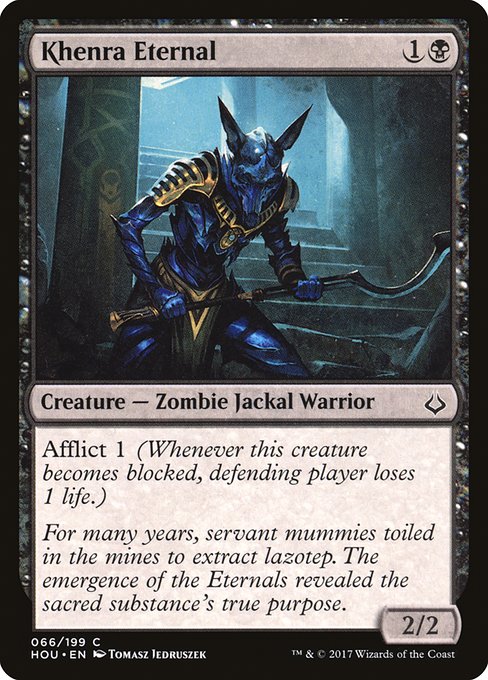
Khenra Eternal
The example card from the rules - a 2/2 Zombie Jackal Warrior with Afflict 1 for two mana. Humble, but it illustrates the mechanic perfectly. In Limited, a 2/2 with a free life loss whenever it's blocked is genuinely annoying to deal with.
Dagger of the Worthy
An equipment that grants the equipped creature Afflict 1. Notable for being the mechanic's main way to appear on a non-creature permanent, letting you spread the Afflict tax across whichever creature fits best in your board state.
Vedalken Ghoul
Technically has Afflict 4 written in its rules text rather than using the keyword, predating the keyword's introduction. It's a historical curiosity - a card that did what Afflict does before Afflict existed.
Cards that echo Afflict without using the keyword
A handful of cards mimic the flavour of Afflict with small mechanical twists:
- Vicious Battlerager and Gloom Sower deal life loss for each blocker assigned to them, rather than a flat trigger - potentially punishing even harder if your opponent gang-blocks.
- Assembled Alphas deals 3 damage per blocker, which functions similarly but interacts with damage prevention.
- Simian Sling and Tormentor's Helm deal damage rather than cause life loss, which means they interact differently with prevention effects.
- Close Quarters grants a damage-on-block effect to all your creatures, which can create enormous board-wide pressure in the right deck.
History and design
Afflict debuted in Hour of Devastation (2017) as a mechanical expression of the Eternals - Bolas's army of embalmed zombie warriors invading Amonkhet. Flavor-wise, it was a strong fit: these were soldiers built to break through any defense, and the mechanic made blocking them feel like a pyrrhic choice.
The mechanic was internally considered for a return in War of the Spark (2019), where the Eternals also appeared. Ultimately it was cut - the set's central mechanical identity was built around planeswalkers, and Afflict creatures attacking planeswalkers created awkward interactions that didn't serve the set's themes.
As of this writing, Afflict sits at 7 on the Storm Scale - Mark Rosewater's informal measure of how likely a mechanic is to return. A 7 means it's possible but unlikely. The cited reasons are its limited design space (the mechanic creates pressure but little else), and a reception that was lukewarm rather than enthusiastic. It's a mechanic that did exactly what it was designed to do, but that job was fairly narrow.
Afflict did appear on the Unfinity sticker sheets, giving it a small footprint in that product's chaotic design space.
I think Afflict is one of those mechanics that works better in practice than it looks on paper - the psychological pressure of the blocking dilemma is real, and in Limited especially, a few Afflict creatures can reshape how combat math works for an entire game. Whether that's enough to justify a return is a fair debate, but its HOU Limited environment was genuinely interesting to navigate because of it.