Cleave: The MTG Mechanic Explained
There's a specific kind of decision that makes Magic feel alive: pay more now, get more later. Cleave is built entirely around that tension. Pay the regular cost and get a focused, efficient effect. Pay the cleave cost - usually significantly more mana - and cut the restrictions right out of the text.
Literally. The word "cleave" means to cut, and that's exactly what the mechanic does to a spell's rules text.
What is Cleave?
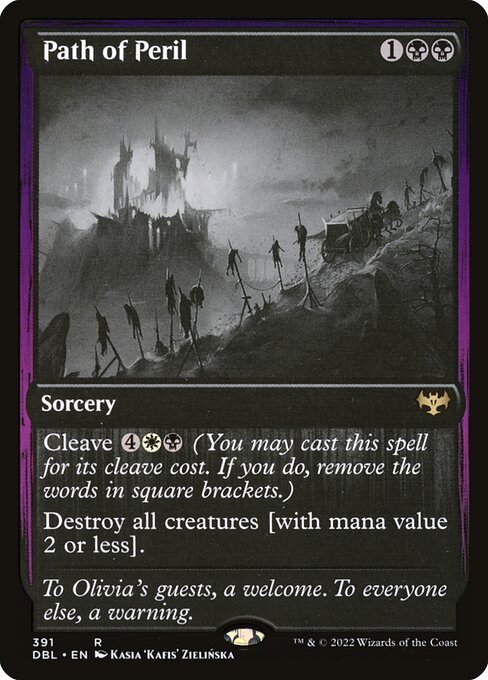
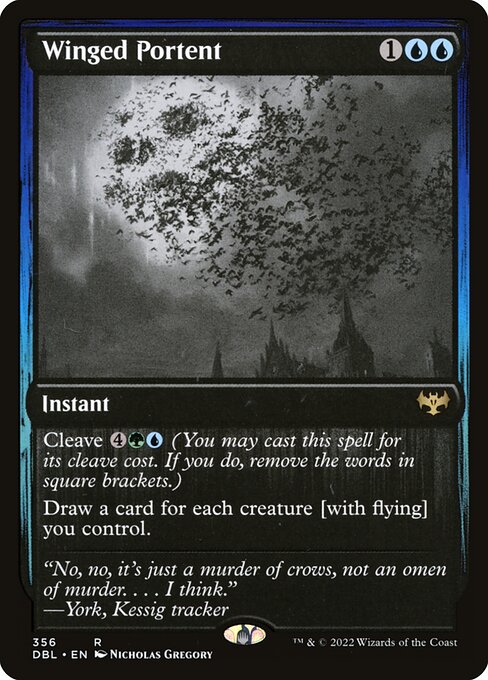
Cleave is a keyword ability found exclusively on Instants and Sorceries. It offers an alternative cost that, if paid, removes bracketed words from the spell's rules text - fundamentally changing (and almost always broadening) what the spell does.
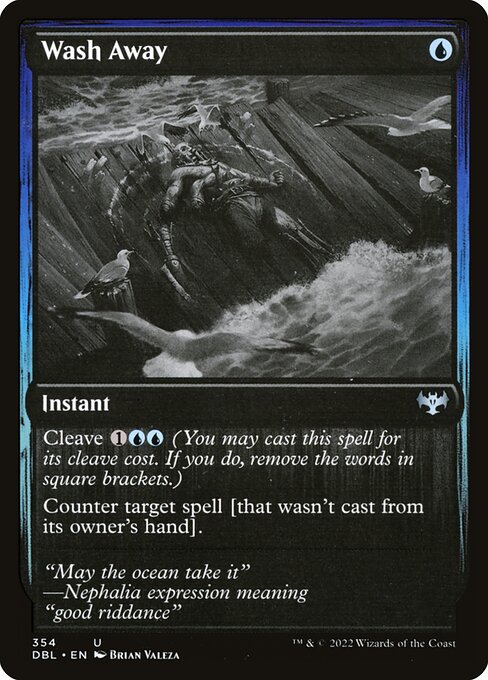
Take Wash Away ({U}) as a clean example. Cast for one blue mana, it counters target spell that wasn't cast from its owner's hand - useful, but narrow. Pay the cleave cost of {1}{U}{U} instead, and the bracketed restriction disappears. Now it counters any target spell, full stop.
The bracketed text is the limiter. Paying the cleave cost removes the limiter.
How Cleave works - the rules
Cleave represents two static abilities that both function while the spell is on the stack.
"Cleave [cost]" means "You may cast this spell by paying [cost] rather than paying its mana cost" and "If this spell's cleave cost was paid, change its text by removing all text found within square brackets in the spell's rules text."
- CR 702.148a
A few important details follow from this:
- It's an alternative cost, not an additional one. When you cleave a spell, you pay the cleave cost instead of the mana cost - not on top of it.
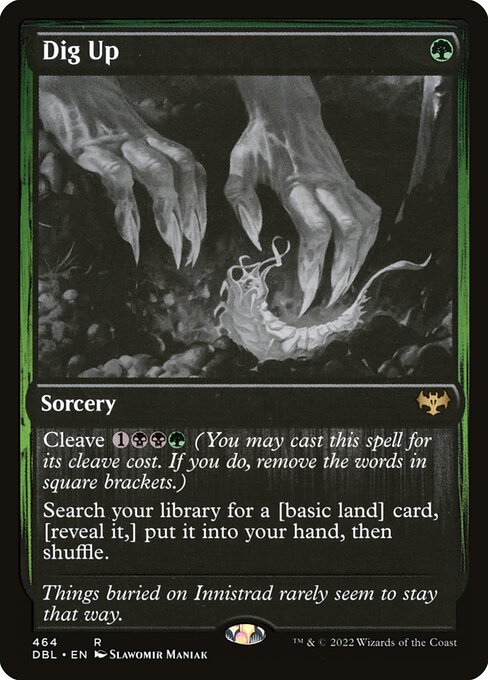
- Color and mana value don't change. No matter which cost you pay, the spell's color and mana value are always determined by its printed mana cost. Dig Up, for instance, is always a green spell with mana value 1, even if you cast it for its cleave cost of {B}{G}{G}.
- The text change is a text-changing effect, governed by CR 612. This matters for edge cases involving copy effects - a copy of a cleaved spell uses the modified text.
- Casting a cleave spell follows the standard rules for alternative costs (CR 601.2b and 601.2f-h), so effects that care about how a spell was cast interact with it as you'd expect.
Common misunderstandings
"Do I have to reveal which cost I'm paying?" Yes - as part of announcing the spell, you declare whether you're using the alternative cleave cost. There's no hidden information here.
"Can I use cost reduction effects with the cleave cost?" Cost reduction effects that reduce the cost to cast a spell generally apply to whichever cost you're actually paying - but if you're unsure about a specific interaction, I'd recommend checking with a judge rather than assuming.
"Does the mana value change?" No. The mana value is always based on the printed mana cost in the top-right corner, regardless of what you actually paid.
Strategy
Playing with Cleave
Cleave spells are best understood as two cards in one slot. The cheap version is efficient and conditional; the cleave version is expensive and flexible. Deckbuilding with cleave means deciding which mode you're primarily building around - and the answer is almost always "the cheap one, with the cleave as a late-game safety valve."
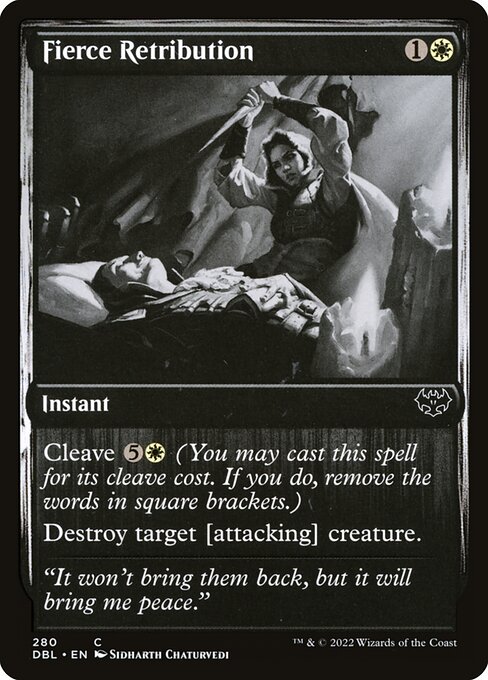
Fierce Retribution ({1}{W}) illustrates this well. For two mana, it destroys a single attacking creature - a narrow but useful combat trick. For {5}{W}, the cleave version destroys any creature, turning a conditional trick into unconditional removal. You'll cast the cheap version most of the time. But having {6} mana up and holding a spell that can answer anything on the board is genuine power.
The key strategic question with every cleave card: how often will I actually need the cleave version? If the narrow version is already good enough for what your deck is doing, the cleave cost is a bonus. If the narrow version is too situational to be reliable, you're essentially paying a premium for a spell that often sits dead in hand.
Playing against Cleave
Opponents holding open mana are always a signal, but cleave makes reading that mana trickier. A player with {U} up could be holding Wash Away in its narrow form - probably not a huge threat. A player with {1}{U}{U} open is potentially holding hard countermagic. If you can force your opponent to spend mana or act before they reach the cleave threshold, you reduce the range of answers they can threaten.
Deck-building considerations
- Cleave spells reward mana-heavy, slower formats and strategies. They're most attractive in formats where games go long enough to cast the expensive version.
- In aggressive shells, the cheap mode matters most. The cleave cost is usually irrelevant if you're winning on turn four.
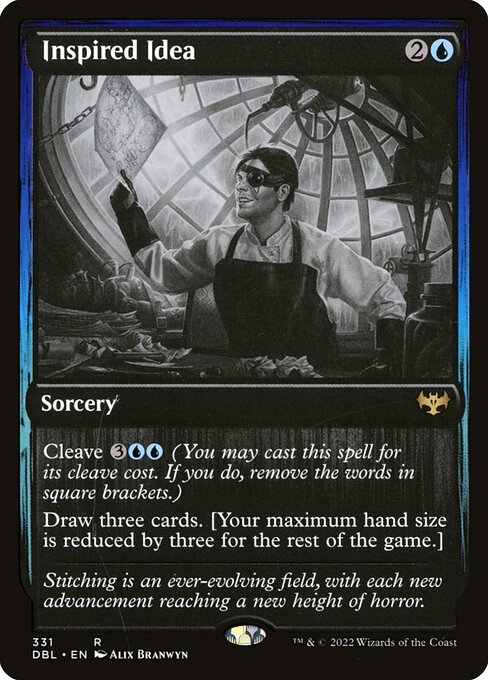
- In control, the cleave option is often the main draw. Inspired Idea ({2}{U}) draws three cards with a hand-size penalty at its base cost - but for {3}{U}{U}, it draws three cards with no downside whatsoever.
Notable Cleave cards
Wash Away
{U} | Cleave {1}{U}{U}
In its base form, Wash Away counters spells that weren't cast from their owner's hand - a very specific hammer for flashback, cascade, reanimated effects, and similar graveyard or library strategies. Cheap and precise. Pay the cleave cost and it becomes a hard {1}{U}{U} counterspell - slower than Counterspell on rate but modal flexibility makes it a genuine consideration in sideboards and control lists that need to cover multiple angles.
Inspired Idea
{2}{U} | Cleave {3}{U}{U}
This one is a beautiful example of cleave's design philosophy. Cast normally, drawing three cards comes with a permanent hand-size reduction of three - a real drawback. Pay {3}{U}{U} and you get three cards, no strings attached. The cleave cost is steep, but unconditional card draw at three cards deep is the kind of effect control decks are always happy to see.
Fierce Retribution
{1}{W} | Cleave {5}{W}
The gap between the two modes here is stark - it costs four extra mana to upgrade from "destroy an attacking creature" to "destroy any creature." That's usually too expensive to be the primary plan, but as a flex slot in white decks that can produce six mana, having access to unconditional removal is worth considering.
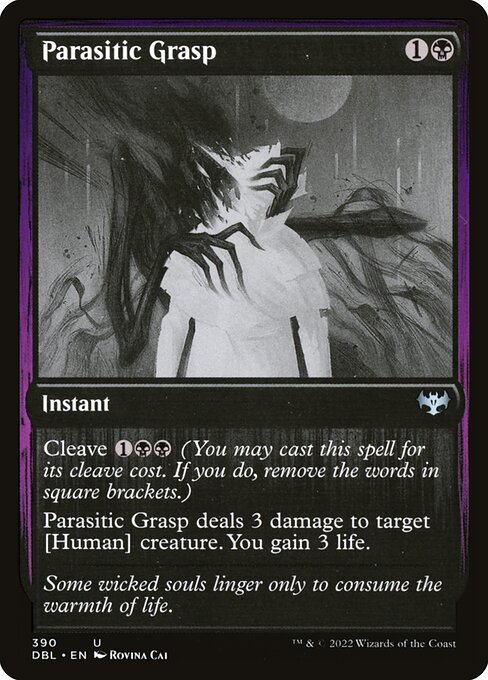
Parasitic Grasp
{1}{B} | Cleave {1}{B}{B}
For {1}{B}, this deals 3 damage to a Human creature and gains you 3 life - strong in the right context, narrow in the wrong one. The cleave cost of {1}{B}{B} removes the Human restriction, making it efficient burn-plus-lifegain that hits any creature. The jump in cost is small enough that you'll genuinely consider which mode you want in many situations.
Dig Up
{G} | Cleave {B}{G}{G}
The textbook cleave card. One green mana: tutor a basic land, put it in hand. Pay {B}{G}{G}: tutor any card, put it in hand. The narrow version is fine ramp. The cleave version is one of the most powerful tutoring effects available at that mana value - finding any card in your library for three mana is extraordinary. The off-colour black pip in the cleave cost means you need a two-colour mana base to access both modes, which is a genuine deckbuilding constraint.
Multicleave - a side note
The Mystery Booster 2 test card Cleaver Blow introduced a variant called multicleave: "You may pay an additional {1} any number of times as you cast this spell. For each time you do, choose a paired set of square brackets and remove the words in between."
Where standard cleave removes all bracketed text at once for a fixed alternative cost, multicleave lets you selectively unlock individual restrictions by paying incrementally. It's a test card, not a tournament-legal mechanic - but it's a fascinating design space that shows how much room cleave's core idea still has to grow.
History
Cleave was introduced in Innistrad: Crimson Vow (2021), but its origins are a bit more tangled than that.
The mechanic was actually designed by Ari Nieh during exploratory design for Streets of New Capenna. There it was called "Misconduct" and was being tested as the signature mechanic for the Brokers faction, who were conceived at that stage as corrupt police officers. The flavour fit - misconduct bending or removing the rules - but the mechanic didn't make it into the final New Capenna set.
Mark Gottlieb then suggested it to Adam Prosak for use in Crimson Vow, where it found a home. Thematically, cleave fits Innistrad's horror-gothic flavour well - cutting, cleaving, removing something from the text (and perhaps from a body 😄).
The mechanic was also quietly foreshadowed even earlier: the 2020 Mystery Booster test card Graveyard Dig had a very similar structure, and was first concepted by Linus Ulyssus Hamilton during the Great Designer Search 3. So in a sense, cleave has roots stretching back to a design competition before it ever appeared on a tournament-legal card.