Craft: The MTG Mechanic Explained
Transforming a card has always felt like a payoff moment in Magic - something shifts, something powerful emerges. Craft takes that feeling and makes it interactive, asking you to sacrifice resources from the battlefield and your graveyard to forge something new. Introduced in The Lost Caverns of Ixalan (LCI), Craft is one of the most flavourful transform mechanics the game has seen, and it rewards building around it in ways that feel genuinely satisfying.
What is Craft?
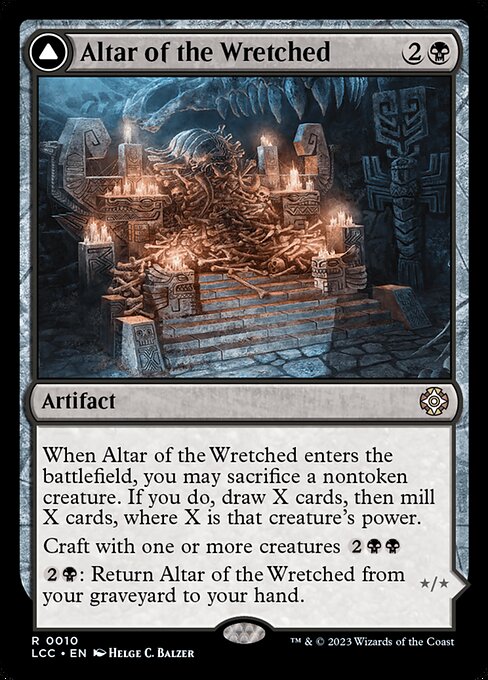
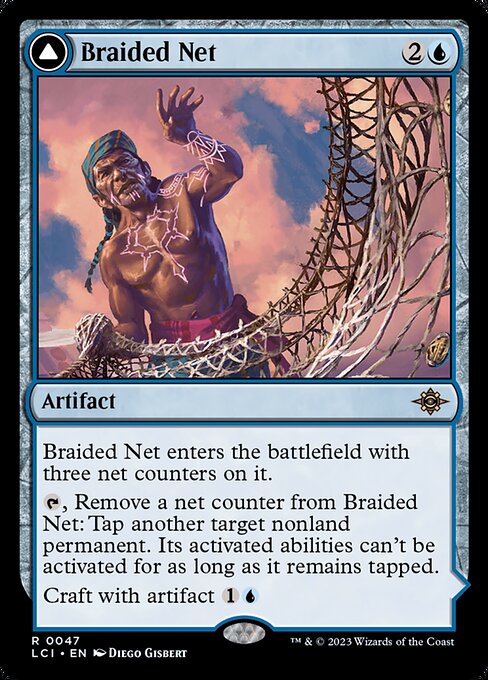
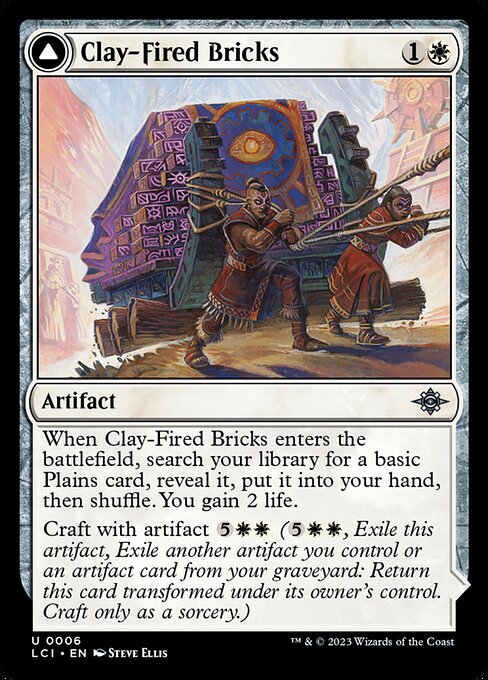
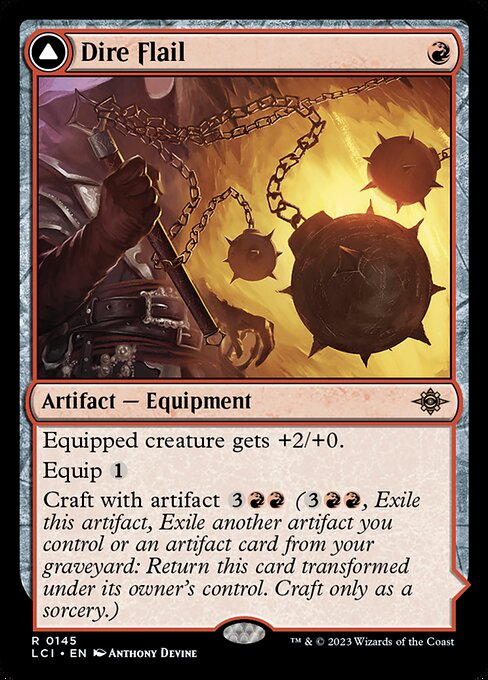
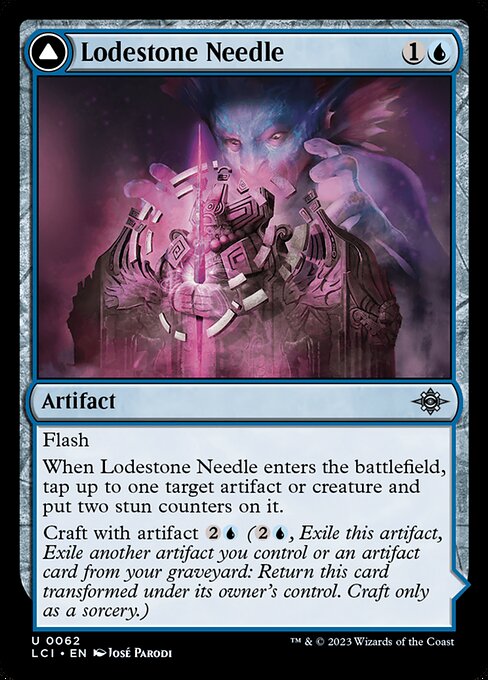
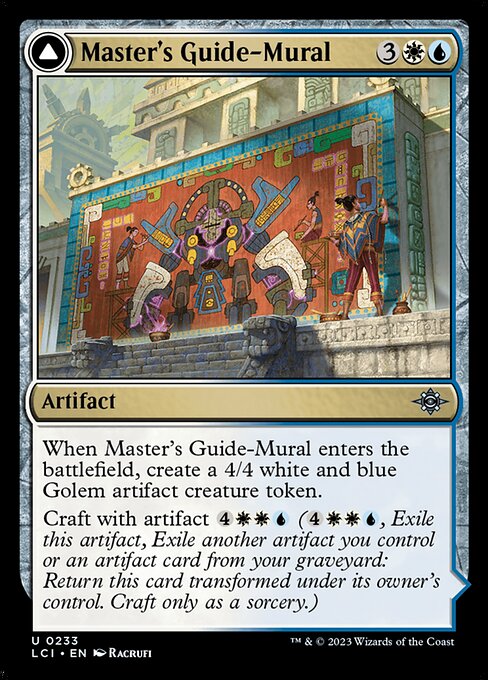
Craft is an activated ability that lets you transform certain artifacts (and a handful of creatures) by exiling the permanent itself along with specific supporting cards - pulled from the battlefield or your graveyard - and paying a mana cost. The result lands on the battlefield transformed, often as a dramatically more powerful version of what you started with.
You always cast the front face of a Craft card - that's the face with the Craft ability on it. Unless something specifically says the card enters transformed, it always enters the battlefield front-side up. The Craft ability is what flips it.
Think of it like forging a weapon: you bring the raw materials, pay the labour, and what comes out of the fire is something new entirely.
Format check: Craft was introduced in LCI (November 2023), so cards with the mechanic are legal in Standard (until they rotate), Pioneer, Modern, Legacy, Vintage, and Commander, depending on the individual card.
How Craft works - the rules
To activate a Craft ability, three things happen at once:
- You exile the permanent with Craft (the card itself leaves the battlefield).
- You exile the specified materials - other permanents you control and/or cards in your graveyard that match the description in the ability.
- You pay the mana cost.
When the ability resolves, the card returns to the battlefield transformed under its owner's control. Importantly, Craft can only be activated as a sorcery - so on your turn, when the stack is empty.
The official rule reads:
"Craft represents an activated ability. It is written as 'Craft with [materials] [cost],' where [materials] is a description of one or more objects. It means '[Cost], Exile this permanent, Exile [materials] from among permanents you control and/or cards in your graveyard: Return this card to the battlefield transformed under its owner's control. Activate only as a sorcery.'" - CR 702.167a
Mixing battlefield and graveyard sources
One of the most important things to understand about Craft is that you don't have to find all your materials in one place. If a Craft ability asks for two artifacts, you can exile one from the battlefield and one from your graveyard - or both from one location. This flexibility is central to how Craft decks are built.
Rules note: When a Craft ability refers to a card type or subtype without using the word "card" (e.g., "Craft with artifact" rather than "Craft with artifact card"), it refers to either a permanent of that type on the battlefield or a card of that type in your graveyard. This is a deliberate exception built into the rules at CR 702.167b.
The exiled materials can matter after crafting
Some transformed permanents reference the cards that were exiled to craft them. That's covered by CR 702.167c - the ability can refer back to those specific cards sitting in exile, which opens the door for some interesting design space.
Common misunderstandings
- You can't use the permanent itself as one of the materials. The ability specifies "other" artifacts, creatures, or whatever type is listed.
- Craft is sorcery speed only. You can't respond to an attack by crafting at instant speed.
- The card leaves and returns. This means it loses any counters, Auras, or Equipment attached to its pre-transform front face. It enters as a new permanent.
What can you Craft with?
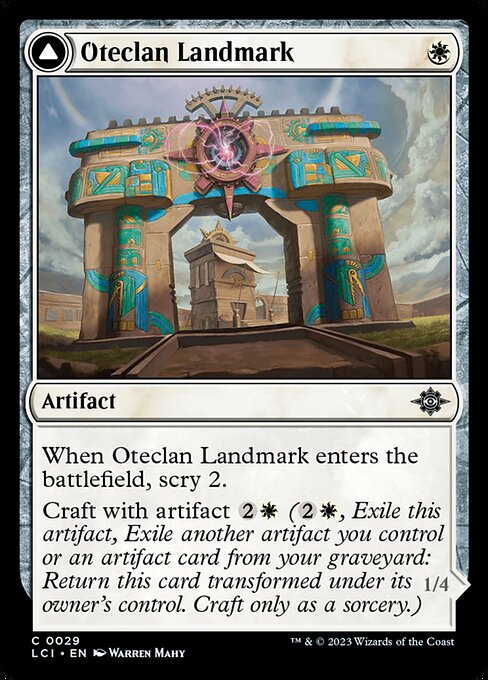
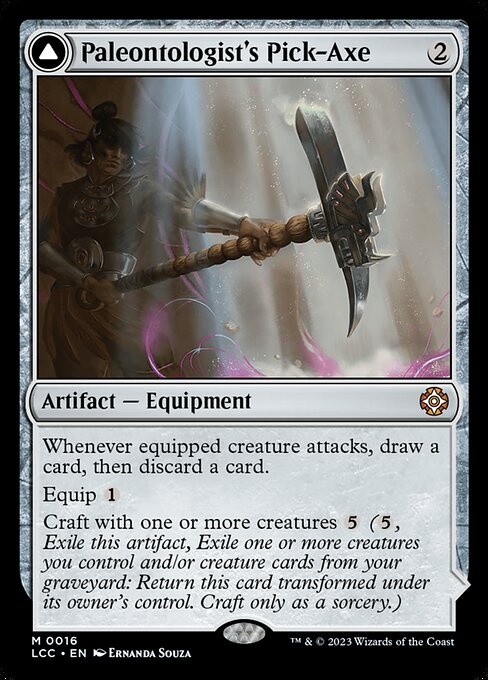
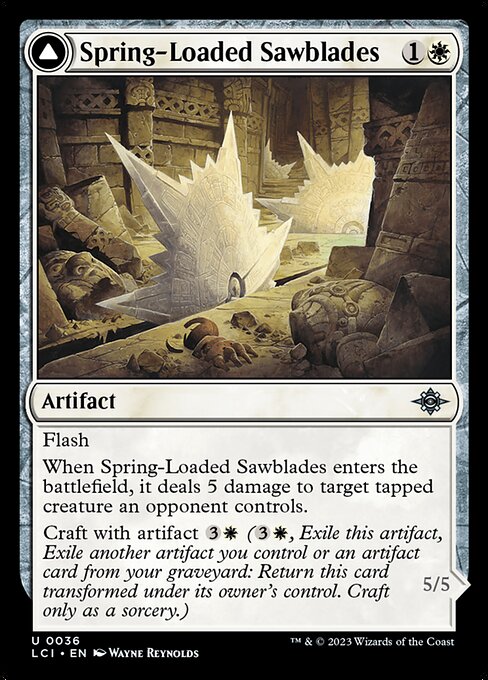
The material requirements vary widely across Craft cards, which is a big part of what makes the mechanic interesting from a deck-building perspective. Here's the full range of material types found on LCI Craft cards:
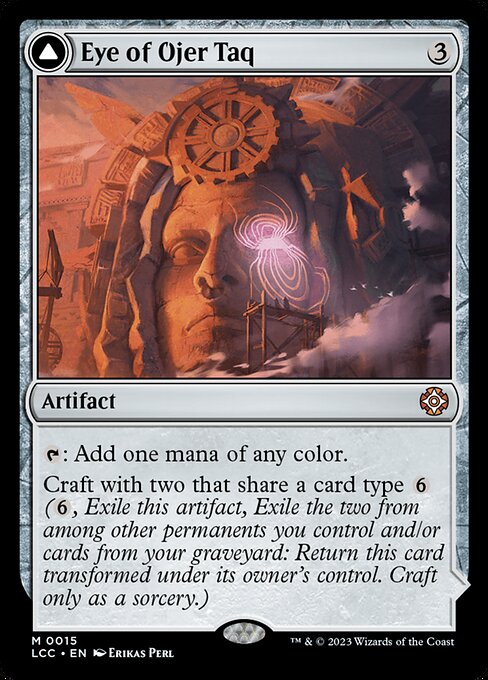
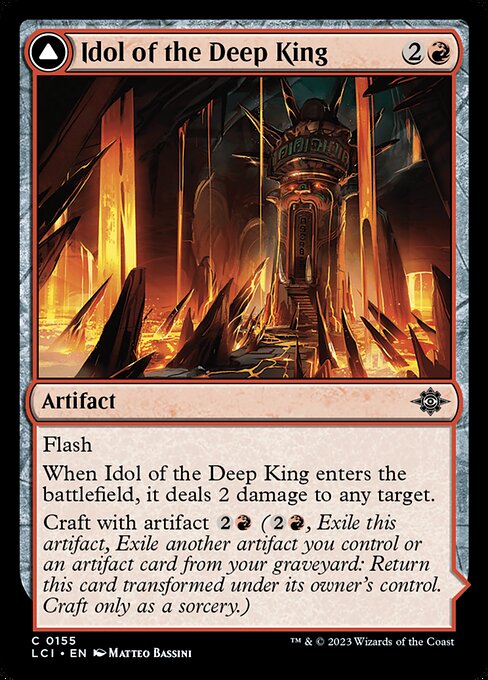
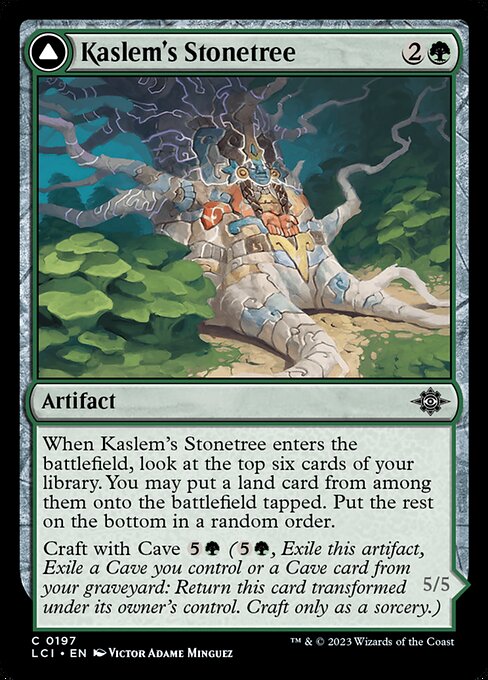
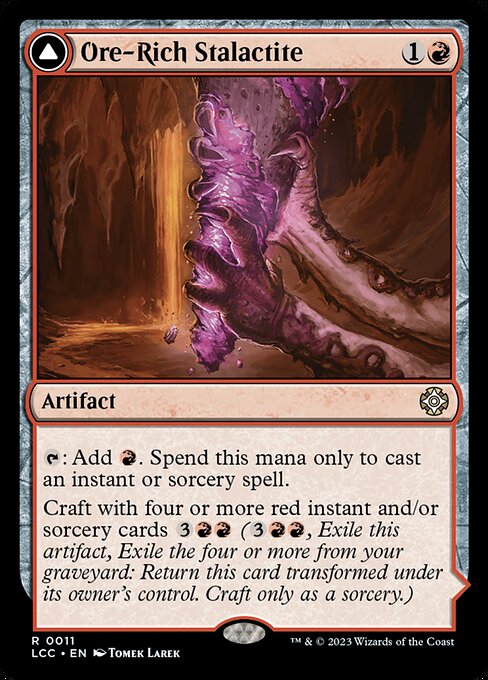
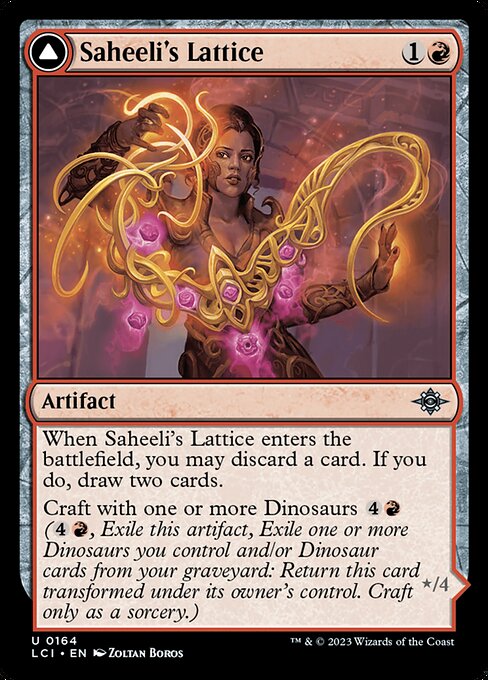
| Material required | Example card | |---|---| | Artifacts | Idol of the Deep King | | Creatures | Paleontologist's Pick-Axe | | Cards that share a card type | Eye of Ojer Taq | | Permanents (any type) | Sunbird Standard | | Dinosaurs | Saheeli's Lattice | | A Dinosaur, a Merfolk, a Pirate, and a Vampire | Throne of the Grim Captain | | Cave | Kaslem's Stonetree | | Island | Waterlogged Hulk | | Nonlands with activated abilities | The Enigma Jewel | | Red instant and/or sorcery cards | Ore-Rich Stalactite |
The variety here is striking. Some Craft cards slot naturally into a themed tribal or artifact deck. Others, like Throne of the Grim Captain, ask you to build around four different creature types - a real deck-building puzzle.
The non-artifact exceptions
Almost every Craft permanent transforms into an artifact. Three exceptions exist, and they're worth knowing: Dread Osseosaur, Wretched Bonemass, and The Grim Captain all transform into Creatures rather than artifacts. All three happen to be black Skeleton creatures, and all three require exiling creatures as their crafting materials. A small, flavourful corner of the mechanic.
Strategy - playing with Craft
Building toward the transform
Craft is fundamentally a graveyard mechanic dressed up as an artifact mechanic, and that shapes how you build around it. You want cards that put materials into your graveyard naturally - looters, self-mill, or sacrifice outlets that leave useful pieces behind. The fact that you can pull materials from either the battlefield or the graveyard means you're rarely stuck; a card you played and lost earlier can still contribute.
The key tension in Craft decks is resource management. Exiling your own permanents and graveyard cards is a real cost. You're paying mana and sacrificing board presence or future options. The transformed card needs to be worth that investment - and in most cases, it is, which is why evaluating the back face of a Craft card matters as much as the front.
Timing and windows
Because Craft is sorcery speed, you're committing to it on your turn. That means you have to weigh it against everything else you could be doing - attacking, playing another spell, keeping up interaction. In my experience, the sweet spot is usually when you've already used your materials for their primary purpose (attacked with a creature, triggered an artifact) and they're now sitting in the graveyard ready to be converted into something bigger.
Playing against Craft
The most effective way to disrupt a Craft activation is before it happens. Exiling the Craft permanent itself before your opponent activates the ability (at instant speed, on their end step) removes the engine entirely. Once the ability is on the stack, the materials are already committed - countering the ability at that point still exiles everything, which can be a significant tempo swing in your favour. Graveyard hate also naturally hampers Craft decks that rely on their graveyard for materials.
Craft as a graveyard synergy enabler
Market Gnome is a great example of how Craft creates its own micro-economy: it's a card that actually rewards being used as a crafting ingredient, turning the cost of the mechanic into a bonus. Cards like this are worth looking for when building a Craft-themed deck - they make the resource expenditure feel like an upside rather than a drawback.
Notable Craft cards
Throne of the Grim Captain
The most demanding Craft requirement in the set - exile a Dinosaur, a Merfolk, a Pirate, and a Vampire. In exchange, you get The Grim Captain, one of the three non-artifact Craft transforms. Building around this card requires committing to four tribes simultaneously, which is a genuine deckbuilding challenge, but the payoff is flavourfully satisfying and mechanically powerful.
The Enigma Jewel
Requires exiling nonland permanents with activated abilities, which is a natural fit in artifact-heavy decks full of activated effects. The specificity of the requirement shapes what the rest of the deck looks like.
Saheeli's Lattice
Crafted with Dinosaurs, which fits neatly into the Dinosaur tribal themes that run through LCI. Saheeli's presence in the set connects the Craft mechanic to the broader artifact and invention themes she's associated with across her story history.
Idol of the Deep King
One of the more accessible Craft cards - requires artifacts, which are easy to accumulate in decks already leaning into artifact synergies. A natural starting point if you want to explore the mechanic.
Waterlogged Hulk
Interesting for requiring an Island rather than a creature or artifact type - pulling a land off the battlefield as a material is a different kind of cost, connecting the mechanic to the blue mana base rather than a creature strategy.
History of Craft
Craft is an ability word introduced in *The Lost Caverns of Ixalan*, which released in November 2023. It sits within the long tradition of double-faced cards and transform mechanics that stretches back to Innistrad (2011), but Craft carves out its own identity by making the transformation a deliberate, cost-heavy activated ability rather than a triggered condition.
Where earlier transform mechanics often flipped cards automatically when you met a threshold (having enough creatures, dealing enough damage, surviving a certain number of turns), Craft asks you to make an active choice and pay an active cost. It's a more strategic, slower kind of transform - less "this happened to me" and more "I decided to do this."
The mechanic fits perfectly into Ixalan's themes of excavation, discovery, and the civilisations hidden in the underground caverns beneath the plane's surface. You're not just finding treasure - you're making something from the raw materials around you. Flavourfully, it's one of the more cohesive mechanic-setting pairings in recent memory.