Crew: MTG Mechanic Explained
There's something deeply satisfying about assembling a ragtag band of creatures, putting them to work, and watching a Vehicle roar to life. That's exactly what the Crew mechanic captures - and it does it with surprising mechanical depth hiding behind a simple, intuitive concept.
What is Crew?
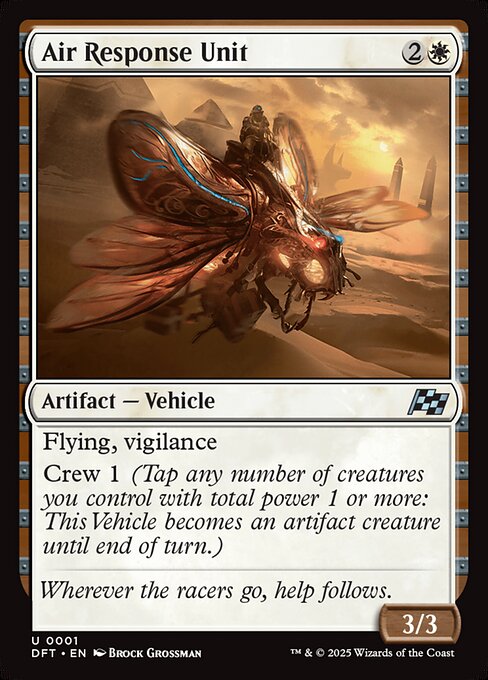
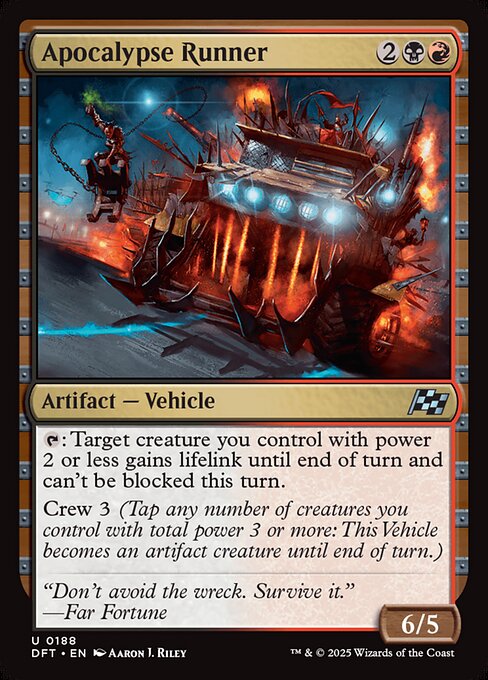
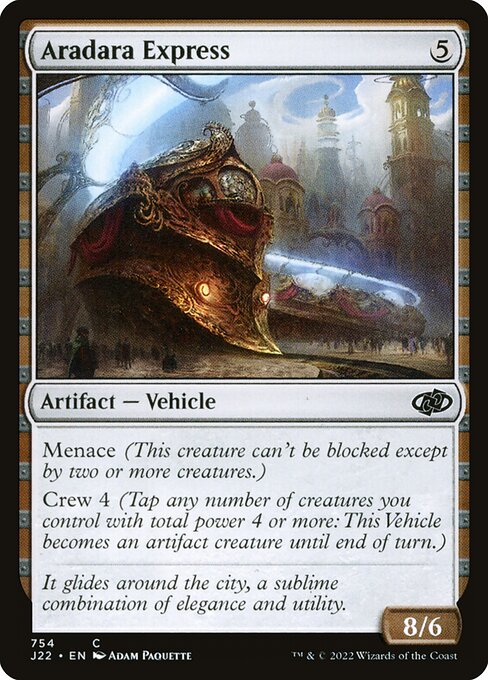
Crew is an activated ability found on Vehicle cards. When you tap creatures you control with enough combined power, the Vehicle transforms from an inert artifact into a fully active artifact creature - ready to attack, block, or trigger whatever abilities it has.
In short: no crew, no Vehicle. These aren't self-propelled machines. They need pilots.
Format check: Crew appears on Vehicle cards across Standard, Pioneer, Modern, Legacy, and Commander. Specific Vehicles are legal only in the formats their sets are legal in - check each card individually.
Rules
How Crew works
The official rules text reads:
"Crew N means 'Tap any number of other untapped creatures you control with total power N or greater: This permanent becomes an artifact creature until end of turn.'" - CR 702.
A few things worth unpacking there:
- You need total power N or greater across all the creatures you tap. So a Crew 3 Vehicle can be crewed by three 1/1s, one 4/4, or any other combination that hits 3 or more.
- The Vehicle becomes an artifact creature until end of turn. It doesn't stop being an artifact - it adds the creature type on top.
- The transformation lasts until end of turn only. On your opponent's turn, it goes back to being a plain artifact (unless you crew it again on their turn, which is allowed).
- You can only tap untapped creatures you control, and they must be creatures at the time you activate the ability.
Common misunderstandings
"Can I crew with a creature that just entered the battlefield?" Only if it doesn't have summoning sickness - or if it has haste. Crewing uses the tap symbol, so the usual summoning sickness rules apply.
"Can I crew on my opponent's turn?" Yes. Crew is an activated ability with no timing restriction, so you can use it at instant speed. This means you can crew a Vehicle specifically to block.
"Does the Vehicle keep any counters or other effects when it stops being a creature?" Yes - the Vehicle itself persists as an artifact. Things that modify the artifact (like +1/+1 counters) stay on it. It just loses the creature type until crewed again.
"Do the tapped creatures have to remain tapped for the Vehicle to stay active?" No. Once you've activated Crew, the creatures can untap and the Vehicle remains an artifact creature until end of turn regardless.
Power matters, not toughness
This is easy to overlook: Crew cares about power, not toughness. A 0/4 Wall contributes nothing to crewing. A 4/0 creature (if such a thing exists on the battlefield) contributes 4. This makes power-pumping effects and high-power utility creatures especially attractive alongside Vehicles.
Strategy
Building around Crew
The fundamental tension with Vehicles is that they ask you to commit creatures to tapping - meaning those creatures can't attack that same turn (unless you crew after attackers are declared, at which point the Vehicle can't attack either). You're essentially choosing between attacking with your creatures or crewing your Vehicle.
This is why high-power, low-attack-value creatures pair so naturally with Vehicles. A creature you'd rather have crewing than swinging - say, a creature with a powerful static ability but mediocre stats for combat - is exactly the kind of pilot you want.
The golden rule of Vehicle deckbuilding: your creatures should want to crew, and your Vehicles should be worth the cost of tapping them.
Low Crew numbers reward go-wide strategies
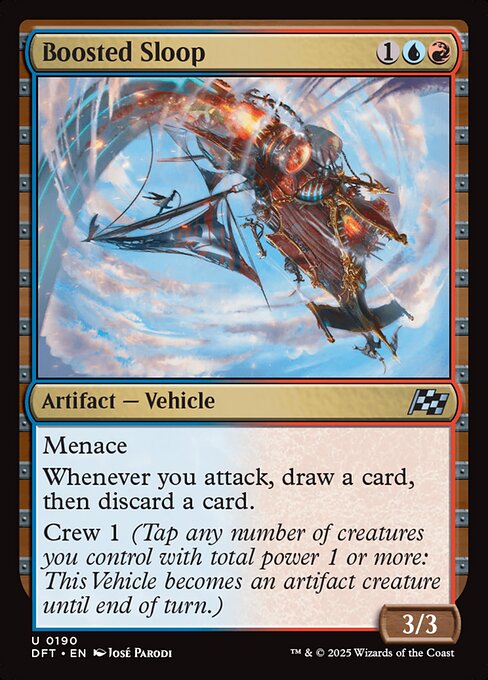
A Vehicle with Crew 1 can be activated by almost anything on your board. Mindlink Mech ({2}{U}) and Boosted Sloop ({1}{U}{R}) both have Crew 1, which means a single 1/1 token turns them on. In a deck that makes a lot of small creatures, this is nearly free - you're not giving up much by tapping one token, and you get a flying threat or a loot engine in return.
Mobilizer Mech ({1}{U}) takes this further: when it gets crewed, it can also activate another Vehicle you control for free. That's a lot of value squeezed out of one tap.
Higher Crew numbers reward big-creature strategies
Crew 3 requires you to think more carefully about what you're tapping. Lifecraft Engine ({3}) is an interesting case - it has Crew 3 but shapes your whole Vehicle strategy, letting you choose a creature type that all your Vehicle creatures share, and buffing every other creature of that type on the board. If you're going deep on Vehicles, the payoff justifies the cost.
Possession Engine ({3}{U}{U}) is another Crew 3 Vehicle worth noting - it steals an opponent's creature when it enters, and that creature stays stolen as long as you control the Vehicle. The Crew cost here is almost secondary to the political power it represents in Commander.
Playing against Crew
The best time to remove a Vehicle is before it gets crewed - while it's just an artifact with no power or toughness. Most creature removal doesn't touch non-creature artifacts, so catching a Vehicle before it wakes up means your removal suite is much more effective against it.
Alternatively, remove the creatures that pilot it. No creatures, no crew. Sweepers are particularly punishing against Vehicle-heavy decks because they strand a pile of inert artifacts on the battlefield.
If you do need to remove an active Vehicle, you need effects that hit artifact creatures - or the rare removal that hits any permanent.
Notable cards
Mindlink Mech ({2}{U})
Whenever this Vehicle becomes crewed for the first time each turn, it copies a nonlegendary creature that crewed it - keeping its 4/3 stats, its Vehicle and artifact types, and its flying. This is one of the more inventive designs in the Crew space: your pilot becomes the ship, in a sense. It's a flexible threat that adapts to whatever creature you have available.
Mobilizer Mech ({1}{U})
A cheap flying Vehicle that, when crewed, can also animate another Vehicle you control for free. In a deck with multiple Vehicles, this creates a real chain of threats from a single tap activation. The Crew 3 cost is the only wrinkle - you need a reasonably sized creature to get the engine running.
Subterranean Schooner ({1}{U})
Crew 1, low mana cost, and whenever it attacks, the creature that crewed it gets to explore - drawing you a land or growing your pilot with a +1/+1 counter. This is a clean, value-generating package that rewards you just for doing the thing you were already doing.
Boosted Sloop ({1}{U}{R})
Menace plus looting whenever you attack is a lot to ask of a two-mana Vehicle. Crew 1 makes this easy to turn on, and the looting keeps your hand churning through the game. Aggressive decks that want card selection will find this surprisingly useful.
Lifecraft Engine ({3})
A build-around in the truest sense. By choosing a creature type at the moment it enters, the Engine sets up a tribal bonus for every other creature of that type you control - including other Vehicle creatures. If you're committed to a Vehicle-heavy strategy, this can buff an entire board.
Reckless Crew ({3}{R})
Not a Vehicle itself, but a sorcery that produces Dwarf Berserker tokens based on how many Vehicles and Equipment you control - and lets you immediately attach Equipment to those tokens. The name does double duty: it's flavorful and it's a payoff card for a very specific archetype.
History
Crew debuted in Kaladesh (2016), the artifact-and-invention set set on a plane of aetherpunk ingenuity. Kaladesh introduced Vehicles as a new artifact subtype, and Crew was the mechanic that brought them to life. The flavour was immediately resonant: Kaladesh's planes are driven by aether-powered engines, and the pilots who guide them are workers, racers, and revolutionaries.
The mechanic reappeared in Aether Revolt (2017), the follow-up set, and has since shown up in sets like Ixalan (2017 and 2023), Kamigawa: Neon Dynasty (2022), Streets of New Capenna (2022), and beyond - anywhere the fiction calls for pilots, ships, or machines that need a hand to operate.
Over time, the designs around Crew have grown more layered. Early Vehicles were fairly straightforward combat threats. Later designs like Mindlink Mech and Possession Engine use the act of crewing itself as a trigger - making how and when you crew a meaningful decision rather than just a prerequisite.
The lore around Crew is equally rich. On Kaladesh, the New Culture Collective - a group of engineers, pilots, aether smugglers, and radicals - organised the famous Ghirapur Sprint, where Vehicles and their crews competed in high-stakes races. The Keelhaulers, a crew of chordatan corsairs and their comrades on Avishkar, favoured fast, stripped-down Vehicles and hard-charging race strategies. These aren't just game pieces - they're crews with names, histories, and grudges.