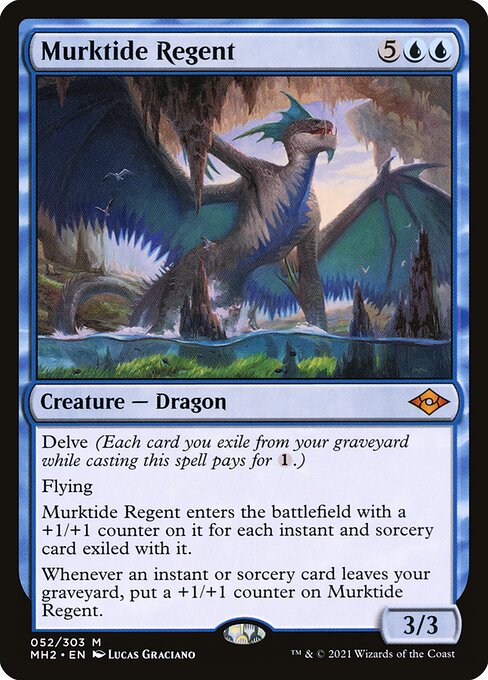
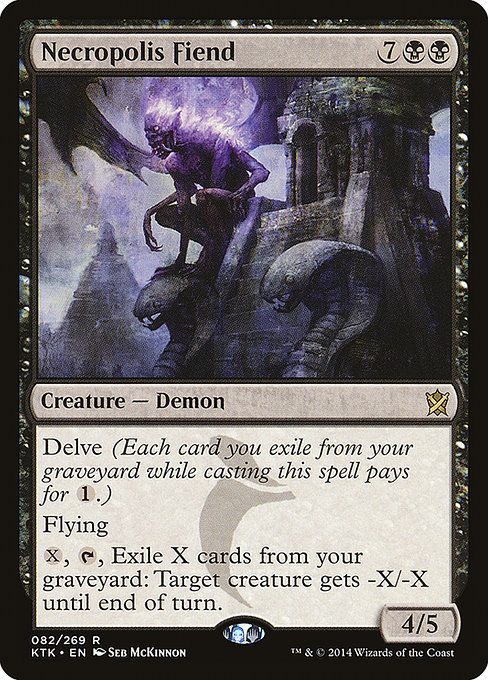
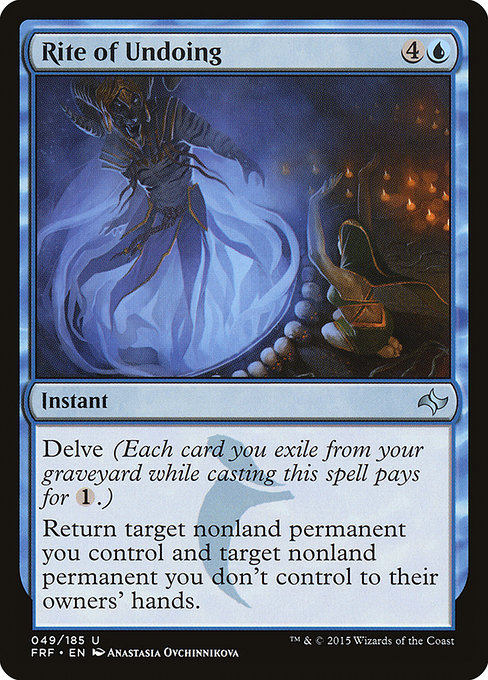
Delve: The MTG Mechanic Explained
Your graveyard isn't just a pile of spent resources. In Magic, it's a second hand - and Delve is one of the most efficient ways the game has ever given you to spend it.
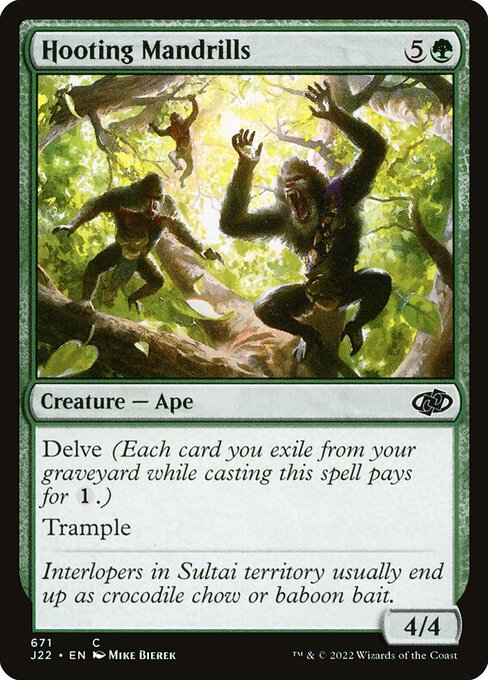
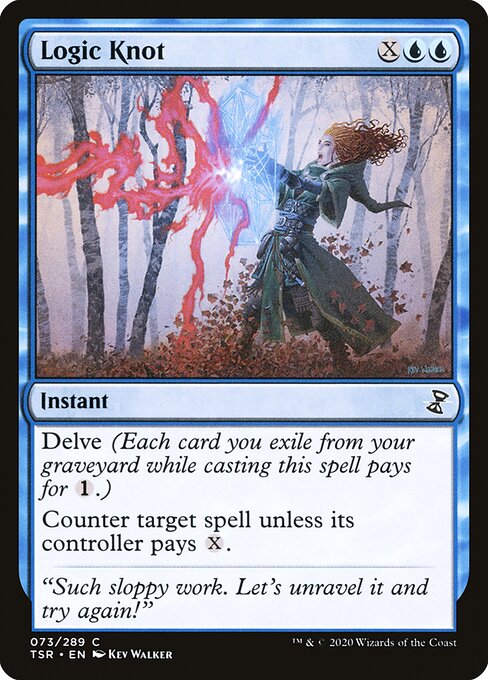
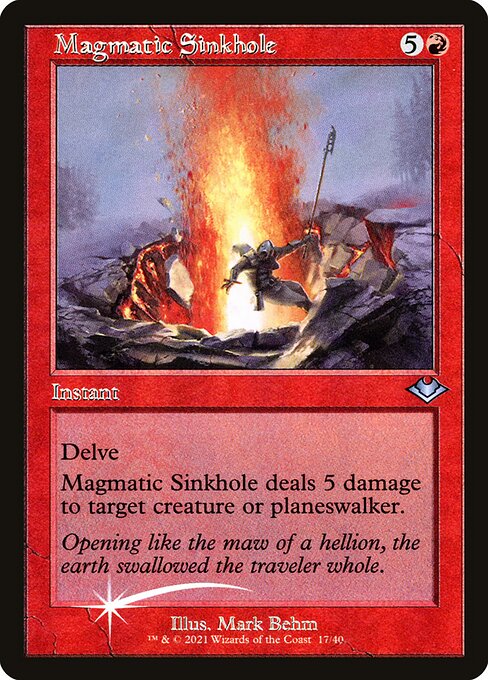
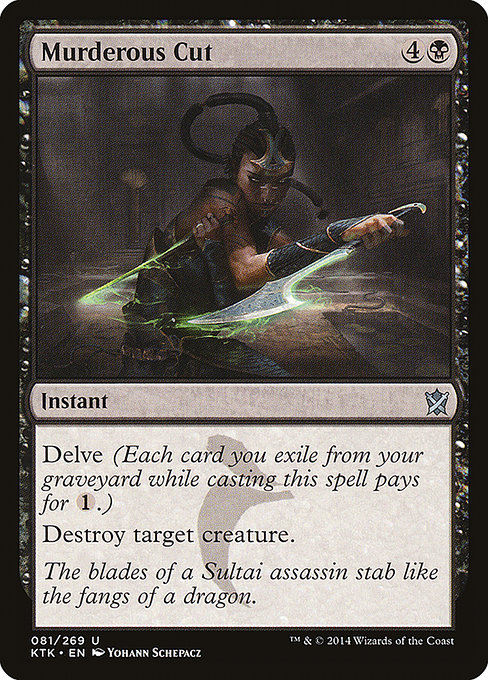
Delve lets you exile cards from your graveyard to pay for the generic mana in a spell's cost. Cast a seven-mana spell with six cards in your graveyard? You might be casting it for a single mana. That gap between a spell's printed cost and what you actually pay is where Delve earns its reputation - and why so many Delve cards have ended up on banlists.
What is Delve?
Delve is a keyword ability that reduces what you pay to cast a spell by letting your graveyard do the work. For each card you exile from your graveyard while casting a Delve spell, you pay {1} less of its generic mana cost.
The keyword text reads: "Each card you exile from your graveyard while casting this spell pays for {1}."
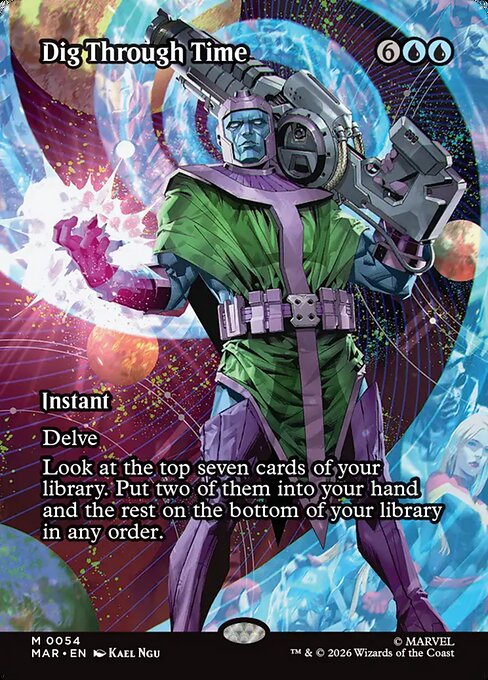
So a spell like Dig Through Time, printed at {6}{U}{U}, can be cast for as little as {U}{U} - if you've got six cards sitting in the graveyard ready to exile. In formats where filling your graveyard is easy, that's not a hypothetical. It's a turn-two play.
Lore aside: The name fits neatly. You're digging through spent resources, pulling something useful from what's already been used up. It's one of those mechanics where the name and the game feel map cleanly onto each other.
How Delve works - the rules
The official definition comes from CR 702.66:
"Delve is a static ability that functions while the spell with delve is on the stack. 'Delve' means 'For each generic mana in this spell's total cost, you may exile a card from your graveyard rather than pay that mana.'" - CR 702.66a
A few important details follow from that:
Delve applies after your total cost is calculated
Delve isn't an alternative cost - it's a cost reduction that applies after the spell's full cost has been determined (CR 702.66b). That distinction matters because it means Delve stacks with alternative costs. If something gives you an alternative cost to cast a spell, you can still use Delve on top of it.
You can only pay for generic mana with Delve
Exiling cards from your graveyard can only substitute for the colourless, generic portion of a spell's cost. You can never use Delve to pay for coloured mana symbols. Dig Through Time will always require {U}{U} in real mana, no matter how many cards you exile.
There's a hard cap on how many cards you can exile
You can't exile more cards than the number of generic mana symbols in the spell's cost. A spell with {6}{U}{U} has six generic mana to pay for - so you can exile at most six cards, and not a single one more.
Multiple instances of Delve don't stack
If a card somehow had Delve printed on it twice, the second instance does nothing. CR 702.66c is blunt about it: they're redundant.
Timing: when do you exile the cards?
You exile graveyard cards at the same time you pay the spell's cost - not before, not after. This matters if other effects are watching for cards leaving the graveyard.
Rules note: The rules for Delve were updated after its original Future Sight (2007) printing. Previously, Delve reduced the cost to cast the spell. Under current rules, you exile cards as part of paying the cost itself. It's a subtle mechanical difference, but it affects how the ability interacts with cost-modification effects.
Strategy
Playing with Delve
Delve rewards decks that fill their graveyards quickly and deliberately. The more efficiently you can load up your graveyard in the early turns, the earlier and cheaper your Delve spells come down.
A few approaches that pair naturally with Delve:
- Cantrips and looting effects - Drawing cards and discarding or milling lets you fill your graveyard while filtering your hand. Fetch lands (in formats that have them) are particularly efficient: they go to the graveyard after use, providing free Delve fodder.
- Self-mill - Spells that mill your own library directly accelerate Delve without costing card advantage.
- Cheap spells - Every spell you cast ends up in the graveyard eventually. A deck full of one- and two-mana spells naturally generates Delve fuel over the first few turns.
The key tension with Delve is that your graveyard is a shared resource. If you're running multiple Delve spells in the same deck, they compete for the same pool of exileable cards. Exiling six cards for one Delve spell is great - until you want to cast your second Delve spell and find the graveyard nearly empty. In practice, most competitive Delve strategies focus on one or two high-impact Delve cards rather than building an entire Delve-heavy suite.
Playing against Delve
Graveyard hate is your primary tool. Exile-based removal like Rest in Peace or Leyline of the Void shuts Delve down completely, since there are no cards left in the graveyard to exile. Even incremental graveyard disruption - exiling a few cards at key moments - can delay a Delve spell by a turn or two, which is often enough.
It's also worth remembering that Delve spells exile cards to cast, not as an optional trigger. Once a Delve spell is on the stack, the cards are gone. Disrupting the spell itself (countering it) is more reliable than trying to interact with the exile payment.
Deck-building considerations
If you're building around Delve in a format that allows it, ask yourself:
- How many cards can I realistically put in my graveyard by turn three or four?
- Am I competing with myself for graveyard resources (other Delve cards, flashback, escape)?
- Is my opponent likely to bring graveyard hate, and do I have a plan B if they do?
Notable Delve cards
Dig Through Time
Dig Through Time ({6}{U}{U}) is the canonical example of Delve at its most powerful. For {U}{U} plus seven cards exiled from your graveyard, you look at the top seven cards of your library and pick the two best ones. That's an enormous amount of card selection at a tiny real cost. It's been banned or restricted in multiple formats - banned in Legacy and Pioneer, restricted in Vintage - precisely because blue decks can fill their graveyard so efficiently that {U}{U} for two of your best seven cards is simply too good a deal.
Death Rattle
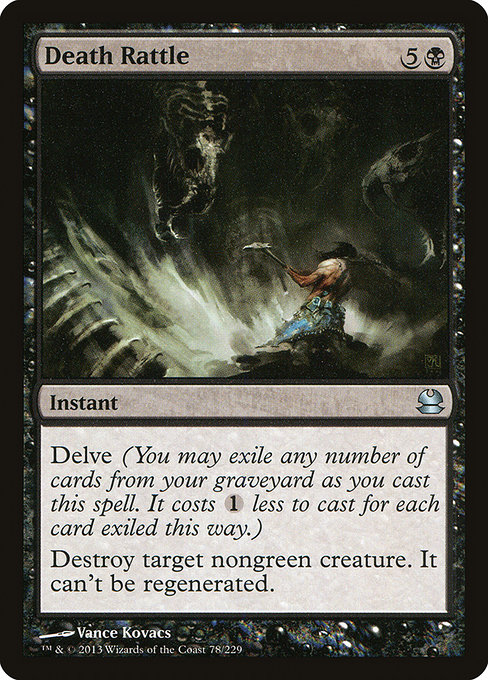
Death Rattle is one of the original Future Sight Delve cards and a clean example of the mechanic at common. Destroy a non-green creature, and it can't be regenerated - for as little as {B} if you exile five cards. The design is elegant: a premium removal spell that's suddenly accessible early when your graveyard is stocked.
History
Delve first appeared in Future Sight (2007) - Magic's "preview of the future" set that introduced mechanics as timeshifted cards suggesting possible design directions. Only three cards in Future Sight had Delve, treating it as a preview mechanic with no immediate follow-up.
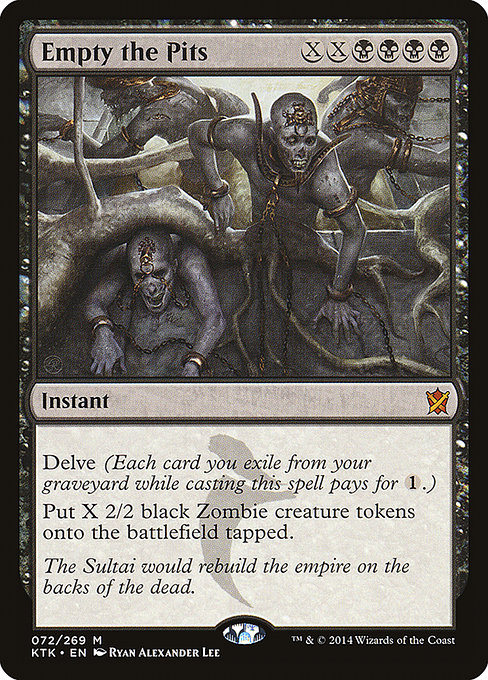
It returned properly in Khans of Tarkir (2014) as the signature mechanic of the Sultai Brood, one of the five clans in that setting. The Sultai were a ruthless, resource-exploiting faction, and Delve fit their identity well - using the dead (in both the lore and game-mechanical sense) to fuel their ambitions. The mechanic carried over into Fate Reforged (2015), the second set in the Tarkir block.
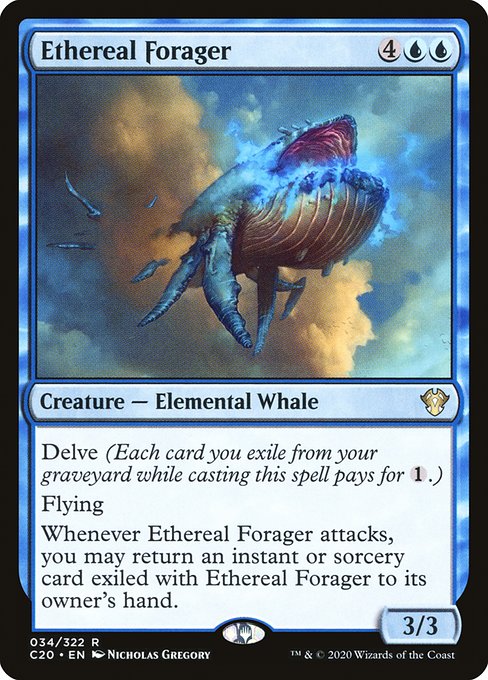
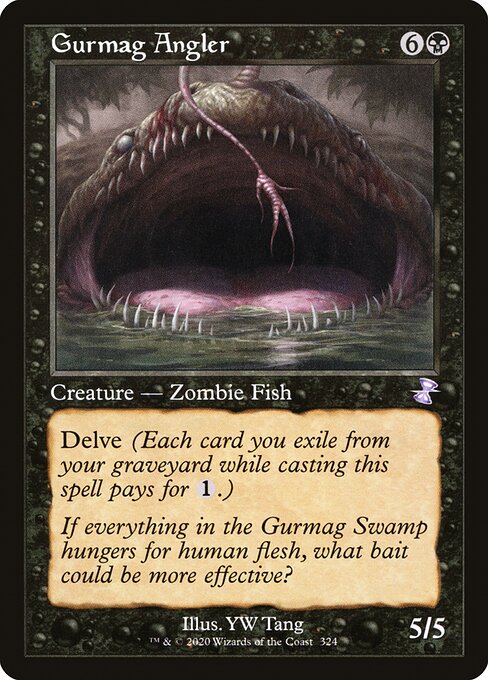
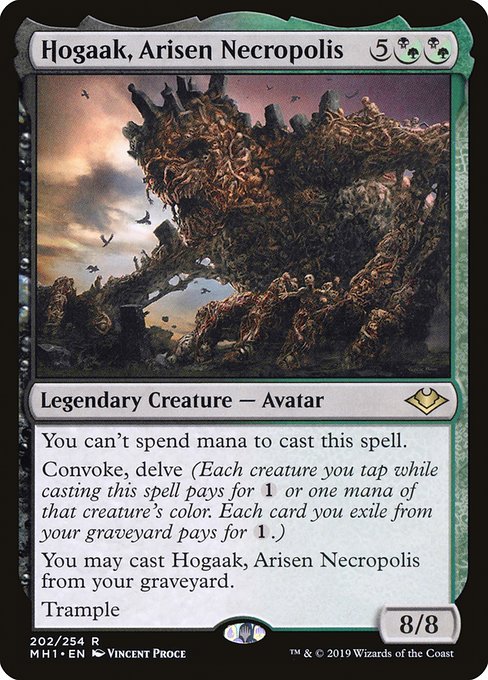
Later appearances came in Modern Horizons (2019) and Commander 2020.
The mechanic's history since then has been mostly defined by its power level. Several Delve cards were banned across multiple formats, and the mechanic now sits high on Mark Rosewater's Storm Scale - his measure of how likely a mechanic is to return to a Standard-legal set. Delve's combination of anti-linear gameplay (you're often incentivised to not use your graveyard for other things) and its sensitivity to the broader card environment makes it tricky to reprint safely. It works beautifully in the right context; in the wrong one, it warps formats quickly.
That's not a knock on the design. It's a testament to it. The premise - your graveyard as fuel - is intuitive, flavorful, and genuinely exciting to play. The problem is that in Magic, "genuinely exciting" and "dangerously efficient" have a tendency to be the same thing. 😄