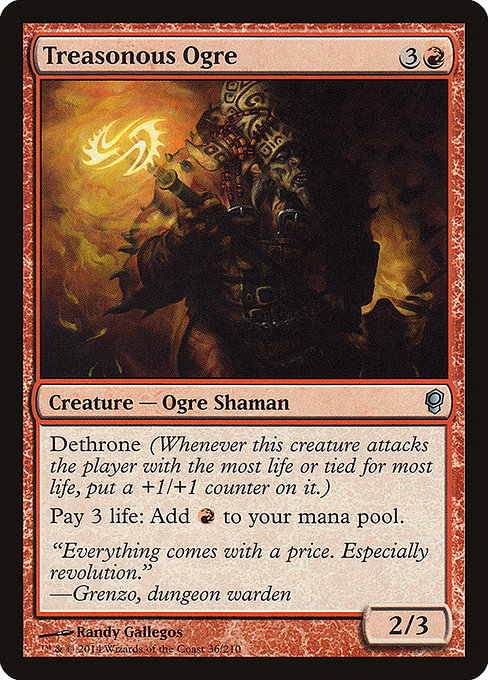
Dethrone: MTG Mechanic Guide
There's something satisfying about a mechanic that rewards you for punching up. Dethrone is exactly that: a keyword that grows your creature every time it goes after the player sitting on the throne of the highest life total. It turns a threat into a political statement, and in multiplayer games, that's a surprisingly powerful thing to be doing.
What is Dethrone?
Dethrone is a keyword ability that puts a +1/+1 counter on a creature whenever it attacks the player with the most life - or tied for the most life. The more you go after the person who's ahead, the bigger your creature gets.
The full rules text reads: "Whenever this creature attacks the player with the most life or tied for most life, put a +1/+1 counter on this creature."
In a multiplayer game, this creates a delicious loop: attack the leader, get bigger, attack the new leader, get bigger still. In a heads-up game, it triggers as long as your opponent is at a higher life total than you - which is often exactly when you want your creatures to be growing.
Dethrone rules
Dethrone is a triggered ability (CR 702.105a), which means it goes on the stack when the attack is declared and resolves before blockers are chosen. That timing matters - the +1/+1 counter is already on the creature before your opponent decides how to block.
Here are the key rules interactions worth knowing:
- Ties count. If multiple players are tied for the most life, dethrone triggers when you attack any of them.
- Planeswalkers don't count. Dethrone only triggers when the creature attacks a player. Sending it at a planeswalker, even one controlled by the highest-life player, won't trigger dethrone.
- The trigger locks in at attack. Once dethrone has triggered, the counter goes on the creature even if life totals change before the ability resolves. The check happens at declaration, not on resolution.
- Multiple instances stack. If a creature somehow has two instances of dethrone, each triggers separately, meaning two +1/+1 counters per qualifying attack.
- Two-Headed Giant works as you'd expect. Dethrone checks against the team's combined life total, and triggers if you attack the team with the most life or tied for it.
Rules note: The +1/+1 counter lands before blockers are declared. If your opponent was planning to trade blockers based on the creature's size, dethrone can change that math mid-attack step.
Strategy
Playing with dethrone
The core tension of dethrone is that it rewards aggression against whoever is winning - which is exactly the person you should be targeting in a multiplayer game anyway. Dethrone effectively aligns your incentive to grow your creatures with the table's incentive to keep the leader in check. That's elegant design.
In Commander specifically, dethrone creatures make strong early threats. A 1/1 with dethrone that attacks the highest-life player every turn can snowball into a real threat by mid-game without you having to invest extra resources. The keyword does the work as long as you keep pointing it at the right player.
A few things to think about when building around dethrone:
- Pair it with evasion. A creature with dethrone that gets blocked every turn still grows, but one that gets through deals damage and grows. Flying, menace, or trample make dethrone creatures significantly more threatening.
- Protect your investment. Once a dethrone creature has accumulated several +1/+1 counters, it becomes a removal magnet. Counterspells, hexproof effects, or indestructible can protect the value you've built up.
- Life gain awareness matters. In Commander, someone running a lifegain strategy might repeatedly become the highest-life player, which means your dethrone creature gets to trigger repeatedly. That's a feature, not a bug.
Playing against dethrone
The simplest answer is to not be the player with the most life when a dethrone creature is attacking - though that's not always in your control. If you're running a lifegain strategy, dethrone creatures naturally aim at you, so having removal ready is important before they get out of hand. A creature that's already picked up four or five counters is a very different problem from a fresh one.
Notable cards with Dethrone
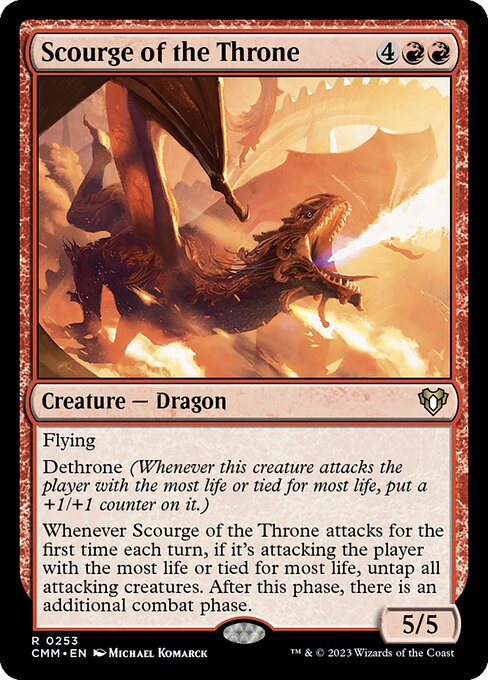
Scourge of the Throne
Scourge of the Throne ({4}{R}{R}) is the headline dethrone card, and honestly it's not a close contest. A 5/5 Dragon with flying is already a reasonable body for six mana, but the second ability is what makes it a genuine Commander threat: the first time it attacks each turn, if it's going after the highest-life player, it untaps all your attacking creatures and grants an additional combat phase.
An extra combat with a board full of creatures is the kind of effect that ends games. Pair that with the +1/+1 counter it earns from dethrone, and Scourge of the Throne snowballs frighteningly fast. In my opinion, this card is the primary reason dethrone has any competitive reputation at all. If you're building a red aggro or dragon-tribal Commander deck and dethrone is on the table, Scourge of the Throne is the reason you put it there.
Marchesa's Infiltrator
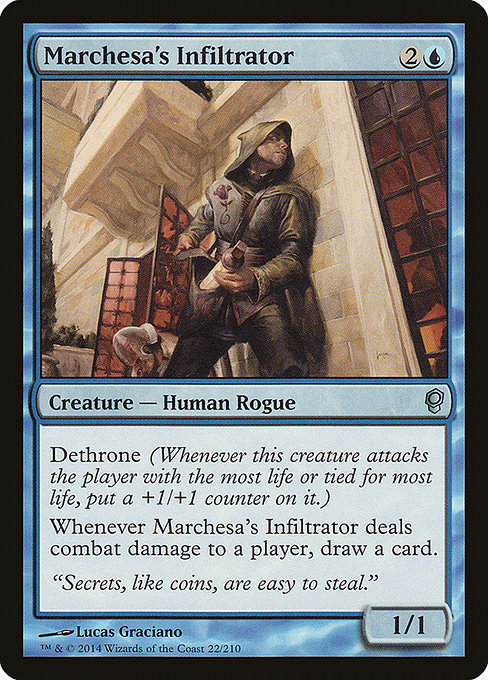
Marchesa's Infiltrator is a 1/1 Human Rogue that draws a card whenever it deals combat damage to a player. The dethrone counter arrives before blockers, which means a well-timed attack against the lead player makes the Infiltrator a 2/2 before your opponent decides how to stop it - turning what might have been a chump block into a real decision. It's a low-cost card that rewards good threat assessment, and in the right deck it can quietly generate a lot of card advantage.
History of Dethrone
Dethrone first appeared in Conspiracy (CNS, 2014), a multiplayer-focused draft set explicitly designed around politics, scheming, and multiplayer dynamics. The keyword is a natural fit for that environment - it incentivises attacking whoever's ahead, which is exactly the kind of behaviour that makes multiplayer games interesting.
For years, dethrone remained almost entirely confined to Conspiracy and its 2016 sequel, Conspiracy: Take the Crown (CN2). The mechanic then made a brief return as a one-off in the Streets of New Capenna (SNC, 2022) Commander precon decks, which kept the Marchesa political-intrigue flavour alive without putting dethrone back into the main set.
It hasn't appeared widely beyond those releases, which is a shame in my view - the mechanic has a clean design that plays well in Commander without being oppressive, and there's real design space left to explore. For now, if you want dethrone cards, the Conspiracy sets and the SNC Commander decks are where to look.