Fading: MTG Mechanic Explained
Some cards in Magic give you a bargain - but with an expiry date attached. Fading is one of the most direct expressions of that idea: you get a permanent that's often efficient for its cost, but a built-in countdown is already ticking the moment it enters the battlefield. When the clock runs out, it's gone.
What is Fading?
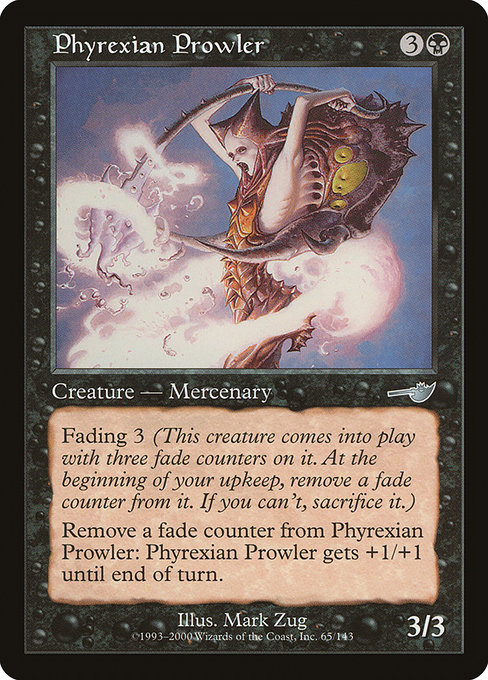
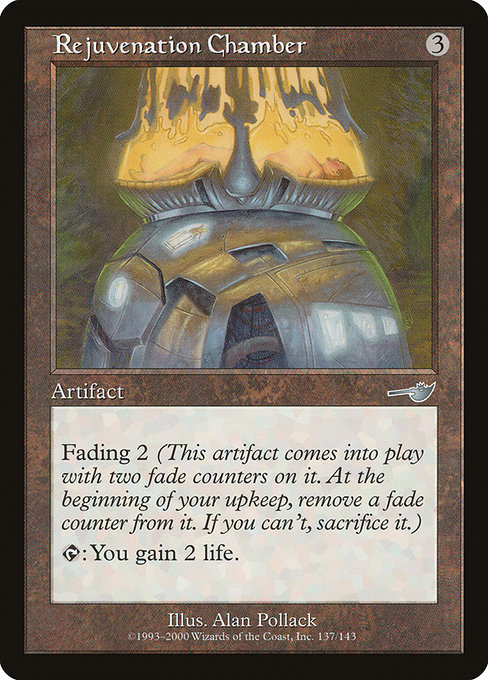
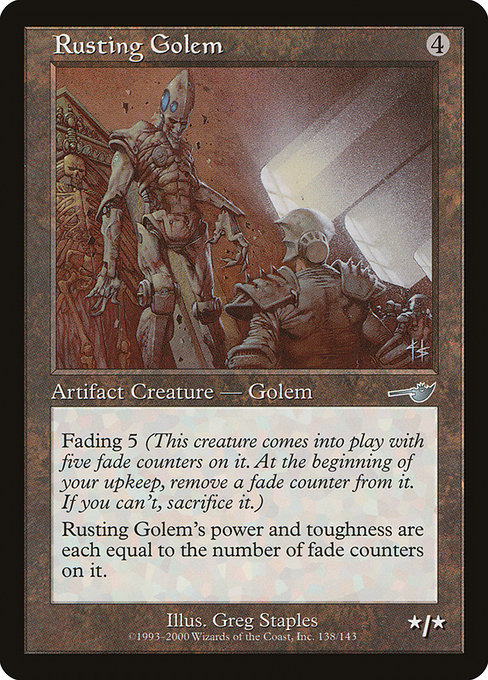
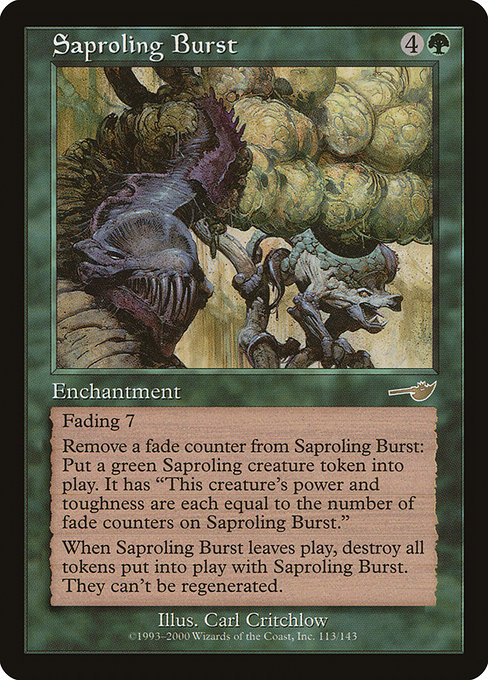
Fading is a keyword ability that limits how long a permanent stays on the battlefield by placing a fixed number of counters on it when it enters. Each of your upkeeps, you remove one of those counters. When you can't remove a counter - because there are none left - you sacrifice the permanent.
Think of it like a rental agreement. You get access to the card's power, but you're always counting down toward the moment you have to give it back.
All tournament-legal cards with Fading were printed in Nemesis (NMS), released in 2000. It's a mechanic frozen in time, attached to a single set.
How Fading works - the rules
The official rules are clean and tightly worded:
"Fading N means 'This permanent enters with N fade counters on it' and 'At the beginning of your upkeep, remove a fade counter from this permanent. If you can't, sacrifice the permanent.'"
- CR 702.32a
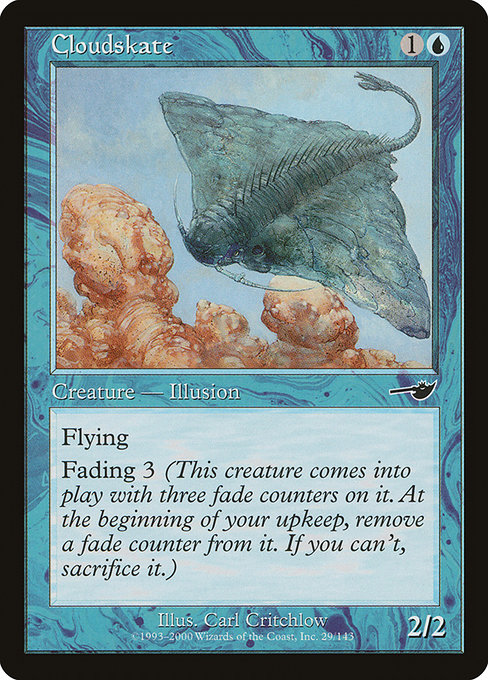
So "Fading 3" on Cloudskate, for example, means it enters with three fade counters. You remove one on your first upkeep (two remain), one on your second (one remains), and one on your third (zero remain). On your fourth upkeep, you can't remove a counter - so you sacrifice it.
That timing is the counterintuitive part. The permanent doesn't die when the last counter comes off. It survives that upkeep and dies on the following one. Many players expect the sacrifice to happen immediately when the last counter is removed, which is how the later mechanic Vanishing works. With Fading, there's always one extra turn of life after the counters run out.
Fade counters
Fading uses its own dedicated counter type: fade counters. These are mechanically distinct from time counters (used by Vanishing and Suspend). That distinction matters practically - effects that interact with time counters won't touch fade counters, and vice versa. The only card in the source material that directly interacts with fade counters outside of the Fading ability itself is Parallax Inhibitor, which can add fade counters to your permanents with Fading - effectively extending their lifespan.
Common misunderstandings
- "The permanent dies when the last counter is removed." No - it survives until your next upkeep after that, when you attempt to remove a counter and can't.
- "Fading and Vanishing are the same mechanic." Nearly, but not quite. Vanishing sacrifices the permanent immediately when the last time counter is removed. Fading does not. Vanishing also uses time counters rather than fade counters.
- "I can choose not to remove a fade counter to delay the sacrifice." You can't. Removing the counter at the beginning of your upkeep is a mandatory triggered ability. If a counter is present, you must remove it.
Strategy - playing with and against Fading
Fading exists because it lets designers print permanents that are stronger than they'd otherwise be allowed to be at a given mana cost - compensated by the fact that they self-destruct after a few turns. Understanding that trade-off is the core of playing around the mechanic.
Playing with Fading
Prioritise immediate impact. A creature or enchantment with Fading should do something useful from the moment it arrives, not three turns from now. If your Fading permanent needs setup time to become good, you'll often sacrifice it before it pays off.
Exploit the extra turn. Because the sacrifice happens on the upkeep after the last counter is removed - not when the last counter comes off - you have one more attack step than you might think. Don't forget to use it.
Lean into the abilities that spend counters. Several Nemesis cards let you remove a fade counter as an activated cost to do something useful. Parallax Wave and Parallax Tide both let you exile creatures or lands respectively by spending fade counters. Jolting Merfolk lets you tap a creature. Using these abilities accelerates your countdown, but that's often a fine trade when you're getting real value from each counter you spend.
Parallax Inhibitor is worth a mention if you're playing a fading-heavy build. Being able to add counters back to your permanents lets you reset the clock, or at minimum squeeze extra activations out of your Parallax enchantments.
Playing against Fading
Sometimes patience wins. If your opponent plays a Fading 2 creature, you may simply be able to wait it out rather than spending removal on it - depending on how much damage it can do in two or three turns.
But don't always wait. Cards like Parallax Wave are genuinely dangerous even on a short timer, because they can exile your creatures and then return them at an awkward moment when the enchantment finally leaves. Interact with high-value Fading permanents before they've spent all their counters doing useful work.
Deck-building note
Fading sees essentially no competitive play in current formats, and the mechanic hasn't appeared on new cards since Nemesis. If you're building a Nemesis-themed cube or a nostalgia Commander deck, Fading cards reward aggression and tempo plays - put them in decks that can close games quickly, so the countdown works for you rather than against you.
Notable cards with Fading
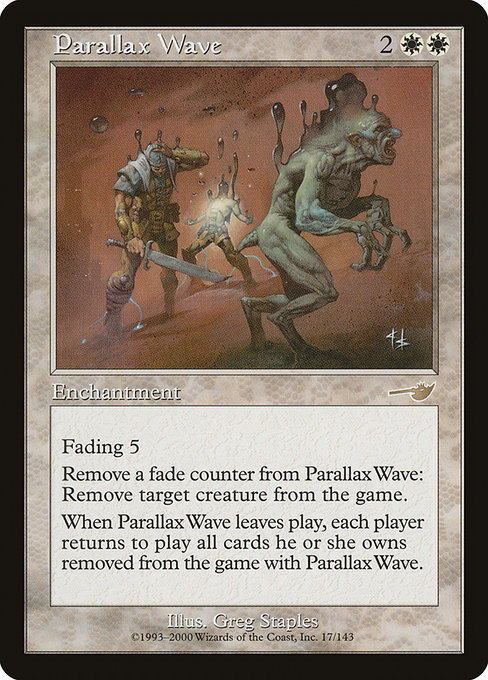
Parallax Wave
Parallax Wave ({2}{W}{W}) is the Fading card with the most competitive history. It enters with five fade counters, and you can spend them to exile creatures - your opponents' or your own. The return trigger fires when the enchantment leaves the battlefield.
This created a famous combo in the Nemesis era: exile your own creature with Parallax Wave, then use a second Parallax Wave (or another effect) to make the first one leave the battlefield, returning your creature immediately. It enabled blink-style loops that were difficult to disrupt. Parallax Wave was a genuine tournament staple in its Standard format.
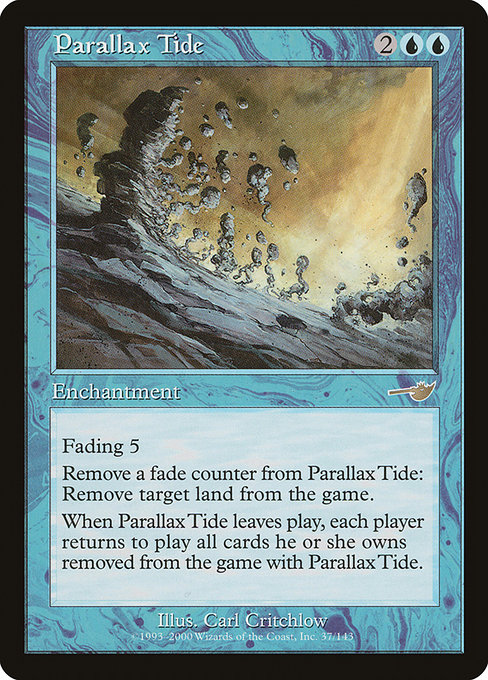
Parallax Tide
Parallax Tide ({2}{U}{U}) does the same trick with lands. Exile your opponent's lands with fade counters, then engineer the enchantment's premature exit to return them at a time of your choosing - or don't, and simply strand your opponent without mana for several turns. This card was part of real land-denial strategies in Nemesis-era Standard.
Blastoderm
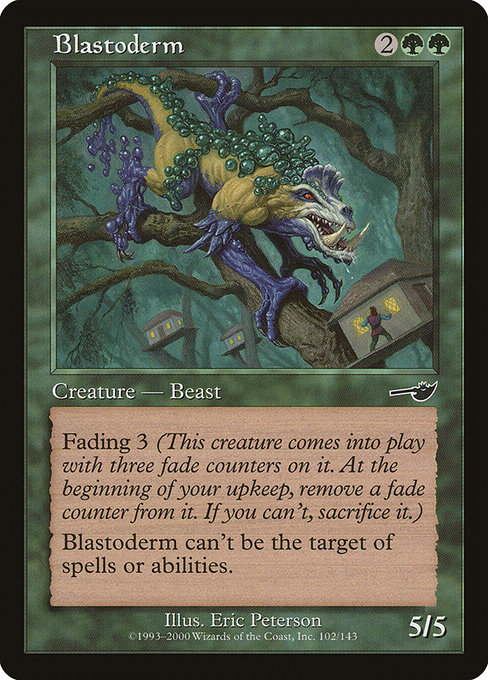
Not listed with the Fading keyword in modern card databases under that name, but worth a historical mention: Blastoderm (a 5/5 for {2}{G}{G} with Fading 3 and shroud) was one of the most played creatures in its Standard format. It was so efficient for its cost that three turns of beatdown was often enough to win or create an insurmountable advantage. Its power level is a perfect illustration of why Fading exists as a balancing mechanism.
Lore aside: Blastoderm was later color-shifted and reprinted as Calciderm in Time Spiral block - but Calciderm uses Vanishing rather than Fading, making it a neat in-print demonstration of how the two mechanics differ.
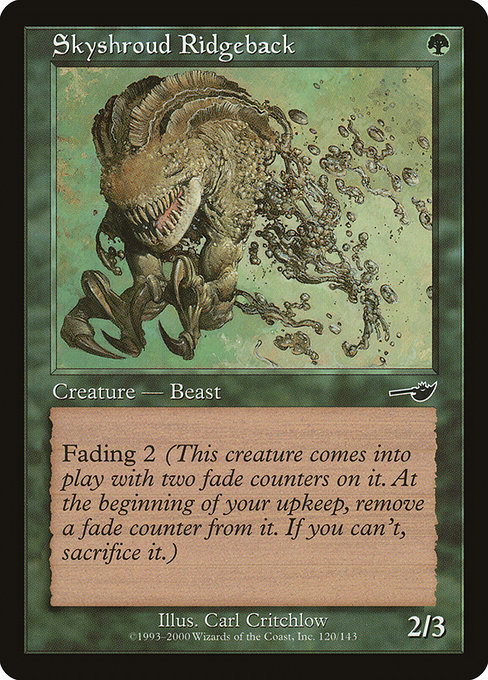
Skyshroud Ridgeback
Skyshroud Ridgeback is a {G} 2/2 with Fading 2 - aggressively costed for one mana, but you only get two turns out of it before sacrificing. It's a good illustration of the core Fading bargain: raw efficiency traded against a very short clock.
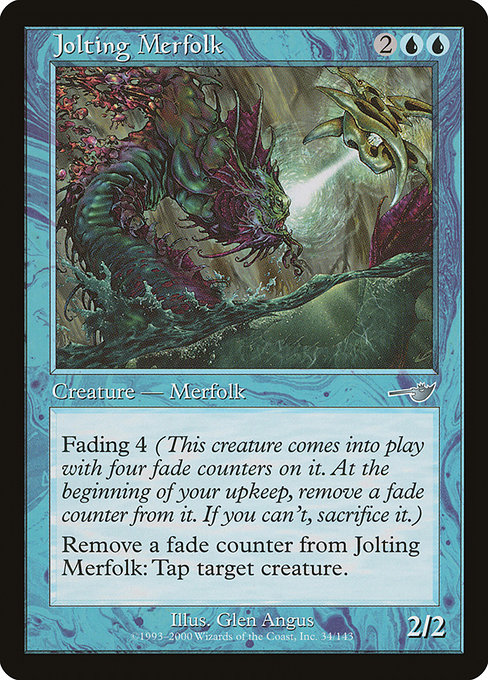
Jolting Merfolk
Jolting Merfolk ({2}{U}{U}) lets you tap a creature by spending a fade counter. This is a useful source of disruption while it lasts, though spending counters accelerates its demise. The interplay between "use the counter for value now" and "keep it to stay on the battlefield longer" is the interesting micro-decision that Fading creates.
History of Fading
Fading debuted in Nemesis in February 2000, part of the Masques block. The design goal was to print efficient, undercosted permanents that balanced themselves by having a built-in expiry. In practice, the mechanic achieved that - cards like Blastoderm were powerful precisely because of it.
However, players found the timing rule genuinely confusing. The extra turn of life after the last counter is removed doesn't match the intuitive expectation that "zero counters means it's gone now." That confusion stuck.
When Wizards revisited the same concept in the Time Spiral block (2006), they introduced Vanishing as a cleaner implementation. Vanishing triggers the sacrifice immediately when the last time counter is removed - matching player expectations - and uses the more broadly applicable time counter rather than the ability-specific fade counter. Vanishing also fit neatly alongside Suspend, which already used time counters.
The mechanic has not appeared on new tournament-legal cards since Nemesis, and Wizards have indicated it is unlikely to return in that form. Fading is, in a sense, a design fossil - a good idea that was refined into something better, and left behind in one set.