Fortify: The MTG Mechanic Explained
Most artifacts in Magic want to be near creatures. Fortify asks a different question: what if your lands could suit up instead?
Fortify is a keyword ability found on a special artifact subtype called Fortifications. It works almost identically to equip - the most familiar attachment mechanic in the game - except that instead of attaching to a creature, you're attaching to a land you control. It's a small mechanical twist with surprisingly deep design implications, and one that Magic's own designers have described as tricky to get right.
What is Fortify?
Fortify is an activated ability found exclusively on Fortification artifacts. When you pay the Fortify cost, you attach that Fortification to a land you control, just as you'd attach an Equipment to a creature. The land then gains whatever bonus the Fortification provides.
Like equip, you can only activate Fortify as a sorcery - meaning during your main phase, when the stack is empty. And like an Equipment, a Fortification enters the battlefield unattached, and it stays on the battlefield even if the land it's attached to leaves play.
If a Fortification has multiple Fortify abilities, you can use any of them.
Rules
The official Comprehensive Rules (November 14, 2025 - Edge of Eternities) spell this out cleanly:
"Fortify [cost]" means "[Cost]: Attach this Fortification to target land you control. Activate only as a sorcery."
- CR 702.67a
A few key points worth nailing down:
- You can only target lands you control. Unlike some effects, you can't Fortify an opponent's land.
- Activate only as a sorcery means main phase, stack empty, your turn. No surprise Fortifications at instant speed.
- The Fortification stays if the land leaves. This is the same rule as Equipment - it becomes unattached and sits on the battlefield, waiting to be reattached to a new land.
- Multiple Fortify abilities on one card can each be activated independently. If your Fortification has two different Fortify costs, you can choose which one to use.
Rules note: Fortifications follow the same attachment rules as Equipment (see CR 301 for the full breakdown), with land substituted for creature throughout. If you're already comfortable with how equip works, Fortify will feel immediately familiar.
Notable cards with Fortify
The Fortify mechanic has appeared on exactly two cards in Magic's history - a reflection of how rarely R&D has returned to this design space.
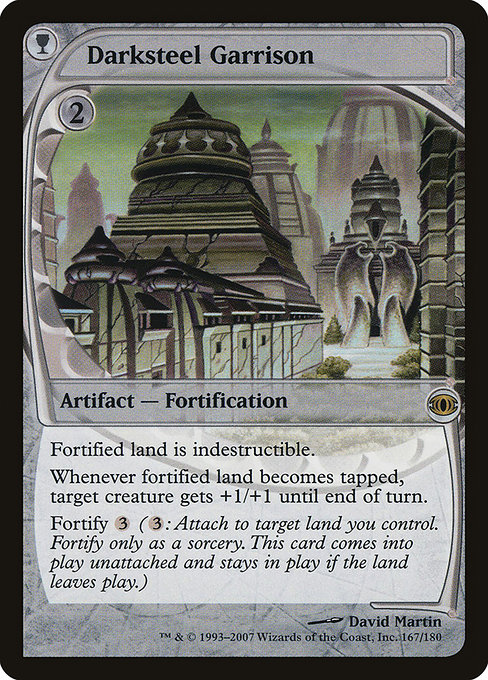
Darksteel Garrison
The original. Printed in Future Sight (2007) as a "future-shifted" card - meaning it was deliberately designed to look like a card from a hypothetical future set - Darksteel Garrison costs {2} to cast and {3} to Fortify.
What it does to your land is genuinely interesting: the fortified land gains indestructible, and whenever it becomes tapped, target creature gets +1/+1 until end of turn. That's a land that can't be destroyed, plus a slow trickle of combat buffs every time you use it for mana or activate it. In a format with land destruction, making even one land indestructible has real value. The creature pump is a nice bonus that rewards you for playing normally.
Darksteel Garrison is the card that defined what a Fortification could be.
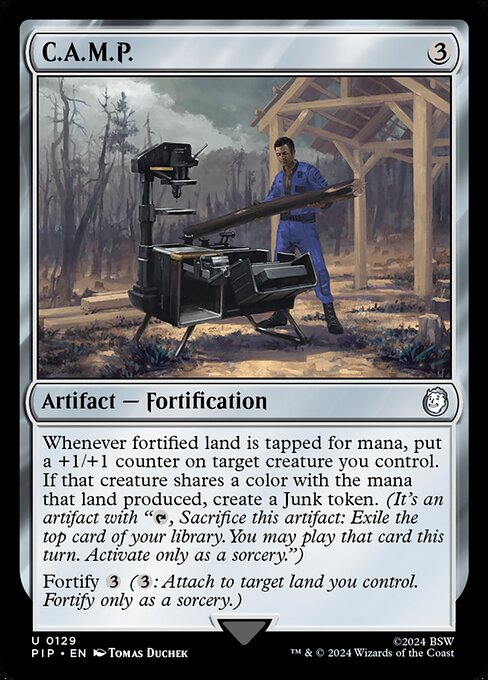
C.A.M.P.
Seventeen years after Darksteel Garrison, C.A.M.P. arrived in the Universes Beyond: Fallout Commander deck. Also {3} to cast and {3} to Fortify, C.A.M.P. rewards you whenever the fortified land is tapped for mana: you put a +1/+1 counter on target creature you control. If that creature shares a color with the mana the land produced, you also create a Junk token - an artifact that lets you exile and potentially play the top card of your library.
C.A.M.P. is more powerful than Darksteel Garrison in a creature-heavy Commander game. Every land tap becomes a counter and potentially a card. In a five-color deck or a deck that runs many creature colors, the Junk token trigger fires constantly. It's a great example of how the mechanic can generate real value without needing the land itself to be anything special.
Strategy
Fortify rewards thinking about your lands as active game pieces rather than passive mana sources. Here's what that looks like in practice.
Playing with Fortifications
Choose the right land. Not all lands are equal targets. A basic land you tap every turn is a better host than a utility land you rarely activate. With Darksteel Garrison, an indestructible basic is a reliable mana source that laughs at land destruction - a meaningful shield in formats where that matters.
With C.A.M.P., match colors deliberately. The Junk token only triggers when the creature shares a color with the mana produced. Attaching C.A.M.P. to a Forest and keeping green creatures in play ensures the bonus fires consistently. In Commander, attaching it to a Breeding Pool or other dual land gives you flexibility depending on which creatures you control.
Plan for the land leaving. Bounce effects, sacrifice effects, and land destruction can all pull your Fortification loose. Unlike Equipment on a creature, losing the land doesn't hurt you twice - you don't also lose the creature. But you do need mana and a main phase to reattach, so keep that cost in mind.
Playing against Fortifications
Target the land, not the Fortification. Destroying or bouncing the fortified land doesn't destroy the Fortification - it just detaches it. But if you can keep the land tapped or prevent the opponent from having a free main phase, they can't reattach easily.
Don't overvalue the threat. With only two Fortification cards ever printed, you're unlikely to face this mechanic outside of Commander games specifically built around it or Legacy/Vintage curios. It's niche enough that you won't need dedicated hate for it.
History
Fortify debuted in Future Sight (2007), one of Magic's most experimental sets - a block-capper designed to preview mechanics that might appear in future sets. Darksteel Garrison was printed as a future-shifted card, rendered in a visual style meant to signal "this belongs to a hypothetical future."
The mechanic never caught on quickly. Mark Rosewater has cited it as genuinely difficult to design for: a Fortification needs to do something meaningfully different from an Aura on a land, but R&D's longstanding caution around land destruction effects limits how powerful - or how land-destruction-adjacent - Fortifications can be. Making a land indestructible or giving it powerful triggered abilities risks enabling strategies that feel unfun, while doing too little makes the whole subtype irrelevant.
That tension kept Fortifications off the printed card list for nearly two decades. The arrival of C.A.M.P. in 2024 suggests R&D found a design that threaded the needle - powerful enough to matter, attached to a mechanic (mana production) that feels organic rather than exploitative.
Whether Fortify gets a third card before another seventeen years pass is, honestly, anyone's guess. 😄
Format check: Both Darksteel Garrison and C.A.M.P. are legal in Commander, Legacy, and Vintage. C.A.M.P. is additionally legal in formats that support Universes Beyond: Fallout cards. Neither is legal in Standard or Pioneer.