Harmonize: MTG Mechanic Guide
Some mechanics ask you to fill your graveyard. Harmonize asks you to do something with it.
Harmonize is a keyword ability that lets you cast certain spells from your graveyard, with a unique twist: you can tap your own creatures to help pay the cost. It rewards you for building a wide board, punishes opponents who let you keep creatures around, and turns your graveyard into a second hand. This guide breaks down exactly how it works, when to use it, and which cards make the most of it.
What is Harmonize?
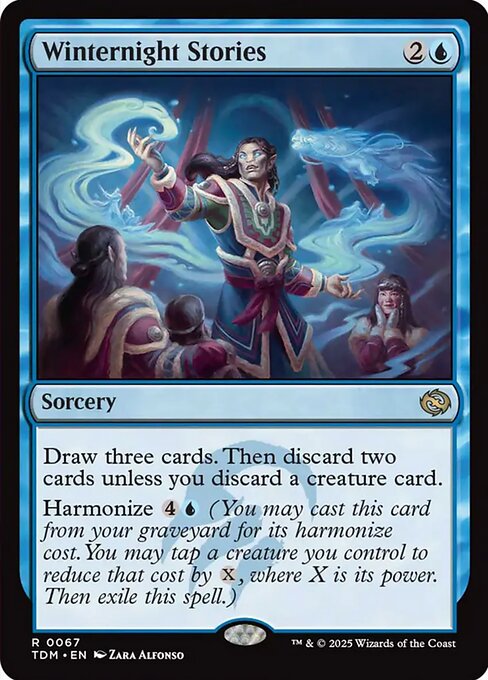
Harmonize is a keyword ability that appears on instants and sorceries (and can be granted to them temporarily). A card with Harmonize has a second cost printed on it - the harmonize cost - and a set of rules attached:
You may cast this card from your graveyard for its harmonize cost. You may tap a creature you control to reduce that cost by an amount of generic mana equal to its power. Then exile this spell.
So there are two distinct things happening when you Harmonize:
- You cast the spell from your graveyard, paying the harmonize cost instead of the regular mana cost.
- You can tap a creature you control to shave generic mana off that cost - up to an amount equal to that creature's power.
Once the spell resolves, it gets exiled rather than going back to the graveyard. You only get the one ride.
The key insight: Harmonize isn't just a graveyard mechanic. It's a board-state mechanic. A powerful creature you control doesn't just attack and block - it acts as a mana discount engine for your graveyard spells.
How the rules work
Paying the harmonize cost
When you want to cast a card using its harmonize ability, you follow the normal process for casting a spell, except:
- The card is cast from your graveyard, not your hand.
- You pay the harmonize cost, not the card's regular mana cost.
- Before finalising payment, you may tap one creature you control to reduce the generic mana component of the harmonize cost by that creature's power.
Rules note: Only one creature can be tapped for the discount - the wording says "tap a creature" (singular), not "tap any number of creatures." Don't expect to divide the work across your whole board.
The creature-tap discount
The reduction only applies to generic mana in the harmonize cost. If a harmonize cost is '{4}{G}' and you tap a creature with power 3, you pay '{1}{G}'. The coloured mana requirements are unaffected.
This matters a lot in practice. A high-power creature can make expensive harmonize costs very affordable, but you still need to have the right colours in your mana base.
Exile on resolution
After the spell resolves (or is countered - rules note: a countered harmonize spell still gets exiled, because the exile instruction is part of the casting process, not the resolution), the card goes to exile rather than the graveyard. You can't loop the same card through harmonize repeatedly.
Harmonize granted by other cards
Not every card with harmonize has it printed directly. Songcrafter Mage ({G}{U}{R}) can grant any instant or sorcery in your graveyard the harmonize keyword until end of turn, with the harmonize cost set equal to the card's regular mana cost. This opens up interesting lines - any instant or sorcery suddenly becomes a one-time graveyard cast, though you're paying full price.
Strategy
Building the right board state
Harmonize rewards players who go wide and tall. A single large creature gives you a big discount; multiple creatures still only give you one tap's worth of reduction, but a wide board means you're more likely to have an untapped creature available when you need to Harmonize.
Think of tapping a creature for harmonize as a second use out of a creature that's been otherwise neutralised - something that's summoning-sick, locked down by a tap effect, or simply outclassed in combat. Harmonize quietly turns those creatures into mana rocks.
Threat density and mana efficiency
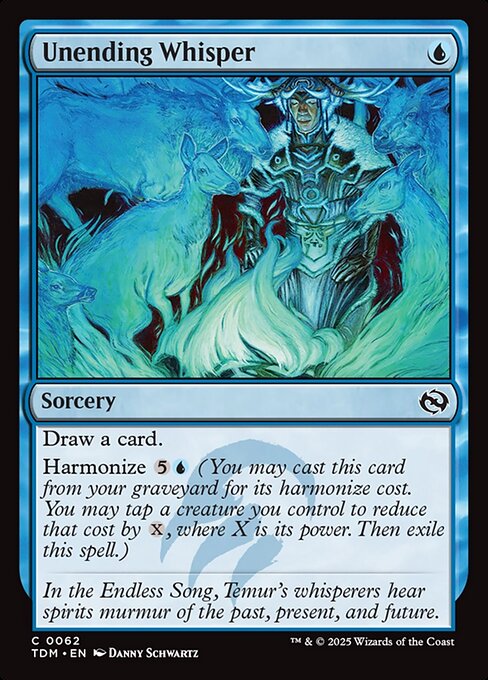
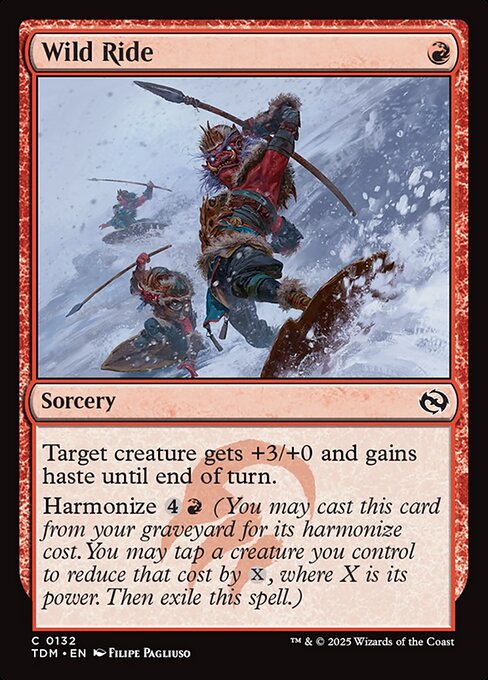
Harmonize spells tend to have harmonize costs that are more expensive than their regular mana costs. Wild Ride costs '{R}' but harmonizes for '{4}{R}'. Unending Whisper costs '{U}' but harmonizes for '{5}{U}'. You're not getting a free spell - you're getting a second copy of an effect, at a premium, paid partly in board presence.
The calculation changes quickly when you have a high-power creature available. A power-5 creature tapping toward Roamer's Routine's '{4}{G}' harmonize cost means you're paying just '{G}' - a land-fetcher for a single green mana is genuinely powerful.
Which cards reward Harmonize most?
The spells with the best harmonize value tend to be the ones where the effect is strong enough to warrant a second casting, and whose harmonize costs are most reducible by a large creature. Nature's Rhythm and Zenith Festival both use X in their harmonize costs, meaning a big creature tapping toward them can stretch the effect significantly.
Synchronized Charge is interesting because the vigilance and trample grant means attacking creatures stay untapped - which could then be tapped for a harmonize discount on the same turn, depending on the order of operations.
Playing against Harmonize
The cleanest answers are the ones that address both axes:
- Graveyard hate (exile effects, Tormod's Crypt-style effects) strips away the harmonize spell before it can be cast.
- Removing creatures reduces the discount, making harmonize costs prohibitively expensive.
- Countering the harmonize cast still exiles the spell, so you trade a counterspell for a permanent exile - a decent outcome.
Leaving a player with both a graveyard full of harmonize spells and a large creature on board is asking for a very efficient turn.
Notable cards
Nature's Rhythm ({X}{G}{G})
A tutor that searches for a creature with mana value X or less and puts it directly onto the battlefield. Already strong. The harmonize cost is '{X}{G}{G}{G}{G}', but with a high-power creature tapping in, you can fetch a meaningful creature mid-to-late game for a surprisingly low outlay. The double-green requirement means this card wants to live in a dedicated green deck.
Wild Ride ({R})
One mana for +3/+0 and haste is a solid combat trick for aggro. The harmonize cost of '{4}{R}' looks steep, but a power-4 creature drops that to '{R}' again - essentially a free second cast. In a deck built around wide, powerful creatures, this can close out games from unexpected positions.
Zenith Festival ({X}{R}{R})
Exile the top X cards, play them until the end of your next turn. It's Commune with Lava-style card advantage, and the harmonize cost mirrors the regular cost: '{X}{R}{R}'. Tapping a high-power creature toward the generic X portion means you can dig deeper for less. This one scales naturally with how much mana and power you have available.
Unending Whisper ({U})
Draw a card for '{U}' - simple, clean, and a lot like Opt without the scry. The harmonize cost of '{5}{U}' is the steepest in relative terms, but that's the price for giving a blue draw spell graveyard reach. In a deck with very large creatures, this is a second draw spell that lives in the graveyard.
Roamer's Routine ({2}{G})
Fetch a basic land, put it onto the battlefield tapped. Standard ramp. The harmonize cost of '{4}{G}' becomes very accessible with even a modest creature. In longer games, casting this from the graveyard to hit your fifth or sixth land drop is exactly the kind of quiet value that wins games.
Songcrafter Mage ({G}{U}{R})
The wildcard of the Harmonize cards. On entering the battlefield, it grants harmonize to any instant or sorcery in your graveyard until end of turn, at a cost equal to that card's regular mana cost. This is a creative deckbuilding hook - it means any spell you've already cast this game is a potential one-more-time play. The flash on the Mage itself means you can set this up at the end of an opponent's turn.
History
Harmonize as a keyword ability was introduced as part of the official rules under CR 702 Keyword Abilities. The mechanic builds on Magic's long history of graveyard recursion, but distinguishes itself by tying the cost reduction to your creatures' power - a design that creates a feedback loop between board development and spell access.
The name "Harmonize" evokes both musical harmony and natural balance, themes consistent with the green-heavy card pool in which the mechanic most frequently appears. The mechanic appears across green and red, with the occasional blue spell (Unending Whisper) rounding out the suite.
Harmonize also exists as a standalone card name - a '{2}{G}{G}' Sorcery that simply draws three cards, with no connection to the keyword mechanic beyond sharing the word. Don't let the name crossover confuse you when searching.
Lore aside: The flavour of harmonize - creatures lending their strength to amplify a spell cast from memory or spiritual echo - fits neatly into Magic's green-red colour philosophy around natural power, instinct, and the idea that nothing is truly wasted.