Provoke: MTG Keyword Mechanic Guide
There's a particular kind of satisfaction in pointing at an opponent's biggest blocker and saying, "you - you're blocking this." That's provoke in a nutshell: a keyword ability that lets you pick which of the defending player's creatures has to step up and fight yours.
It's a small mechanic with an elegant design. Let's dig into exactly how it works, when to use it, and where it came from.
What is Provoke?
Provoke is a keyword ability on attacking creatures. When a creature with provoke attacks, you may choose a creature the defending player controls, force it to block the provoke creature this combat, and - crucially - untap it first if it's already tapped.
That last part is easy to overlook, but it's what gives provoke its real bite. An opponent can't hide behind the fact that they've already committed their creatures to other tasks. If you target a tapped creature, it untaps and blocks.
Format check: Provoke is not an evergreen keyword, meaning it doesn't appear in every set. It's also not deciduous (not regularly revisited). Outside of a specific Limited format context, you're unlikely to encounter it in current Standard.
How Provoke works - the rules
Provoke is a triggered ability, not an activated one. It doesn't cost anything to use; it just triggers when the creature attacks.
Here's the official rules text, straight from the Comprehensive Rules (November 14, 2025 - Edge of Eternities):
CR 702.39a: "Provoke" means "Whenever this creature attacks, you may choose to have target creature defending player controls block this creature this combat if able. If you do, untap that creature."
A few things follow from that wording that are worth spelling out clearly.
The block still has to be legal
Provoke forces a creature to block if able - but "able" is doing real work there. A creature without flying cannot block a creature with flying, even if provoked. A creature with a blocking restriction (like "can only block creatures with power 2 or less") cannot be forced to violate that restriction. Provoke compels a creature to block; it doesn't override the rules of what constitutes a legal block.
The trigger is optional
The wording says "you may choose to have" - so you can attack with a creature that has provoke and simply choose not to use the ability. If the target creature is something you'd rather not fight, you're not obligated to point at anything.
Multiple instances stack separately
If a creature somehow has provoke twice (from CR 702.39b), each instance triggers separately. In practice this is a rare edge case, but good to know.
Timing
The provoke trigger goes on the stack during the declare attackers step, before blockers are declared. This means the forced block is resolved and in place before your opponent makes any other blocking decisions.
Strategy
On the surface, provoke is a combat trick. Look deeper, and it's really about forcing favourable trades or clearing the path for your other creatures.
Picking off key blockers
The most straightforward use: target the creature that would otherwise stop your best attacker. If your opponent has a 4/4 that would wall off everything you have, provoke it into blocking a creature you're comfortable losing, or one with deathtouch.
Deathtouch and provoke are a natural pairing.** A small creature with deathtouch and provoke can effectively threaten to trade with anything your opponent controls, regardless of size. Your opponent either lets the deathtouch creature in (and takes damage) or sacrifices their best creature to kill a small one.
Untapping as a bonus - or a trap
Provoke untapping a tapped creature is usually a benefit, but it's worth thinking through the whole board. If your opponent has an activated ability that requires tapping, you might accidentally give them an opportunity to use it again before combat damage. This comes up rarely, but it's the kind of thing that matters in close games.
Provoking into a bad block for your opponent
Sometimes the goal isn't to kill the targeted creature - it's to prevent it from blocking something else. By forcing a specific creature to block the provoke creature, you can free up a lane for your stronger attacker to deal damage unchallenged.
Playing against provoke
The main defense against provoke is having creatures with built-in protection - indestructible blockers laugh at it, and creatures with abilities that trigger on blocking can turn the forced block into an unexpected advantage. Otherwise, the honest answer is that provoke is tricky to play around once it's targeting your creature. Keep your life total high enough that you can afford to eat a hit when your best blocker gets snagged.
Notable cards with Provoke
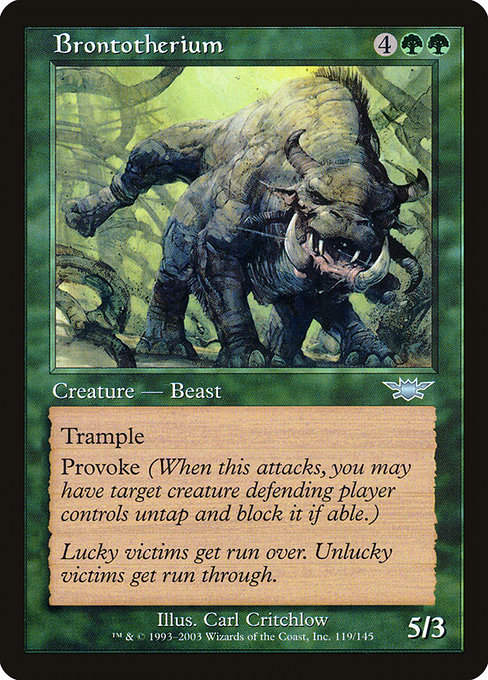
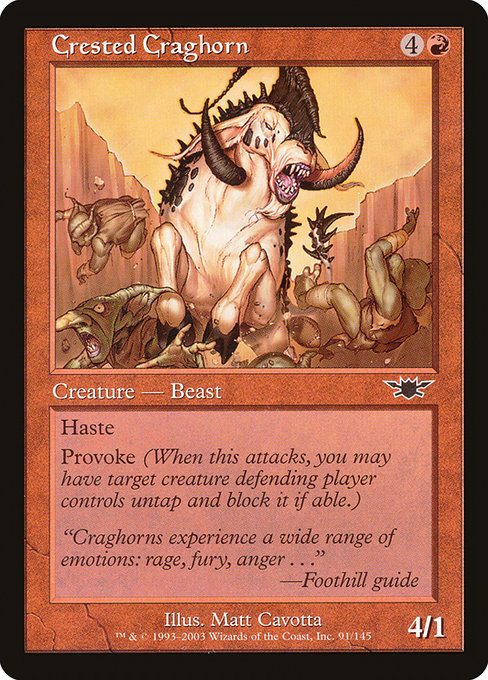
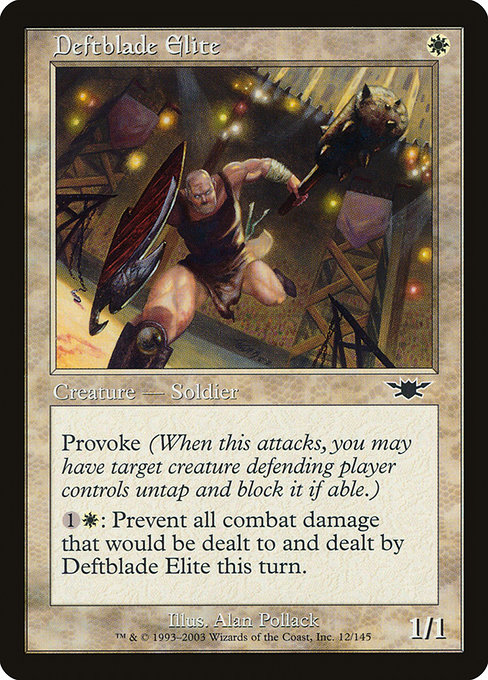
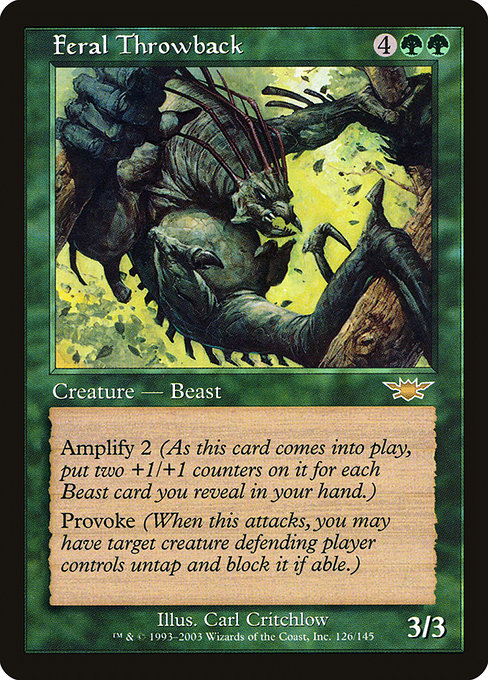
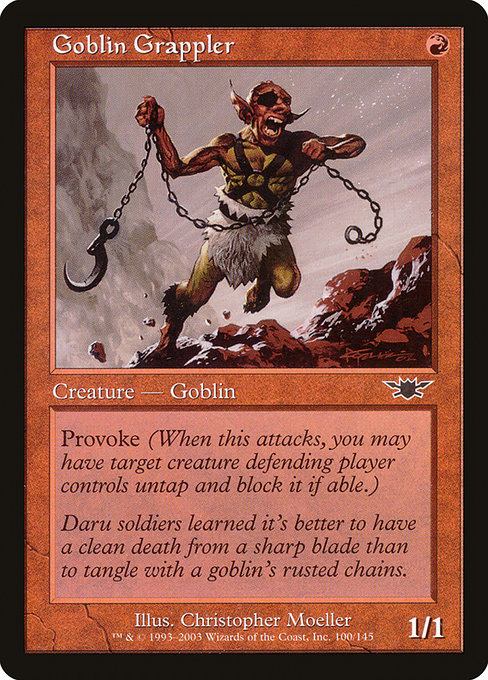
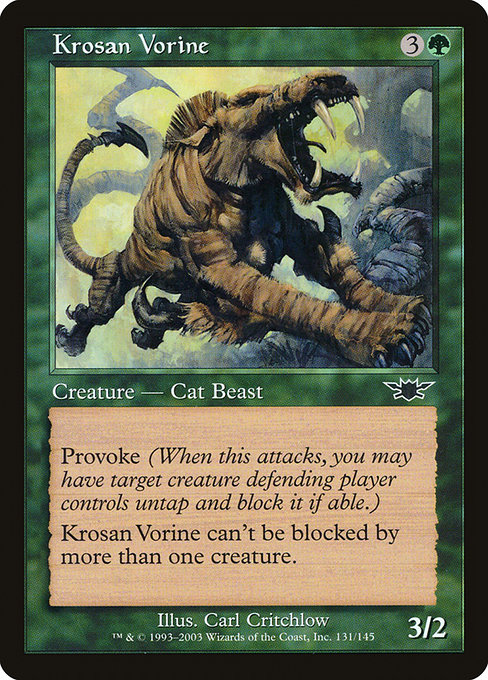
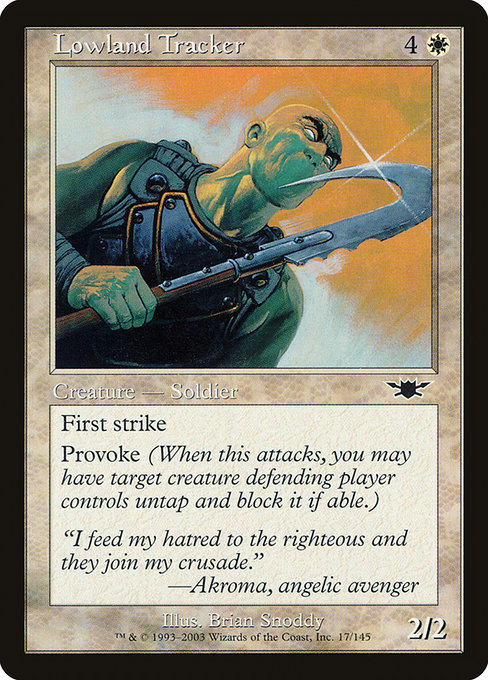
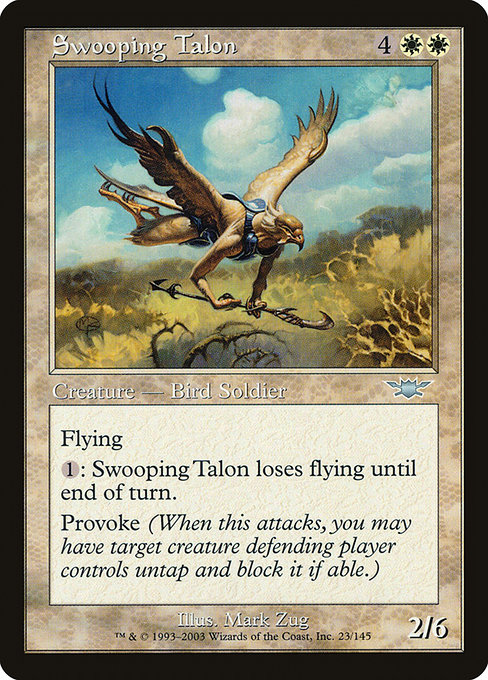
The keyword appeared primarily in Legions (2003), a set notable for being the first Magic expansion to contain only creature cards. All the provoke creatures in Legions share a consistent piece of art direction - each one features a hook element, visually reinforcing the flavour of "reaching out and picking a fight."
Krosan Vorine is the example creature cited in the rules themselves: a 3/2 Cat Beast that can't be blocked by more than one creature. The provoke ability lets it drag a specific creature into a one-on-one fight, and the can't-be-blocked-by-more-than-one clause makes sure that fight stays clean. It's a tidy package that shows off what provoke is designed to do.
Outside Legions, the only other card printed with the provoke keyword is Greater Morphling, which appeared on an Un-set sticker sheet in Unfinity. Provoke was one of the non-evergreen, non-deciduous keywords included in the Unfinity sticker sheets - a fun nod to a niche but beloved mechanic.
There's also a card simply called Provoke from Stronghold (1998), an Instant that reads: untap target creature you don't control, that creature blocks this turn if able, and draw a card. It predates the keyword by several years and captures the same idea in spell form.
History
Before provoke was a keyword, the concept appeared on two older cards: Provoke from Stronghold (1998) and Crashing Boars from Exodus (1998). Both had non-keyword wordings that produced the same basic effect - target a creature, force it to block.
The ability was formally keyworded when Legions released in February 2003. It was a focused mechanical theme for that set, and every provoke creature in Legions was designed with it as a central part of its identity.
After Legions, the keyword essentially disappeared from regular sets. The introduction of the fight mechanic - which also creates forced creature-versus-creature combat, but outside the combat phase - filled a similar design space and arguably made provoke's return harder to justify. Fight is cleaner to template, works on both offense and defense, and doesn't require the attacking constraint.
Provoke did make one more appearance, in spirit if not exact form, when Unfinity included it on a sticker sheet as a nod to the game's more obscure mechanical history. It's the kind of thing that lands well for players who remember cracking Legions packs - a small, knowing callback to a mechanic that did something genuinely interesting for one brief moment in 2003.