Prowess: MTG Mechanic Explained
There's a particular joy in watching a small monk become a terrifying threat the moment you point a spell at anything. That's prowess in a nutshell: a keyword that rewards you for doing what blue-red spell decks want to do anyway, and then hits you with the consequences.
What is Prowess?
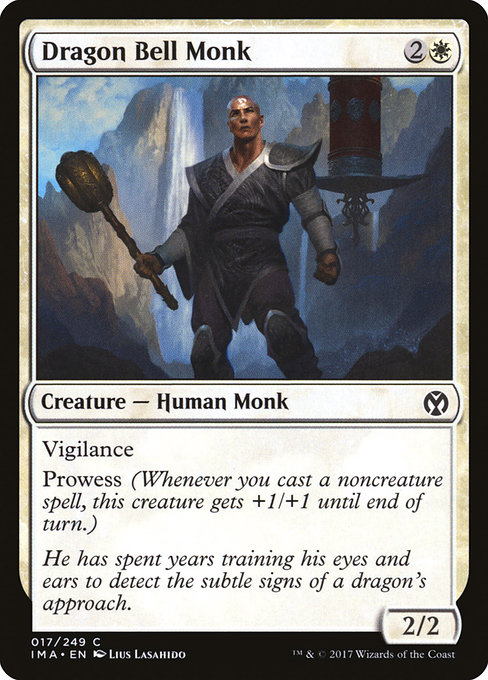
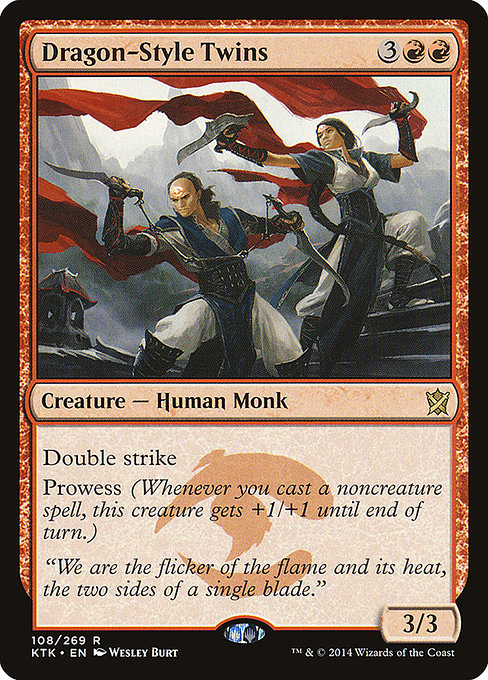
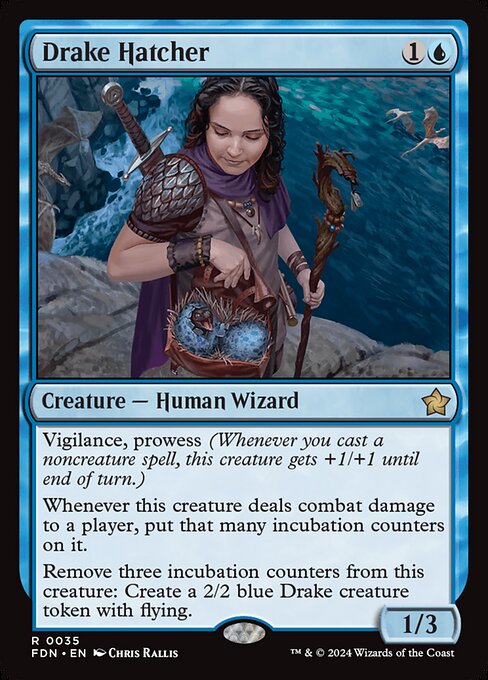
Prowess is a keyword ability that gives a creature +1/+1 until end of turn whenever its controller casts a noncreature spell. That's it - simple on the surface, but surprisingly deep in practice.
If you're slinging instants, sorceries, enchantments, artifacts, or planeswalkers, every one of those spells pumps your prowess creatures. Cast three spells in a turn? Your 1/2 just attacked as a 4/5, and your opponent had to figure that out in real time while the stack was resolving.
Rules note: Prowess triggers on cast, not on resolution. Your creature gets the bonus when the spell goes on the stack, not when it lands. This matters for spell timing and can occasionally catch both players off guard.
Rules
Prowess is a triggered ability. The official rules text (Comprehensive Rules, November 14, 2025 - Edge of Eternities) reads:
"Prowess is a triggered ability. 'Prowess' means 'Whenever you cast a noncreature spell, this creature gets +1/+1 until end of turn.'" - CR 702.108a
"If a creature has multiple instances of prowess, each triggers separately." - CR 702.108b
A few things worth clarifying:
- Only noncreature spells count. Creature spells, including creature tokens created by other effects, don't trigger prowess.
- Multiple instances stack. If a creature somehow has prowess twice, casting a single noncreature spell triggers both - it gets +2/+2 that turn.
- The boost is temporary. The +1/+1 lasts until end of turn. Your monk wakes up the next day at its printed stats.
- Modal spells work. If you cast a spell that lets you choose modes, it still only triggers prowess once - but it's still one noncreature spell.
Common misunderstandings
The biggest misread new players make is assuming prowess triggers when any spell is cast. It doesn't - an opponent casting a spell across the table does nothing for your prowess creatures. Only spells you cast trigger it.
Another common slip: prowess does not trigger on activated or triggered abilities, no matter how spell-like they feel. Cycling a card, using an equipment's equip ability, or cracking a Treasure token - none of these are casting a spell, so prowess stays quiet.
Strategy
Playing with prowess
Prowess creatures want to be in spell-dense decks - ideally ones running cheap instants and sorceries. The classic configuration is a blue-red (Izzet) or Jeskai shell loaded with cantrips (draw-one spells like Opt or Consider), burn spells, and counterspells. Every cantrip does double duty: it replaces itself and pumps your board.
The key insight is timing. Because prowess triggers on cast, you can leave mana up for instants during combat, then tap in with your creatures and pump them mid-combat by casting spells in response to blocks. A 2/2 that attacked into a 3/3 can suddenly win that fight if you cast a single cheap instant.
This creates a decision tree for your opponent that is genuinely uncomfortable. Do they block and risk a pump? Do they let the creature through and eat the damage? Prowess turns your spell mana into combat math.
Building around prowess
A few principles that hold up across formats:
- Prioritise cheap noncreature spells. A prowess deck that curves out at four mana for spells is missing the point. You want to cast two or three spells in a turn to stack triggers.
- Cantrips are your best friends. Spells that draw cards refuel your hand and trigger prowess. Running out of gas is this archetype's biggest weakness.
- Keep your creature count lean. More creatures means fewer noncreature spells, which means fewer triggers. Most prowess decks run a relatively small creature suite and let the pump do the heavy lifting.
- Instant-speed spells multiply your options. Sorceries are fine, but instants let you trigger prowess during combat or in response to removal, which dramatically increases your lines of play.
Playing against prowess
The best answers tend to be removal before attacks are declared, or anything that can hit multiple small creatures at once. Trying to block a prowess creature is risky - you'll often lose that math puzzle if your opponent has mana up. When you can, kill the creature before it gets to swing, or use removal that dodges the +1/+1 bonus (damage-based removal into a pumped creature can whiff if you don't account for the stack).
Notable Cards
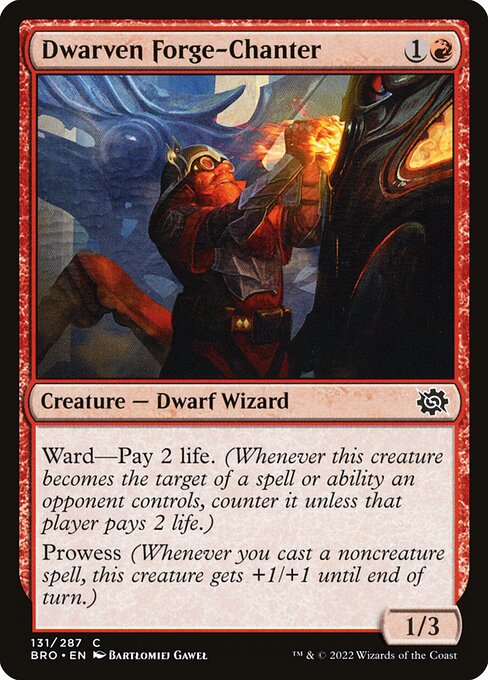
Harmonic Prodigy ({1}{R}) is a standout - a 1/3 with prowess that also doubles triggered abilities of Shamans and other Wizards you control. In the right shell, this card's second ability does wild things, but even on its own it's an efficient prowess threat that rewards a spell-heavy approach.
Jeskai Elder is the classic teaching example: a 1/2 for {1}{U} with prowess plus a loot trigger on combat damage. It embodies the Jeskai philosophy - small, disciplined, but dangerous when spells are flowing.
Three cards that grant prowess to other creatures are also worth knowing:
- Narset, Enlightened Exile - spreads prowess across your other creatures, which can get out of hand fast.
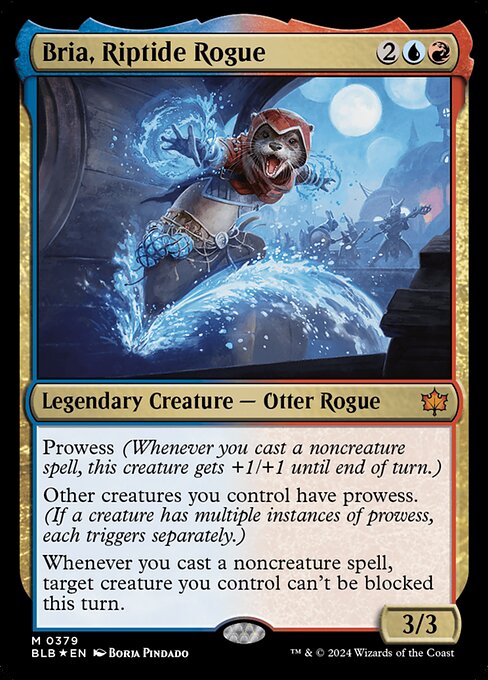
- Bria, Riptide Rogue - gives prowess to other creatures you control.
- Triton Wavebreaker - another prowess-granting option in blue.
Lore aside: Some cards in the database have "prowess" in their name - Hunter's Prowess, Lightning Prowess, Prowess of the Fair - but these are flavour uses of the English word, not the keyword ability. Don't confuse the two.
History
Prowess was designed by Jonathon Loucks during the second Great Designer Search - one of those rare cases where a mechanic designed in a public competition made it all the way into print. It debuted in Khans of Tarkir (2014) as the signature mechanic of the Jeskai Way, the blue-red-white clan obsessed with skill, discipline, and martial perfection. Thematically, it's a perfect fit: the idea that training your mind (casting spells, thinking) sharpens the body.
The mechanic returned in Fate Reforged (2015), and then Wizards R&D made a significant call: prowess became evergreen in Magic Origins (2015). The reasoning was that blue needed a combat-relevant keyword that wasn't purely about evasion - flying and unblockable effects are fine, but they don't interact with combat the same way prowess does.
Evergreen status didn't last, though. Mark Rosewater has been open about the design problems prowess caused at the set level:
- It overlapped awkwardly with historic triggers in Dominaria (2018), since both care about noncreature permanent types.
- It felt weak in creature-dense sets, where the spell density drops and prowess barely fires.
- Its coverage of artifacts and enchantments was a bad fit for guilds like the Izzet League in Guilds of Ravnica (2018), which wanted a mechanic that rewarded specifically instants and sorceries.
These friction points meant prowess kept getting pulled from sets that seemed like obvious homes for it. After Hour of Devastation (2017), prowess was removed from the evergreen list.
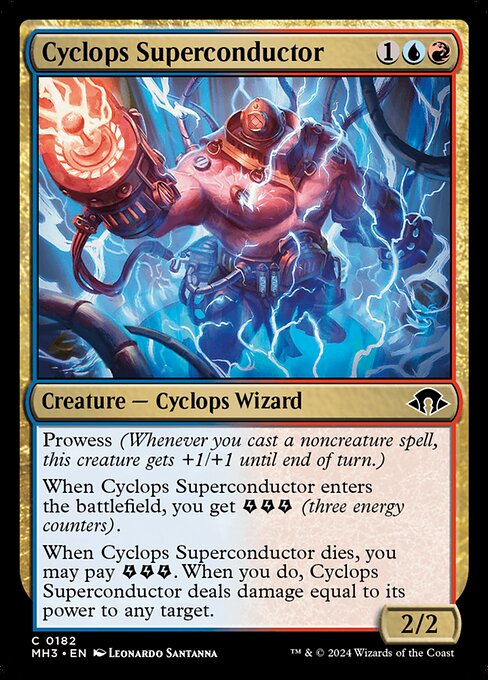
It wasn't retired entirely, though. Prowess returned in Commander 2019 and Core Set 2021, and it's now classified as deciduous - a mechanic that's available to use but doesn't appear in every set. Think of it like double strike: you'll see it roughly once or twice in a major set, less often in supplementary products. It has made larger appearances in Modern Horizons 3 and Bloomburrow, suggesting it still has a healthy home in the game wherever spell-slinging is the main attraction.