Retrace: MTG Mechanic Explained
In most games of Magic, lands sitting in your hand late in the game feel like dead weight. Retrace is the mechanic that quietly says: not necessarily. It lets you cast instants and sorceries directly from your graveyard - over and over again - as long as you have a land card to discard as payment. It's a simple idea with surprisingly deep implications, and once you've built a deck around it, you start looking at every land in hand differently.
What is Retrace?
Retrace is a keyword ability that appears on instant and sorcery cards. A card with retrace can be cast from your graveyard by paying its normal mana cost plus an additional cost: discarding a land card from your hand.
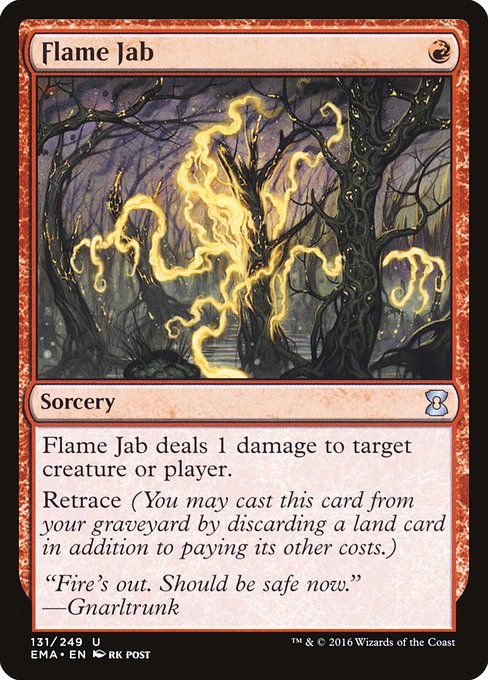
Take Flame Jab as the textbook example. It reads:
Flame Jab deals 1 damage to any target. Retrace (You may cast this card from your graveyard by discarding a land card in addition to paying its other costs.)
So for {R} plus a land card discarded, you can ping something for 1 damage from the graveyard. Then, when it resolves or gets countered, it goes right back to your graveyard - ready to be cast again next turn, or even the same turn if you have another land in hand.
That's the key thing that makes retrace unusual: it doesn't go to exile when it resolves. It stays in your graveyard as a reusable resource, limited only by how many land cards you can feed it.
Rules
Here's what the Comprehensive Rules say (as of November 14, 2025 - Edge of Eternities):
CR 702.81a: Retrace is a static ability that functions while the card with retrace is in a player's graveyard. "Retrace" means "You may cast this card from your graveyard by discarding a land card as an additional cost to cast it." Casting a spell using its retrace ability follows the rules for paying additional costs in rules 601.2b and 601.2f-h.
Key rules details
- You still pay the mana cost. Retrace is an additional cost, not a replacement cost. Discarding a land doesn't replace the mana - it goes on top of it.
- Normal timing still applies. A retrace sorcery can only be cast on your own main phase when the stack is empty, just like any other sorcery. A retrace instant can be cast whenever you could cast any instant.
- When it resolves or is countered, it goes back to the graveyard. This is what makes retrace fundamentally different from flashback, which exiles the card after use.
- You can cast it again immediately. If you're the active player, you have priority the moment the spell resolves. That means you can cast the same retrace card again right away - before any opponent can try to remove the card from your graveyard. Since casting moves the card onto the stack, no one else can touch it while it's there.
- Retrace functions only in the graveyard. The ability doesn't do anything while the card is in your hand, library, or exile. It's a graveyard-only static ability.
Common misunderstandings
"Does retrace exile the card after use, like flashback?" No. This is the most frequent mix-up. Flashback exiles the card on resolution. Retrace sends it back to the graveyard, making it available again indefinitely.
"Can I cast a retrace sorcery at instant speed?" No. Unless something else is giving it that permission, a retrace sorcery follows normal sorcery timing even when cast from the graveyard.
"Does discarding the land replace the mana cost?" No. You pay both the mana cost and discard the land.
Strategy
Playing with retrace
Retrace rewards a specific kind of deck-building mindset: valuing land density more than most decks would. Running 24 or even 25+ lands isn't just about hitting your drops - it's about ensuring you have fuel for your late-game retrace engine. Lands become spells.
The best retrace spells tend to be efficient at their base cost and scale with repetition. A card that deals a little damage once is marginal. A card that deals a little damage every turn, as long as you're flooding on land, is an inevitability engine.
Decks built around retrace often want:
- High land counts (24-26 in 60-card formats)
- Land search effects to ensure extra lands in hand
- Cards that reward graveyard depth or discard synergies
- A late-game plan that can leverage the value of recurring spells
Format check: Most retrace cards are legal in Modern, Legacy, and Vintage. Check the specific card's legality for Standard or Pioneer, as these formats rotate and older retrace cards from Eventide won't be legal there.
Playing against retrace
The most direct answer to retrace is graveyard hate - exile effects like Rest in Peace, Relic of Progenitus, or even targeted exile removal. Since retrace cards sit in the graveyard between uses, a well-timed exile permanently removes the engine.
Pressure is also effective. A retrace card costs mana and a land, which means the opponent has to find turns where they can afford both. Aggressive strategies that don't give them those quiet turns can outpace the value retrace generates.
If you're playing control, countering a retrace spell is less punishing than countering a flashback spell - the card goes back to the graveyard, not exile, so they haven't lost it. This can make the counter feel less decisive, though it still buys time and denies the immediate effect.
Interaction with land-heavy or discard-synergy builds
Retrace pairs naturally with strategies that generate extra land cards - from fetchlands (which put basics in your hand sometimes via shuffling effects) to dedicated land-search spells. In Commander, where 100-card decks often support heavier land counts and slower games, retrace can generate enormous long-term value if left unchecked.
There's also a subtle synergy with any deck that wants to discard. If you're running discard outlets for other reasons (madness, reanimation, looting effects), retrace gives you a productive place to point those discarded lands rather than tossing them away for nothing.
Notable cards with Retrace
Flame Jab - The simplest and most iconic example. One damage for {R} is usually not where you want to be, but repeating it turn after turn while flooding out is a legitimate inevitability plan in grindy games, particularly in Pauper where resources are tighter.
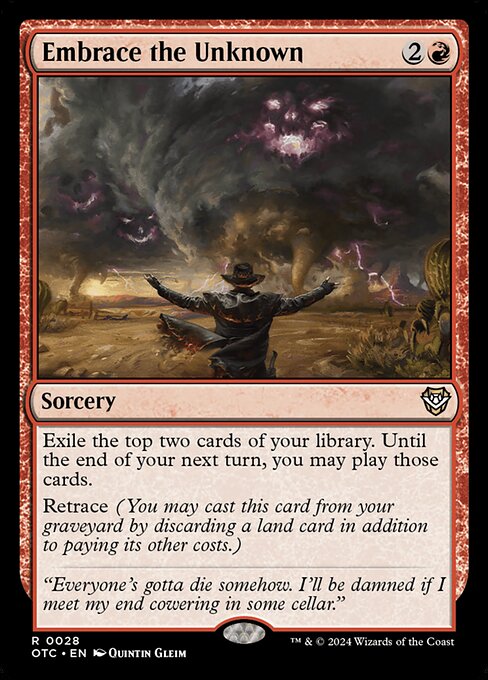
Embrace the Unknown - At {2}{R}, this sorcery exiles the top two cards of your library and lets you play them until the end of your next turn. The retrace ability makes this a repeatable card advantage engine in red, which doesn't usually get that kind of sustained value. In a deck flush with extra lands, this can be devastating.
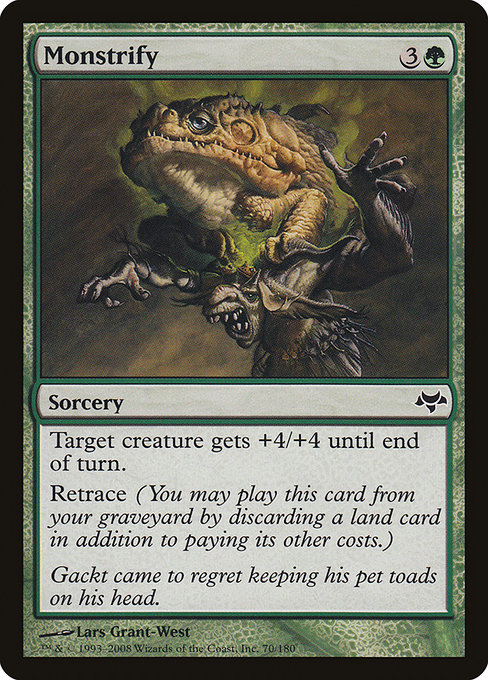
Monstrify - Gives a creature +4/+4 until end of turn for {3}{G}. A reusable pump spell that can threaten lethal from nowhere, turn after turn, in a creature-based green deck with extra lands. Straightforward, but the repetition makes it meaningful.
Recross the Paths - A more unusual retrace card. It ramps you by putting a land directly onto the battlefield, and if you win a clash, it returns to your hand rather than your graveyard. The retrace ability backs it up if you lose the clash - you still have a land-fetching spell available to cast again.
Retrace beyond dedicated retrace cards
Wrenn and Six - This legendary planeswalker from Modern Horizons (2019) has a -1 ability that gives a land card in your graveyard retrace until end of turn. That's not quite the same as a card having retrace natively, but it uses the keyword directly and puts it on lands rather than spells - a genuinely novel application of the mechanic.
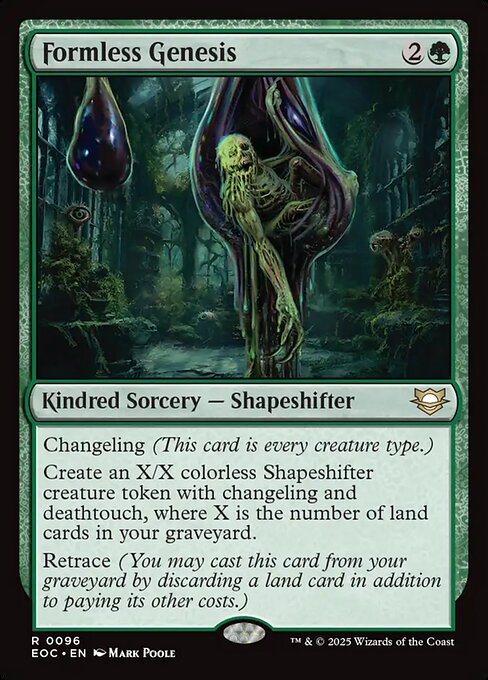
Deeproot Historian from The Lost Caverns of Ixalan (2023) does something the mechanic had never done before: it grants retrace to permanent spells - specifically Druid and Merfolk spells. Since retrace's rules text says "You may cast this card from your graveyard," extending it to creature spells is a meaningful expansion. It also captures kindred spells that reference those types.
History
Retrace was introduced in Eventide (2008), the second set of the Shadowmoor block. It was designed to give late-game land-heavy hands a purpose, fitting thematically into the set's evoke-heavy, sacrifice-and-cost ethos.
The mechanic didn't return for a long time. Lead designer Mark Rosewater placed it at 7 out of 10 on the Storm Scale - his informal measure of how likely a mechanic is to return to a Standard-legal set. The reasons: the repetitive play pattern (casting the same spell over and over every turn) and developmental difficulty in balancing spells that can be cast indefinitely rather than once.
Lore aside: Jump-start, introduced in Guilds of Ravnica (2018), is often mentioned alongside retrace as a related idea. It also lets you cast from the graveyard by discarding a card - but crucially, only once, since the spell exiles on resolution. Rosewater has noted that jump-start addresses some of retrace's design issues by capping the repetition, which is why it could appear on higher-impact spells.
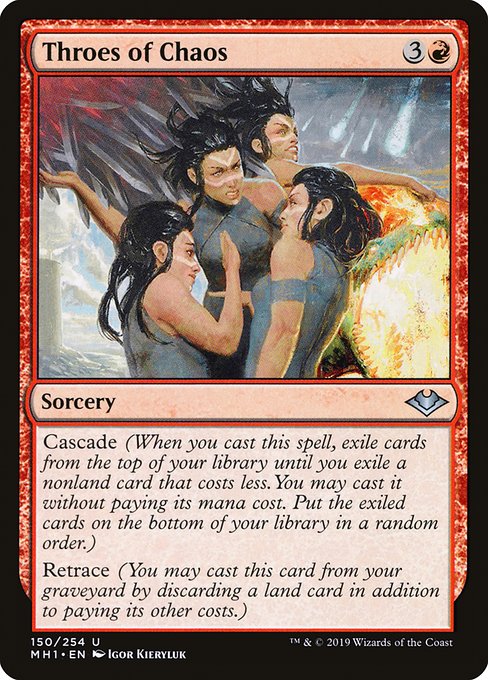
Retrace resurfaced quietly in Modern Horizons (2019) on Wrenn and Six and Throes of Chaos - both non-Standard legal sets, which gave the design team more freedom to use a mechanic with known repetition concerns.
The most recent expansion of the mechanic came in **The Lost Caverns of Ixalan** (2023) Commander decks, where Deeproot Historian extended retrace to creature spells for the first time. Whether this signals retrace returning more broadly remains to be seen - but a 7 on the Storm Scale suggests it'll keep appearing in supplemental products rather than Standard sets. 😄