Scavenge: MTG Mechanic Guide
There's something deeply Golgari about the idea of your fallen creatures not quite being done fighting. Scavenge is the mechanical expression of that philosophy: exile a dead creature, and let its strength flow into something still standing.
What is Scavenge?
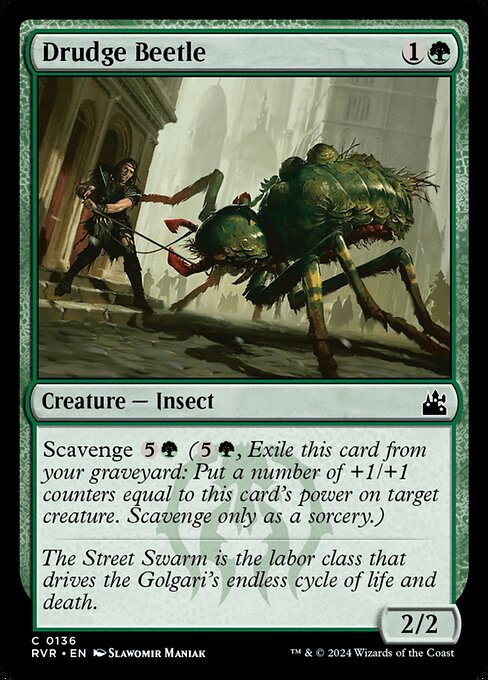
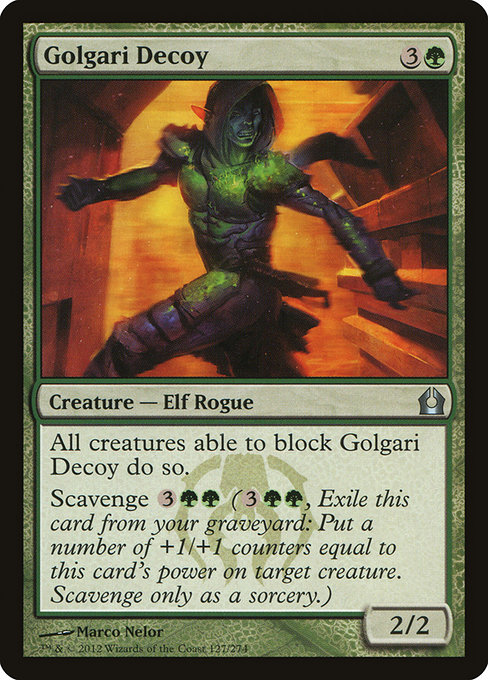
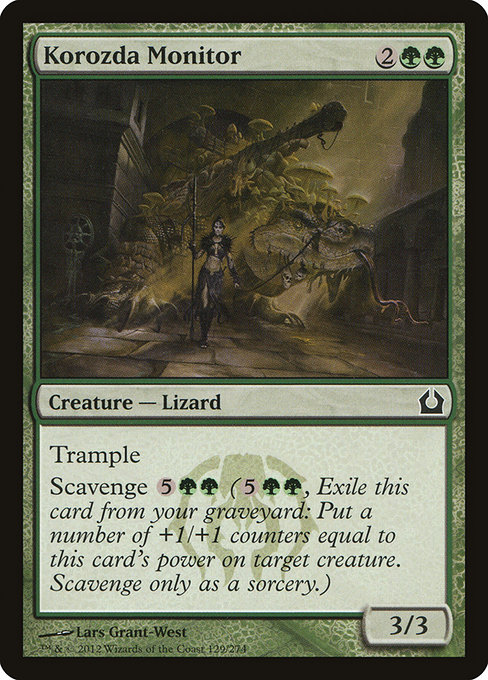
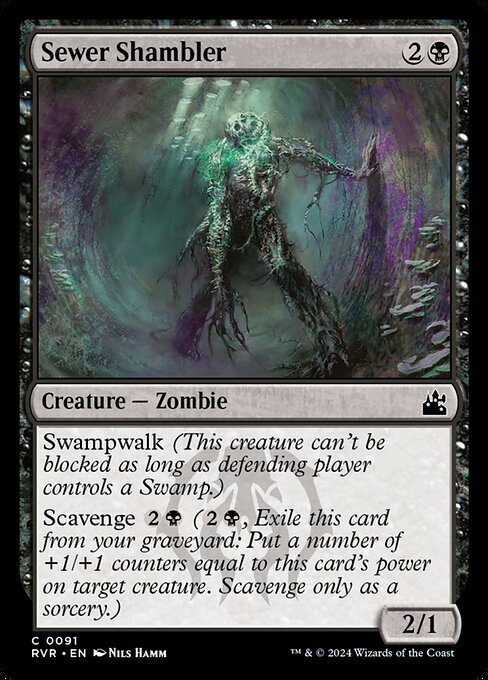
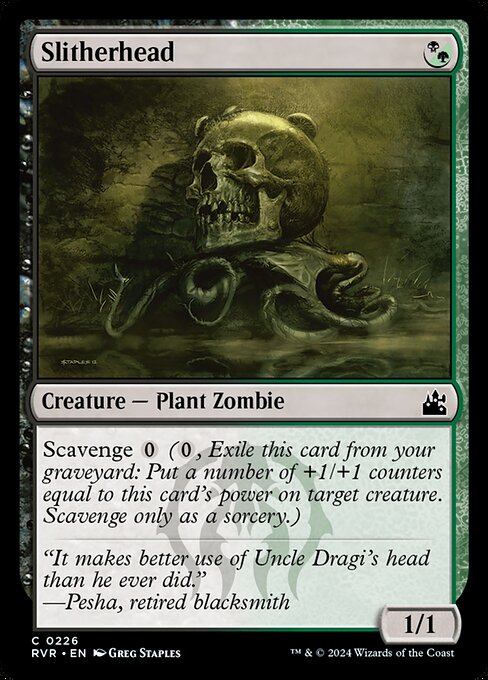
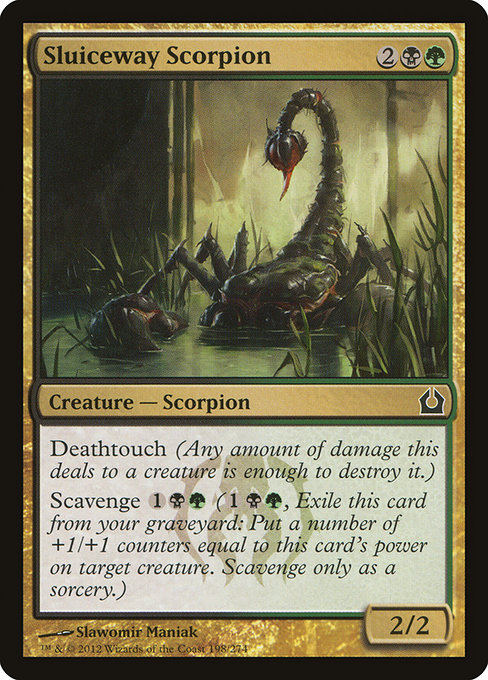
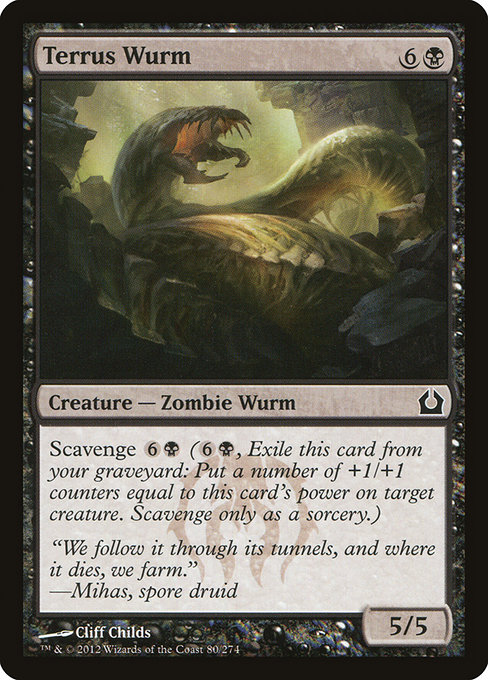
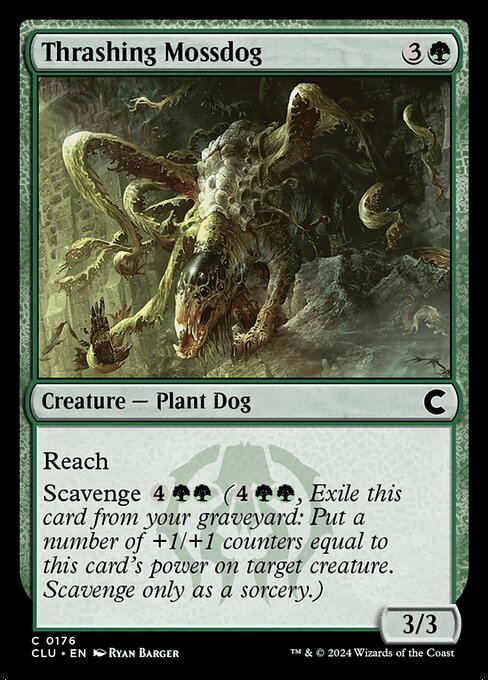
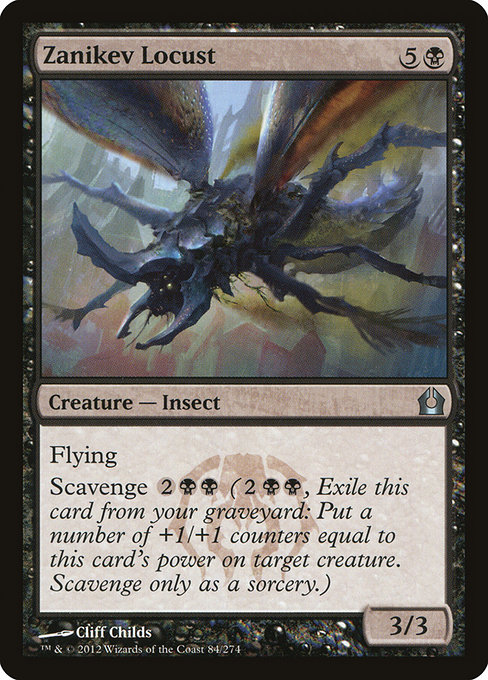
Scavenge is an activated keyword ability that lives in the graveyard. When a creature with scavenge ends up in your graveyard, you can pay its scavenge cost to exile it and place a number of +1/+1 counters on a target creature equal to the power of the card you just exiled. It's a way of recycling the raw strength of your dead creatures into something still on the battlefield.
Think of it like a fallen warrior passing their strength to a comrade - the body is gone, but the power lives on.
Scavenge was introduced in Return to Ravnica (RTR, 2012) as the signature mechanic of the Golgari Swarm guild, which has always blended death and growth as two sides of the same coin.
How Scavenge works - the rules
The full rules text from the Comprehensive Rules (November 14, 2025 - Edge of Eternities) is worth reading carefully:
"Scavenge [cost]" means "[Cost], Exile this card from your graveyard: Put a number of +1/+1 counters equal to the power of the card you exiled on target creature. Activate only as a sorcery."
- CR 702.97a
A few things worth unpacking there:
- It only functions from the graveyard. Scavenge does nothing while the card is in your hand, on the battlefield, or anywhere else. It's purely a graveyard ability.
- Exiling the card is part of the cost. You pay the mana cost and exile the card as a single cost payment. Once you've done that, the ability is on the stack - your opponent can't respond by removing the card from your graveyard to stop it.
- It resolves like a sorcery. You can only activate scavenge when you could cast a sorcery - on your own turn, during your main phase, when the stack is empty. No surprise counters at instant speed.
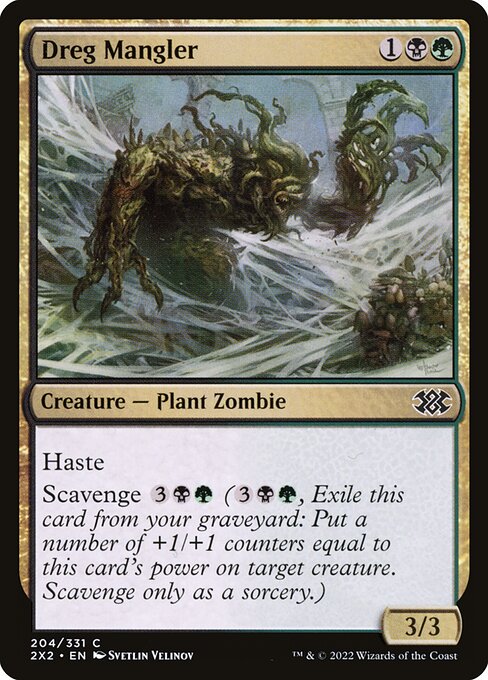
- The counter count is based on the card's printed power. Dreg Mangler, for example, is a 3/3, so scavenging it puts three +1/+1 counters on the target creature.
Rules note: Because exiling is part of the cost, graveyard hate like Scrabbling Claws or Scavenger Grounds can't be used in response to stop a scavenge activation that's already been paid for. If your opponent wants to disrupt a scavenge, they need to act before you announce and pay for the ability.
Common misunderstandings
- You can target any creature, not just your own. The rules text says "target creature" without restriction - though putting counters on an opponent's creature is rarely the right call.
- Power modifications don't matter. The counters are based on the power printed on the card (or its power as it exists in the graveyard), not any in-game power boosts it had while on the battlefield.
- You can't scavenge a card that's been exiled. Once it's in exile, it's gone. Scavenge only functions in the graveyard.
Strategy - playing with and against Scavenge
Building with Scavenge
Scavenge rewards you for playing creatures with high power relative to their mana cost - a creature that trades efficiently in combat and then pumps a teammate from the graveyard is doing double duty in a single card slot.
The key tension with scavenge is that it's slow. Most scavenge costs are 4-6 mana on top of what you already paid to cast the creature. That means scavenge is a late-game tool, not an early-game one. Decks that want to use it need to survive long enough to activate it, and need creatures on the battlefield still worth pumping when they do.
A few things scavenge pairs well with:
- +1/+1 counter synergies - anything that cares about counters being placed or creatures growing gets extra mileage from scavenge activations.
- Self-mill - getting your scavenge creatures into the graveyard faster makes the ability available sooner, and often for creatures you didn't even have to cast.
- Durable, recursive threats - scavenge works best when you have something worth pumping. A creature with indestructible, hexproof, or built-in recursion becomes an even bigger target with counters on it.
Playing against Scavenge
Scavenge has a few natural weaknesses that you can lean on:
- Graveyard hate hurts. If you exile your opponent's graveyard before they activate scavenge, those creatures are gone. Scavenger Grounds is an ironic answer - a land that wipes all graveyards for a small investment.
- Fast decks outpace it. A 5-mana scavenge activation on turn six is fine, but if the game's already been decided by then, it doesn't matter. Aggro decks that apply early pressure can make scavenge irrelevant before it becomes a factor.
- Removing the target in response works. Unlike the cost (which is paid on activation), the ability still needs a legal target when it resolves. If you can destroy or exile the creature your opponent is trying to pump after they've paid the scavenge cost, the ability fizzles and the counters are lost - though the exiled card is still gone.
Notable Scavenge cards
Dreg Mangler
Dreg Mangler ({1}{B}{G}) is probably the most-played scavenge card from Return to Ravnica. A 3/3 with haste for three mana is already a solid rate - it attacks immediately and applies pressure. Then when it dies, its scavenge cost of {3}{B}{G} puts three +1/+1 counters on whatever's still on your side. It's a creature that applies pressure in two different game states, which is exactly what you want.
Lotleth Troll
Lotleth Troll ({B}{G}) isn't a scavenge card itself, but it's worth mentioning as the poster creature for the Golgari graveyard strategy that scavenge sits inside. Discarding creatures to it fuels the graveyard for scavenge activations while building a growing threat - the synergy is real.
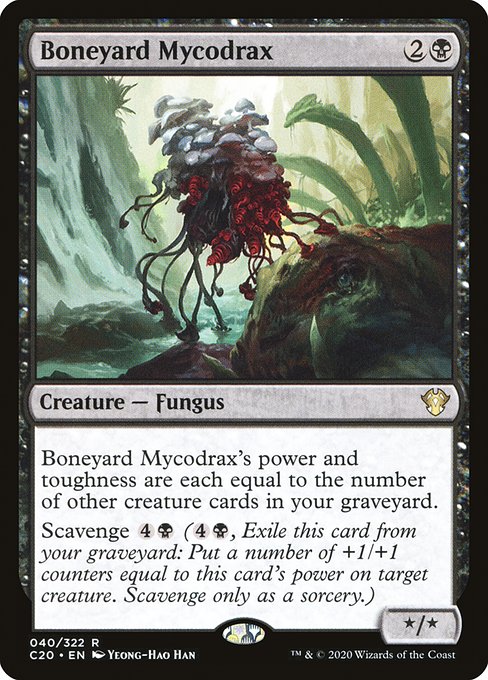
Boneyard Mycodrax
Boneyard Mycodrax (from Commander 2020) is notable as the first scavenge card printed outside the Return to Ravnica block. Its power scales with the number of creature cards in your graveyard, which means its scavenge activation can be enormous in the right deck. It was also a signal that Wizards hadn't entirely abandoned the mechanic.
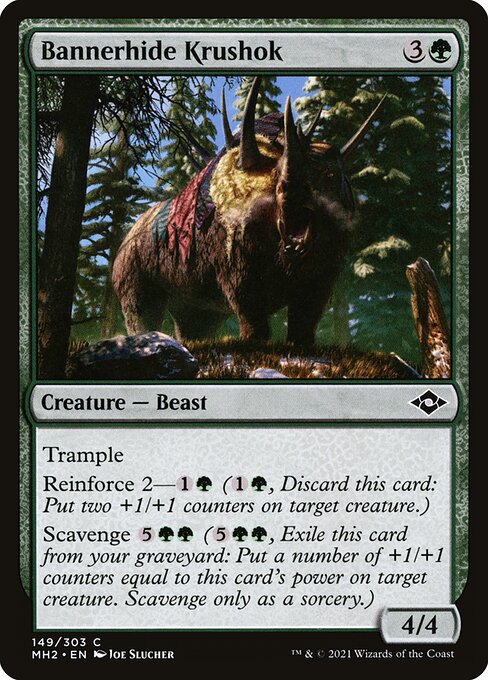
Bannerhide Krushok
Bannerhide Krushok (from Modern Horizons 2, 2021) brought scavenge to a higher-power environment. Its scavenge cost puts +1/+1 counters equal to its power on a creature - and it has a decent base power to work with. It's a callback to the mechanic for players who enjoy graveyard-based strategies in non-rotating formats.
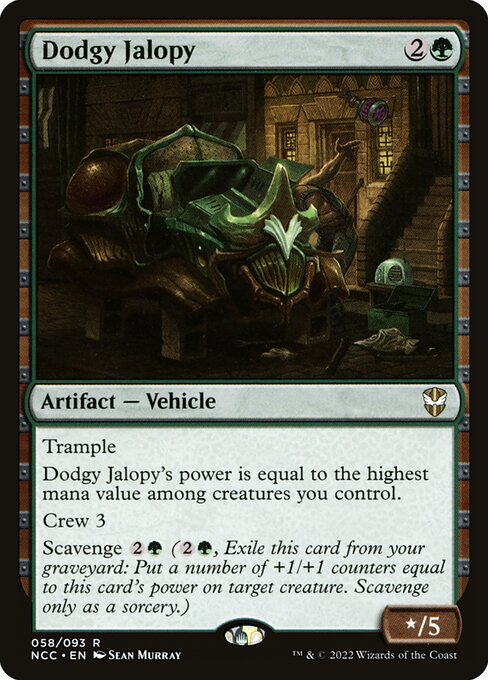
Dodgy Jalopy
Dodgy Jalopy (Streets of New Capenna Commander) earns a special mention because it's a Vehicle with scavenge - making it the only noncreature card with the ability, which is rules-textually possible since scavenge refers to the card's power (Vehicles have power) and can technically sit on any card type. It's a weird one, and I love it for that.
History and design context
Scavenge debuted in Return to Ravnica (2012) as the Golgari mechanic, with Dragon's Maze adding two more cards to the pool. The design intent is clear: death should be a resource for the Golgari, not just a setback. Flashback says "cast this spell again from the graveyard." Scavenge says "your dead creature's strength lives on in another."
In practice, scavenge was reasonably popular during its Standard season but hasn't been a mechanic that Wizards has returned to often. Lead designer Mark Rosewater has rated it a 4 on the Storm Scale (a metric for how likely a mechanic is to return), citing its graveyard gameplay as a positive but its narrow applications and medium popularity as reasons it probably won't headline a set again.
The criticisms of scavenge are fair: it's slow, it's weak to the graveyard hate that's common in competitive sideboard slots, and the payoff requires both a dead creature and a living one worth pumping. Against fast decks that can kill your threats before you untap, or against control decks that exert pressure on your graveyard, scavenge can feel clunky.
Still, it's appeared in Commander 2020, Modern Horizons 2 (2021)**, and the Streets of New Capenna Commander decks - which suggests Wizards still sees a home for it in supplemental products even if it's unlikely to return as a core draft mechanic anytime soon.
Lore aside: The Golgari Swarm in Ravnica's lore literally practice a cycle of death and rebirth - their society is built on the idea that nothing is wasted. Elves, zombies, insects, and fungi all coexist under their banner. Scavenge is as much a lore expression as a game mechanic, which is one reason it fits the guild so perfectly.
Format check: Scavenge cards from Return to Ravnica are not legal in Standard or Pioneer. They are legal in Modern (where Modern Horizons 2's Bannerhide Krushok appears), Legacy, and Vintage. Commander is the most natural home for scavenge-based strategies today, where the game goes long enough for the mechanic to shine.