Transfigure: MTG Mechanic Explained
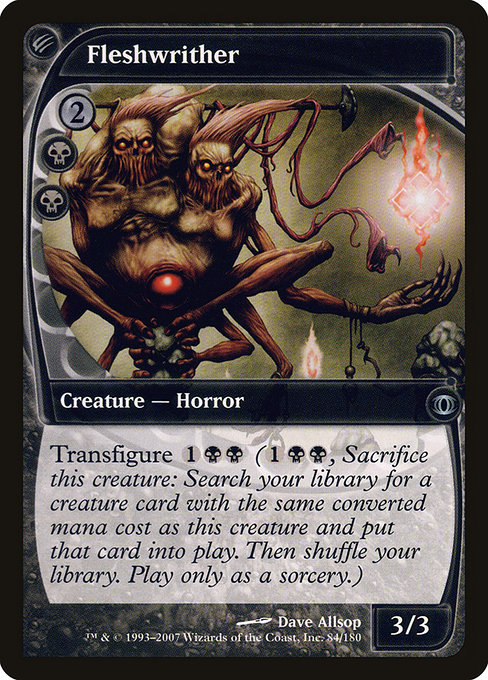
There's something quietly fascinating about a keyword that exists on exactly one card. Transfigure is that keyword - a single-appearance mechanic from Future Sight (2007) that does something elegant: sacrifice a creature, go find a better one with the same price tag. It's a tutor stapled to a body, and the only card that has ever carried it is Fleshwrither.
Let's dig into what it does, how it works, and why it's worth knowing even if you'll probably never build around it.
What is Transfigure?
Transfigure is an activated keyword ability that lets you sacrifice the permanent it appears on to search your library for a creature card with the same mana value and put it directly onto the battlefield. No hand step, no casting - it just arrives.
Think of it as a creature-specific tutor that replaces itself. You're not drawing a card; you're swapping one creature for another of equal mana cost. The card you find enters the battlefield rather than your hand, which is a meaningful distinction - it bypasses casting restrictions, ward costs, and anything that might counter a spell.
Format check: Transfigure appears only on Fleshwrither, which is legal in Legacy, Vintage, and Commander. It has never been reprinted or appeared in a Standard-legal set in its original form.
Rules
The comprehensive rules entry for Transfigure is clean and precise:
"Transfigure [cost]" means "[Cost], Sacrifice this permanent: Search your library for a creature card with the same mana value as this permanent and put it onto the battlefield. Then shuffle your library. Activate only as a sorcery."
- CR 702.71a (November 14, 2025 - Edge of Eternities)
How the ability works step by step
- You pay the transfigure cost and sacrifice the permanent as part of activating the ability.
- You search your library for a creature card with the exact same mana value as the sacrificed permanent.
- That creature enters the battlefield directly - it isn't cast.
- You shuffle your library.
Key rules details and common misunderstandings
Mana value is fixed, not flexible. You must find a creature with the same mana value - not less, not more. Fleshwrither's mana value is 4, so you're always fetching a four-mana creature.
The creature enters the battlefield, not your hand. This is crucial. It can't be countered with a traditional counterspell, it doesn't trigger "when you cast" abilities, and it bypasses any additional costs you would normally need to pay to cast the creature.
Sorcery speed only. The ability can only be activated when you could cast a sorcery - your main phase, your turn, an empty stack. You can't use it in response to removal, for example.
The permanent is sacrificed as part of the cost. If the ability is somehow countered (by something like Stifle), Fleshwrither is already gone. You don't get it back.
**Transfigure is similar to transmute** - the Ravnica keyword that tutors for cards of the same mana value into your hand - with two important differences: transmute works from your hand, not the battlefield, and transmute fetches any card, while transfigure fetches only creatures and puts them directly into play.
Strategy
Transfigure rewards you for knowing exactly what four-mana creature you want for any given game state. The sacrifice cost means you're trading Fleshwrither away, so you want the creature you fetch to be worth more in context than whatever Fleshwrither was doing.
Playing with Transfigure
Treat Fleshwrither as a silver-bullet engine. In Commander especially, you can use it as a toolbox piece - a 3/3 body that threatens to become any four-mana creature in your deck. If your opponent leaves it alive, it's a 3/3. If you need a specific answer, you cash it in.
Pair it with creature density at the target mana value. The more powerful four-mana creatures you have in your deck, the more threatening the ability becomes. Targets like Karmic Guide, Siege Rhino, Phyrexian Obliterator, or anything with a strong enters-the-battlefield trigger are natural fits.
The enters-the-battlefield angle is real. Because the fetched creature enters the battlefield rather than being cast, you're bypassing any "when cast" triggers on your opponent's side and getting straight to the ETB. In formats like Legacy, this can matter for getting around hate pieces.
Sacrifice synergies apply. Fleshwrither sacrifices itself to activate, so any deck that cares about creatures dying - aristocrats-style strategies, Dictate of Erebos, Mayhem Devil - gets incidental value from the activation.
Playing against Transfigure
The cleanest answer is to kill Fleshwrither before its controller can activate transfigure. Since the ability is sorcery-speed only, you have the entire end step and your own turn to deal with it.
If you can't remove it at instant speed before their main phase, exile is preferable to simply destroying it - you don't want to give them the sacrifice trigger for free.
Stifle or similar abilities can counter the activated ability after costs are paid, which means Fleshwrither is gone and they get nothing. This is a tempo-positive outcome if you're in a Legacy shell that already plays Stifle.
Notable cards
There is, honestly, only one:
Fleshwrither
Fleshwrither ({1}{B}{B}{B}) is a 3/3 Horror with Transfigure {1}{B}{B}{B}. It was printed as a timeshifted card in Future Sight - the set that previewed potential future design directions for Magic - which is why it has a distinctive purple-tinged frame.
The transfigure cost ({1}{B}{B}{B}) matches its casting cost, so the mana value is 4 on both ends. You pay four mana to cast a 3/3, then pay four more mana (plus the sacrifice) to search for any four-mana creature in your deck.
The fact that it's a 3/3 for four isn't exciting on its own - the value is entirely in what you can go find. In Commander, where singleton construction makes tutors especially powerful, Fleshwrither is occasionally included in black creature-heavy decks specifically as a redundant path to a key four-drop.
History
Transfigure was introduced in Future Sight (2007), a set explicitly designed to explore what Magic might look like in the future - complete with a "timeshifted" card sheet that showed off mechanics that could be used in upcoming sets. Cards on that sheet had experimental purple borders to signal their speculative nature.
Fleshwrither was one of those timeshifted cards, carrying transfigure as a novel twist on transmute, which had appeared in Ravnica: City of Guilds (2005)** two years earlier. The core idea - pay a cost equal to the card's mana value to fetch something else of the same cost - carried over, but transfigure adapted it for permanents already on the battlefield and narrowed the search to creatures only.
Despite the promise of Future Sight's framing, transfigure never appeared again. Mark Rosewater has stated that the mechanic is unlikely to be reused. The reasons aren't exhaustively documented, but the very limited design space - only one card has ever used it - and the overlap with other tutor mechanics probably explain the absence. Transmute covers the hand-based version across multiple cards; transfigure's battlefield-only, creature-only restriction left it as a curiosity rather than a toolkit.
It remains one of Magic's rarer pieces of history: a keyword that came, did its job on exactly one card, and quietly never came back.