Offering: MTG Mechanic Explained
Some mechanics reward you for playing with your tribe rather than just alongside it. Offering is one of those - a keyword that turns sacrifice into both a cost reduction and a timing trick, letting you ambush opponents with massive creatures at instant speed.
What is Offering?
Offering is a keyword ability that lets you cast a spell at a reduced mana cost - and with flash - by sacrificing an appropriate permanent as an additional cost. Each card with Offering specifies a type: "Rat offering", "Snake offering", "Goblin offering", and so on. If you choose to use it, you sacrifice a permanent of that type, subtract its mana cost from what you'd otherwise pay, and cast the spell as though it were an instant.
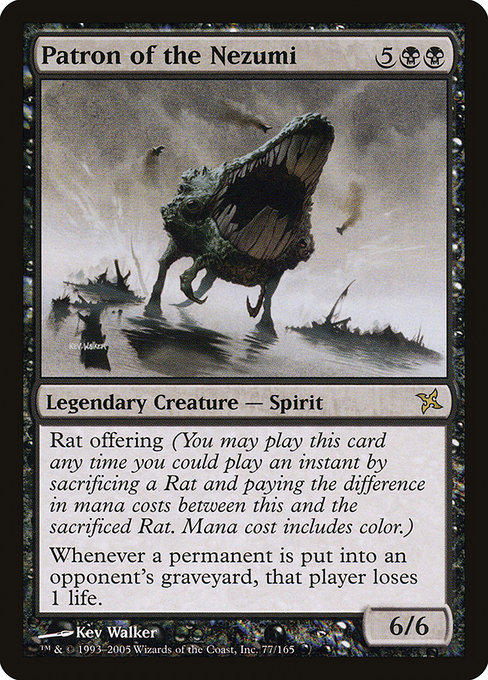
The core appeal is elegant: your tribal creatures aren't just battlefield presence, they're also fuel. A Rat you've been swinging with for three turns can suddenly become the down payment on a 6/6 Legendary Spirit at the end of your opponent's turn.
Format check: Offering cards are legal in formats based on their respective sets. The original five Patron cards are from Betrayers of Kamigawa (2005), making them legal in Legacy and Vintage but not Modern, Standard, or Pioneer. Blast-Furnace Hellkite, the mechanic's return appearance in The Brothers' War Commander decks (2022), is legal in Commander and any format that allows Commander precon cards.
How Offering works: the rules
Offering is a static ability that functions while the spell is on the stack. The full rules text from the Comprehensive Rules (November 14, 2025 - Edge of Eternities) is:
"[Quality] offering means 'As an additional cost to cast this spell, you may sacrifice a [quality] permanent. If you chose to pay the additional cost, this spell's total cost is reduced by the sacrificed permanent's mana cost, and you may cast this spell any time you could cast an instant.'" - CR 702.48a
There are a few moving parts worth breaking down.
Choosing to use it is optional
Offering is always optional. You can cast an Offering card the normal way - full cost, at sorcery speed - without sacrificing anything. The sacrifice is only required if you want the cost reduction and flash timing.
How the cost reduction is calculated
The mana cost of the sacrificed permanent is subtracted from the total cost of the spell:
- Generic mana in the sacrificed permanent's cost reduces generic mana in the spell's cost.
- Colored and colorless mana reduces mana of the same type first, then any excess bleeds into reducing generic mana.
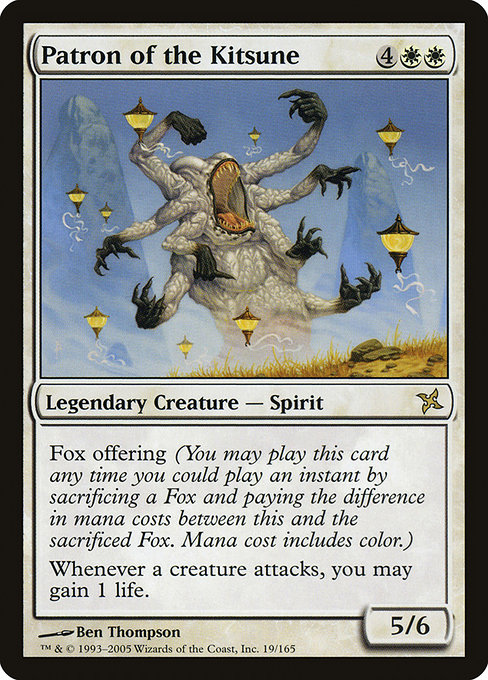
A practical example: Patron of the Kitsune costs {4}{W}. If you sacrifice a Fox that costs {1}{W}, the {W} covers the white pip and the {1} covers one generic mana, bringing your total to {3}. If you sacrifice a Fox that costs {2}, the two generic mana reduce the generic portion, and you pay {2}{W}.
Cost increases from effects like Sphere of Resistance apply before the Offering reduction is calculated, so the permanent's mana cost can cover those inflated costs too.
Flash timing is the big payoff
When you use Offering, you can cast the spell any time you could cast an instant. This is the mechanical heart of the ability. Dropping a large Legendary Spirit at the end of your opponent's turn - after they've tapped out - is dramatically more powerful than telegraphing it on your own turn.
Rules note: The sacrifice happens as you announce the spell and pay costs. No player gets priority to respond to the sacrifice before the creature spell is on the stack. Once it's on the stack, then players can respond - but the permanent is already gone.
You can sacrifice a permanent with a mana cost of 0
Sacrificing a permanent with a mana cost of {0} doesn't reduce the cost at all, but it still grants you flash timing. If you have a token of the right creature type - most tokens have a mana cost of 0 - you can cast the Patron at instant speed for its full mana cost. No reduction, but the timing alone can be worth it.
Only one permanent, no exceptions
You may sacrifice exactly one permanent when using Offering. You can't sacrifice multiple creatures to stack further reductions.
Strategy: playing with and against Offering
Building around Offering
Offering rewards tight tribal construction. The more creatures of the relevant type you have on board, the more options you have for both the reduction and the instant-speed timing. A tribal deck running a Patron wants redundancy - not just so you have sacrificial fodder, but because the best scenarios involve a creature that's already done its job on the battlefield and can now double as mana discount.
The ideal line is sacrificing a creature you'd otherwise lose anyway - one that's about to die to a removal spell, or that's been outclassed on the board. Think of it as trading a liability for a massive threat, at instant speed, for reduced cost. That's an enormous amount of value from a single card.
Cost reduction is calculated from the permanent's mana cost, not its current power level. An expensive creature you've been buffing with counters still only contributes its printed mana cost to the reduction. Keep that in mind when choosing what to sacrifice.
Playing against Offering
The key threat to respect is the flash timing. An opponent running Patron of the Nezumi in a Rat deck isn't just building a board - they might be holding up mana to flash in a 6/6 at end of turn. If they pass with mana open and have tribal creatures in play, treat it like they could be holding an instant.
The other pressure point: Offering is announced as you cast the spell, and the sacrifice happens before opponents can respond to the permanent being sacrificed. You can counter the Patron spell once it's on the stack, but you can't save the sacrificed creature with removal or bounce. Target the permanent before your opponent announces the Offering if you want to deny them the discount or the flash window.
Effects that prevent players from casting creatures also shut off Offering entirely - if you can't cast the spell, you can't use the ability to cheat it in at instant speed.
Notable Offering cards
The Patron cycle - Betrayers of Kamigawa (2005)
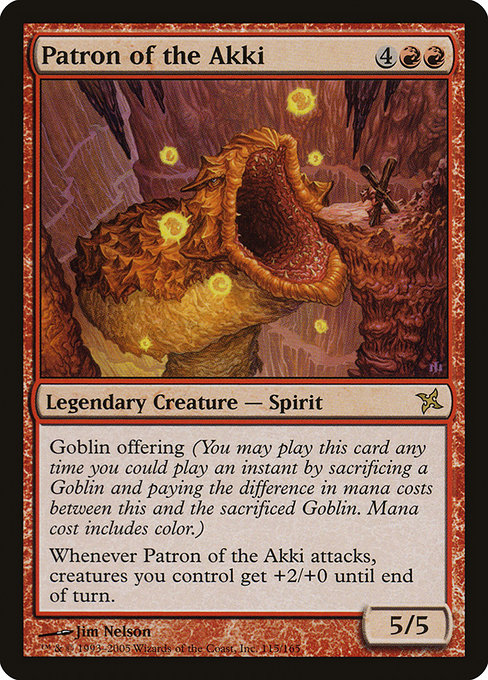
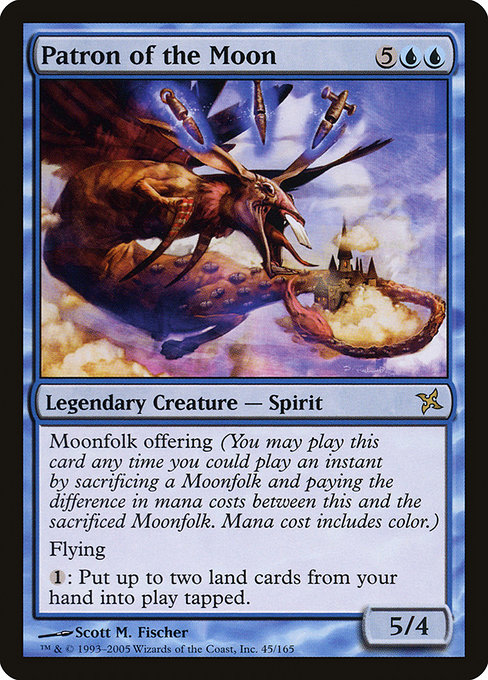
Offering was introduced as a five-card cycle of Legendary Spirits in Betrayers of Kamigawa (BOK). Each Patron pairs with a creature type prominent in that set's tribal themes.
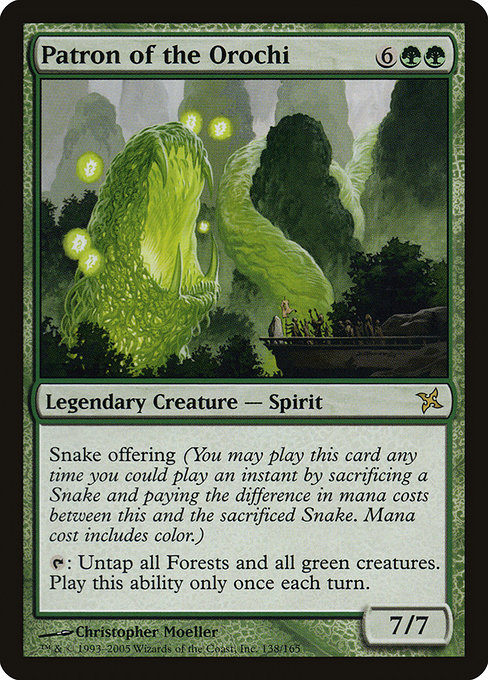
| Card | Offering Type | Stats | Ability | |---|---|---|---| | Patron of the Akki | Goblin offering | 5/4 | Gives your Goblins Bushido 2 | | Patron of the Kitsune | Fox offering | 4/6 | Creatures you control gain vigilance; gain life on attack | | Patron of the Moon | Moonfolk offering | 3/5 | Put lands from hand onto battlefield tapped | | Patron of the Nezumi | Rat offering | 6/6 | Opponents lose 1 life when permanents go to their graveyard | | Patron of the Orochi | Snake offering | 4/4 | Untap target Forest and Snake each upkeep |
All five are Legendary Creatures - Spirits with mana costs in the five-to-six range, which means a well-costed sacrificed permanent can bring the actual casting cost down substantially.
Patron of the Nezumi is probably the most impactful in dedicated tribal builds, since its drain trigger is passive and punishing over a long game. Patron of the Kitsune pairs naturally with aggressive Fox decks that want to keep attacking without tapping out defensively.
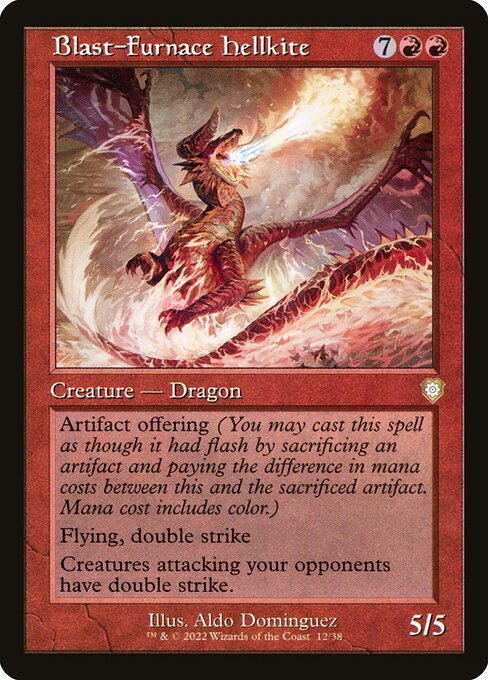
Blast-Furnace Hellkite - The Brothers' War Commander (2022)
Blast-Furnace Hellkite is the only Offering card printed outside of Betrayers of Kamigawa, arriving in a Commander precon nearly seventeen years later. It uses "Artifact offering", which fits neatly into artifact-heavy Commander strategies that naturally generate expendable artifact tokens or can sacrifice worn-out equipment and vehicles for a flying Dragon with an aggressive attack trigger.
The seventeen-year gap between appearances makes Offering one of Magic's more dormant mechanics - a piece of Kamigawa history that quietly resurfaced once.
History and design
Offering was introduced in Betrayers of Kamigawa (2005), the second set in the original Kamigawa block. Kamigawa was built around a war between the material world and the spirit world, and the Patron Spirits fit that theme perfectly - powerful kami that demanded tribute from their mortal followers.
The mechanic captures that lore beautifully in rules form. Sacrificing a Rat to call down Patron of the Nezumi isn't just a cost reduction; it's a ritual offering. That alignment between mechanics and story is one of the things the original Kamigawa block did better than almost any set before it.
Design-wise, Offering solved a real problem: how do you make large, expensive tribal payoffs feel worth including without making them generically powerful? By tying the cost reduction to a specific creature type, the Patrons are strong only in decks built to support them - they don't just slot into any big-spell strategy. That kind of tight, contextual power is elegant design.
The mechanic didn't return when Kamigawa: Neon Dynasty (NEO) revisited the plane in 2022 - that set introduced Saga, Channel, and Ninjutsu as its flagship mechanics. Offering's lone reappearance remains Blast-Furnace Hellkite in the The Brothers' War Commander decks, also in 2022, which makes that year quietly notable for the mechanic.