Annihilator: The MTG Mechanic Explained
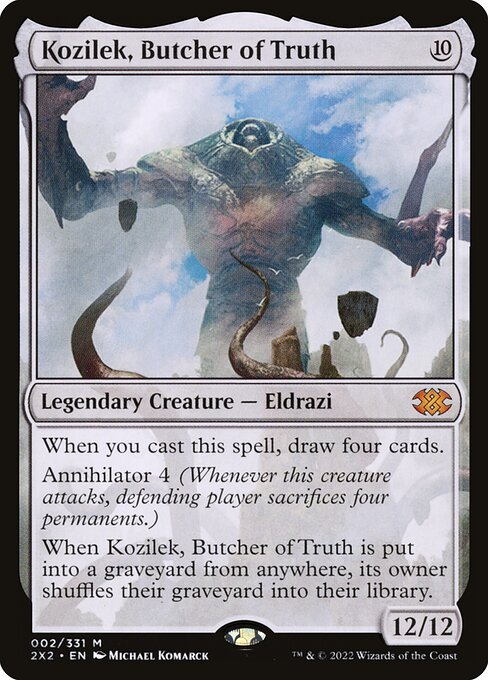
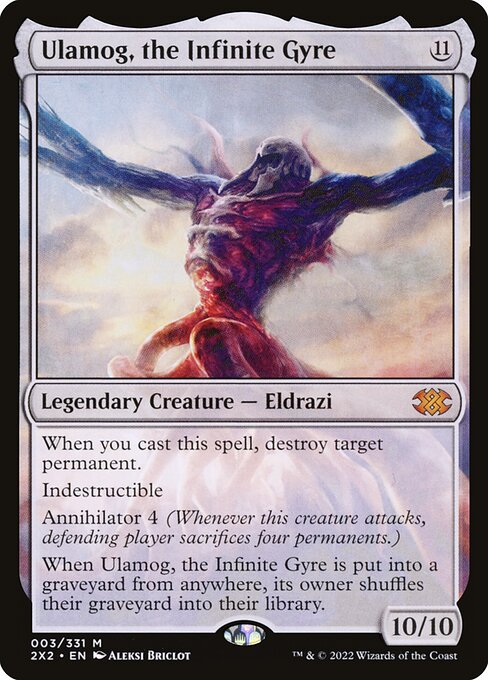
There's a moment in Magic that every player dreads: your opponent untaps, looks across the table at their enormous colourless monstrosity, and says, "attack with Ulamog." You have four lands, a couple of creatures, and a planeswalker you've spent three turns building up. Before combat damage even resolves, you have to sacrifice four permanents of your choice. That's annihilator - and it's one of the most psychologically brutal keywords ever printed.
What is Annihilator?
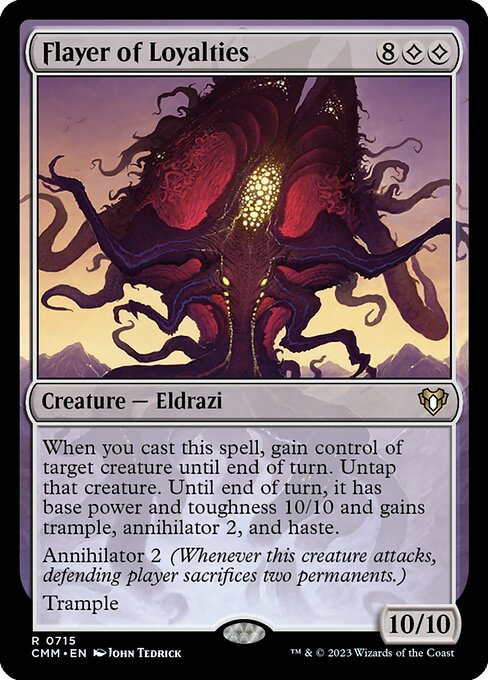
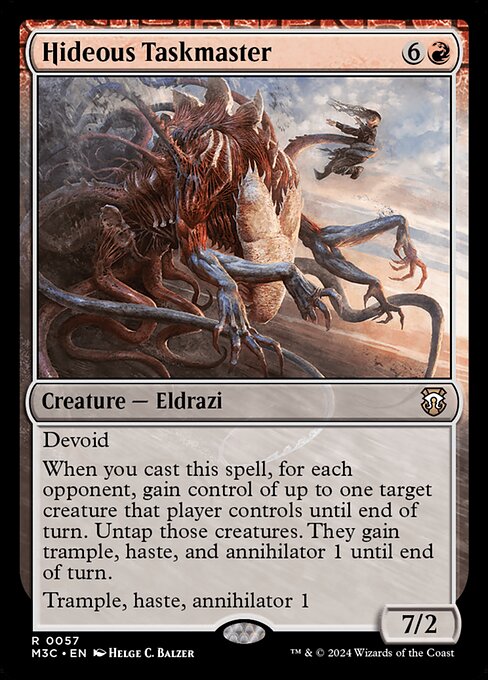
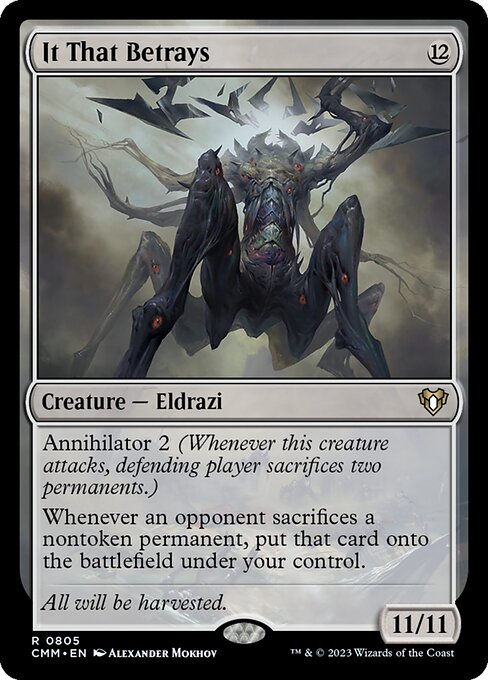
Annihilator is a triggered keyword ability that appears primarily on Eldrazi creatures. When a creature with annihilator attacks, the defending player must sacrifice a number of permanents equal to the annihilator value - before blockers are even declared, and before any combat damage is dealt.
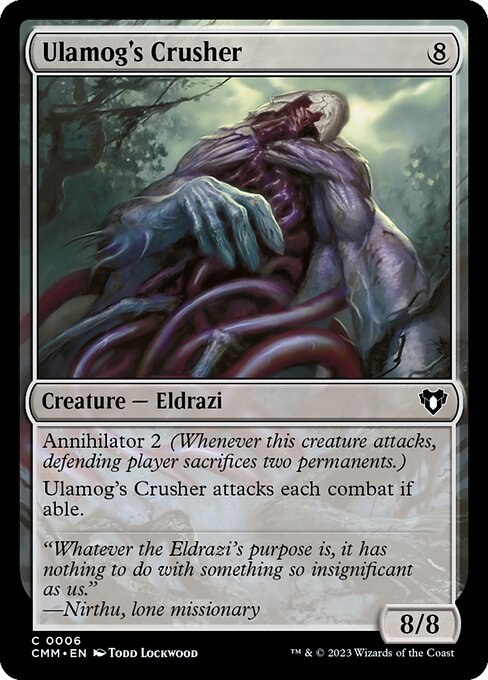
So a creature with annihilator 2 attacking means the defending player loses two permanents immediately, just for the privilege of being attacked. Block or don't block, you're already paying a steep tax.
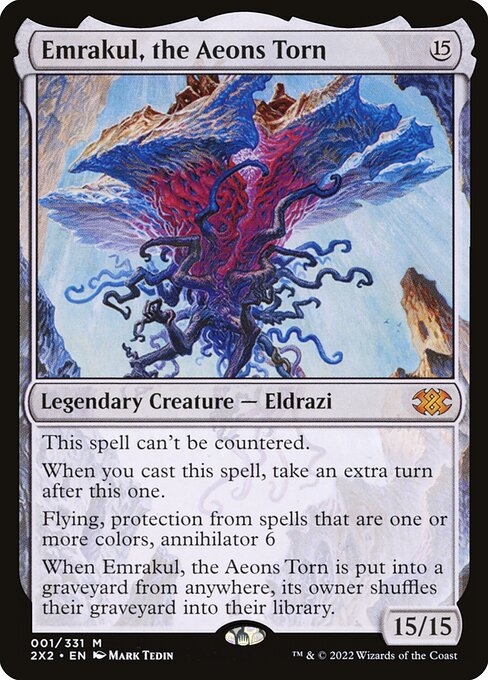
The mechanic was introduced in Rise of the Eldrazi (ROE, 2010) and was designed to do two things at once: break up the large board stalls that ROE's slower draft format tended to create, and represent the Eldrazi as story-level threats - cosmic destroyers that unmake entire planes simply by existing.
How Annihilator works: the rules
The official rules text is straightforward:
"Annihilator N means 'Whenever this creature attacks, defending player sacrifices N permanents.'" - CR 702.86a
A few important points follow from that:
- The trigger goes on the stack when the creature is declared as an attacker. It resolves before the defending player chooses blockers.
- The defending player chooses which permanents to sacrifice. There's no targeting, so nothing with hexproof or indestructibility protects from the sacrifice itself - indestructible permanents can be sacrificed, they just don't die from damage.
- If a creature has multiple instances of annihilator, each one triggers separately (CR 702.86b). A creature with annihilator 2 and annihilator 1 from two different sources triggers twice - sacrificing two, then sacrificing one.
- Permanents include lands, creatures, artifacts, enchantments, and planeswalkers. Everything on the battlefield is fair game.
Rules note: Annihilator triggers when the creature attacks, not when it deals damage. Preventing damage, or even exiling the attacker in response, does not stop the trigger from resolving once it's on the stack. You still sacrifice those permanents.
Common misunderstanding: The defending player must sacrifice exactly N permanents. If they control fewer permanents than N, they sacrifice as many as they can - they don't lose the game directly from this. But losing all your permanents against an 8/8 or larger is usually the same thing.
Strategy: playing with and against Annihilator
Getting annihilator creatures into play
The creatures that carry annihilator have enormous mana costs - we're talking eight, nine, eleven mana. Getting them into play legitimately takes serious ramp: cards like Cultivate, Kodama's Reach, land-fetching creatures, and mana rocks. In Commander especially, green ramp packages are the most common path to cheating these costs down to something realistic by turn five or six.
Alternatively, reanimation and cheat-into-play effects bypass the casting cost entirely - though note that some annihilator creatures (like Ulamog, the Infinite Gyre) have "when you cast this spell" triggers that won't fire if you're putting them directly onto the battlefield.
When annihilator is on your side
Once an annihilator creature is swinging, the pressure it creates is almost unmatched. Your opponent faces a brutal choice every single attack step: block and likely lose the creature they're blocking with on top of the sacrificed permanents, or not block and take a massive hit to their life total while still losing permanents.
The real power is cumulative. An annihilator 4 creature attacking twice means the opponent has sacrificed eight permanents across two turns. Very few boards survive that kind of attrition, and annihilator is particularly savage against resource-intensive strategies like control and midrange that depend on maintaining a battlefield of expensive cards.
Playing against annihilator
The honest answer is that once a large annihilator creature is attacking freely, you're usually in serious trouble. The best strategies are preventative:
- Counter it or kill it before it attacks. Removal and counterspells before the first attack step are far more efficient than trying to recover after the first sacrifice trigger.
- Race it. If you can win before it attacks twice, the annihilator value becomes irrelevant. Aggressive decks can sometimes simply ignore the threat and aim at the face.
- Sacrifice your least important permanents deliberately. If you have to lose permanents, prioritise keeping the ones that let you answer the threat. Losing token creatures or low-value lands is better than losing your win condition.
- Sacrifice in response to get value. If something has a sacrifice trigger or a death trigger, you can choose to sacrifice that permanent to "get it for free" when the annihilator trigger resolves.
Format check: Annihilator cards are mostly legal in Commander, Legacy, and Vintage. Most of the major annihilator creatures aren't legal in Standard or Pioneer. Modern Horizons 3 (MH3, 2024) added new annihilator cards that are legal in Modern - check your format's legality before building.
Notable cards with Annihilator
Ulamog, the Infinite Gyre - Annihilator 4
The centrepiece of the original Eldrazi titan cycle from ROE. At {11} mana, Ulamog destroys a permanent the moment it's cast, comes with indestructible, and then demands the defending player sacrifice four permanents every attack. Four permanents. In a game where most players struggle to maintain five or six permanents at once, that's a board-wipe stapled to a combat step. Its library-shuffling death trigger also means milling it doesn't help. This is the card that defines what annihilator can do at its ceiling.
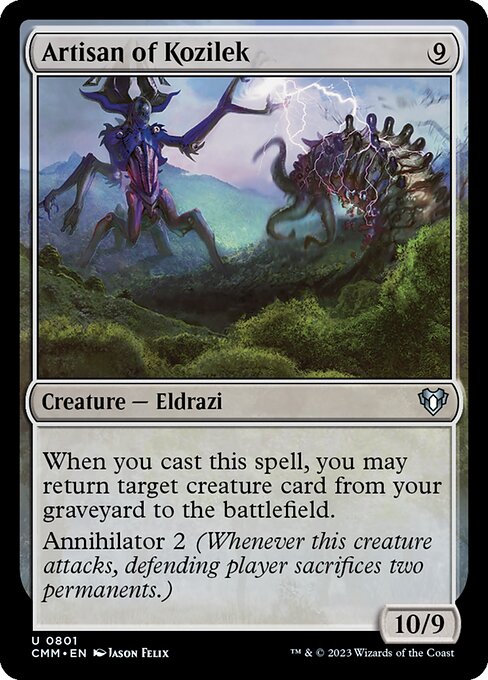
Artisan of Kozilek - Annihilator 2
At {9} mana - still expensive, but more achievable than Ulamog - Artisan returns a creature card from your graveyard to the battlefield when cast, then threatens annihilator 2 every attack. It's one of the more Commander-accessible annihilator creatures, and the reanimation trigger gives you immediate value even if it's answered quickly.
Nulldrifter - Annihilator 1
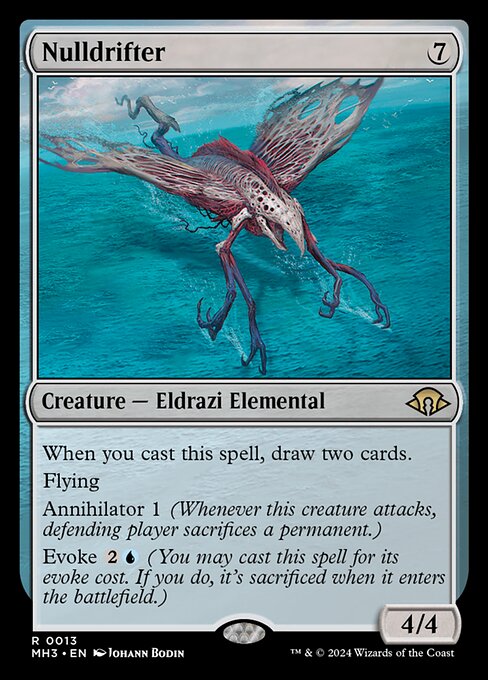
One of the more interesting designs from Modern Horizons 3, Nulldrifter costs {7} at full price but has an evoke cost of {2}{U} - pay that, and you immediately draw two cards and sacrifice it. As a full cast, you get a 5/5 flier with annihilator 1 and still draw two cards. The flexibility between "efficient draw spell" and "real threat" makes it genuinely interesting for blue-heavy Eldrazi strategies.
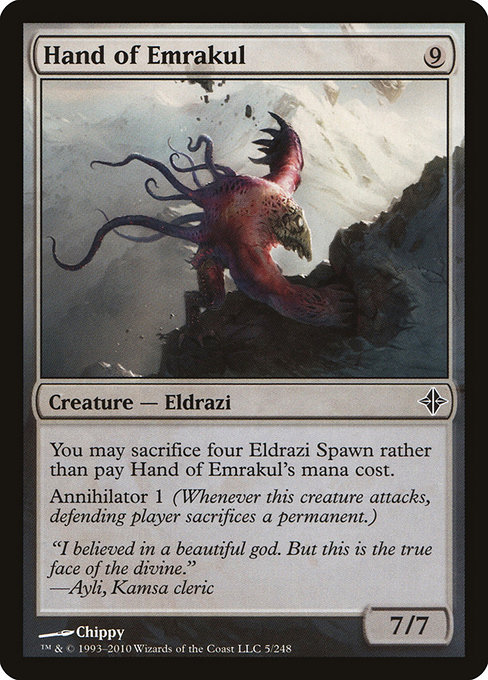
Hand of Emrakul - Annihilator 1
The accessible entry point. Nine mana base cost, but you can cast it for free by sacrificing four Eldrazi Spawn tokens - and ROE was designed to generate those tokens. A 7/7 with annihilator 1 is a serious threat at any mana cost, and "free" is a mana cost that gets anyone's attention.
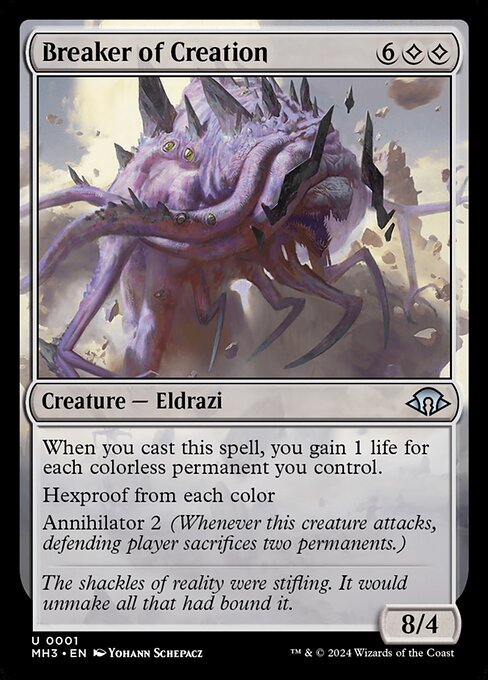
Breaker of Creation - Annihilator 2
From MH3, Breaker of Creation costs {6}{C}{C} (the {C} symbol representing colourless mana specifically), gains you life equal to the number of colourless permanents you control when cast, and has hexproof from each colour. That last ability is notable: most removal spells are coloured, so Breaker of Creation is remarkably hard to answer with conventional means once it's on the battlefield.
Eldrazi Conscription - Grants Annihilator 2
An Aura from ROE that gives the enchanted creature +10/+10, trample, and annihilator 2. Slapping this onto any attacking creature creates an immediate crisis. It's fragile (it can be enchantment removal'd), but the raw stats change make it a Commander favourite for Voltron strategies.
History of Annihilator
Annihilator debuted in Rise of the Eldrazi (April 2010), a set deliberately designed around a slower, more epic Limited format where huge creatures could actually reach the battlefield. The mechanic was central to the set's identity - it made the Eldrazi feel genuinely apocalyptic, not just big.
When the Eldrazi returned in Battle for Zendikar (BFZ, 2015), they left annihilator behind. The design team felt the mechanic was too punishing and had too little counterplay, replacing it with the Processors and colourless mana mechanics instead. Bane of Bala Ged from that set offered a nod to the concept - exile two permanents when it attacks - without technically using the keyword.
Mark Rosewater placed annihilator high on the Storm Scale (his measure of how unlikely a mechanic is to return to a Standard-legal set), calling out its design limitations: it's brutal in limited environments, creates feel-bad moments with little recourse, and is hard to scale fairly.
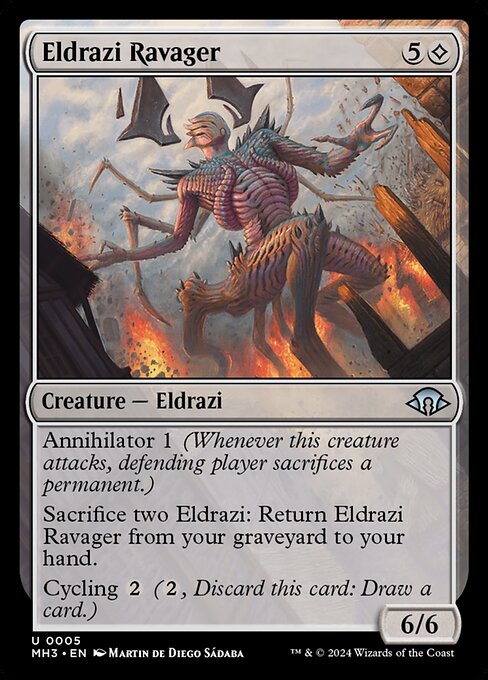
Despite that, annihilator has made returns. The Nazgûl Battle-Mace from the Lord of the Rings Holiday Release grants annihilator to equipped creatures - an unexpected crossover appearance. And Modern Horizons 3 (2024) brought annihilator back properly, with several new Eldrazi cards including Breaker of Creation, Nulldrifter, Eldrazi Ravager, and the Kindred support card Idol of False Gods - the first time an Eldrazi-tribal permanent granted annihilator to other creatures.
The mechanic also appears on cards that grant annihilator to others, including **Azlask, the Swelling Scourge** (which grants it to Spawns and Scions) and Eldrazi Conscription.
I think the story of annihilator is a good example of Magic's design tension: some of the most memorable, flavourful mechanics are the ones that are hardest to balance. Annihilator feels like the end of the world - which is exactly right for the Eldrazi - but that feeling comes at the cost of being deeply miserable to play against when you can't interact with it. The MH3 return suggests Wizards has found a space for it in non-rotating formats, where players opt in to a higher power level anyway.