Embalm: MTG Mechanic Explained
There's something quietly satisfying about a card that refuses to stay dead. Embalm is exactly that kind of mechanic - it turns the graveyard into a second hand, letting you wrap up a fallen creature in bandages and send it back into battle as a Zombie token. It's flavorful, resilient, and surprisingly tricky to play around.
Embalm was introduced in Amonkhet (2017) and is centred in white and blue. If you've ever wanted your creatures to pull double duty - once when you cast them, and again when they die - this mechanic is for you.
What is Embalm?
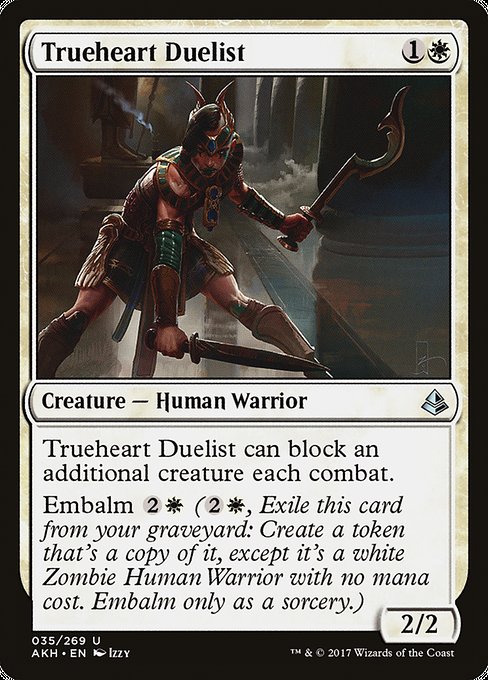
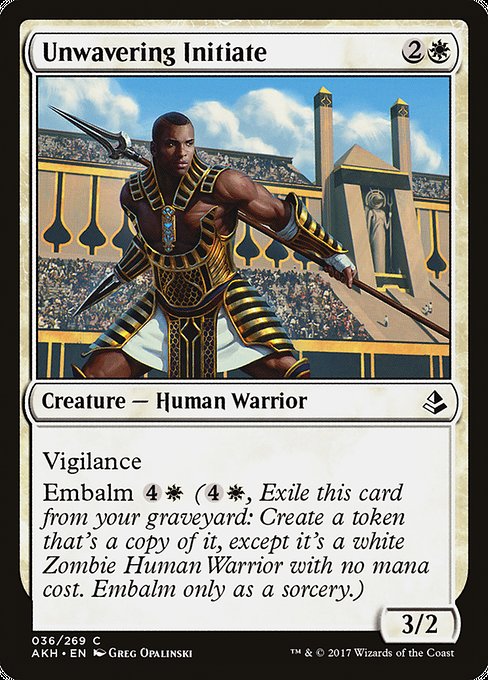
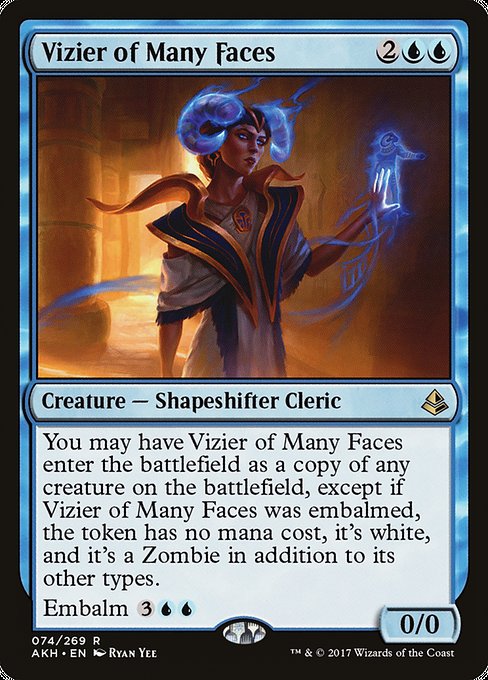
Embalm is a keyword ability that appears on creature cards. When a creature with embalm ends up in your graveyard, you can pay its embalm cost (an activated ability) to exile it and create a token copy. That token is a slightly modified version of the original: it's white, it has no mana cost, and it gains the Zombie subtype in addition to whatever types it already had.
Think of it like a second casting - except instead of the card coming back to the battlefield directly, you're creating a fresh token from scratch. The original card is gone forever (exiled), but its spirit, or in Amonkhet's terms, its mummified form, lives on.
Lore aside: Amonkhet is deeply inspired by ancient Egyptian mythology, where mummification was a sacred practice to preserve the body for the afterlife. Embalm captures that flavour beautifully - your creatures are literally being prepared for a second life of service. Each creature with embalm in the Amonkhet set even came with a corresponding token card depicting its mummified form.
How Embalm works - the rules
Here's the official definition, straight from the Comprehensive Rules (November 14, 2025 - Edge of Eternities):
"Embalm [cost]" means "[Cost], Exile this card from your graveyard: Create a token that's a copy of this card, except it's white, it has no mana cost, and it's a Zombie in addition to its other types. Activate only as a sorcery."
- CR 702.128a
Let's unpack the key pieces:
- It's a graveyard ability. Embalm only functions while the card is in your graveyard. It can't be activated from your hand, library, or exile.
- You exile the card. Once you activate embalm, the original card is exiled - not returned to the battlefield, not sent anywhere else. This is a meaningful cost.
- The token is a copy, with three changes. It's white (regardless of the original's colours), it has no mana cost, and it's a Zombie in addition to its other creature types. Everything else - power, toughness, abilities, other subtypes - carries over.
- Sorcery speed only. You can only activate embalm on your own turn, during your main phase, when the stack is empty. No sneaking out a Zombie blocker at instant speed.
- The token is "embalmed". CR 702.128b notes that tokens created this way are specifically considered embalmed tokens, which matters for some card interactions.
Common misunderstandings
"Does the token have the embalm ability too?" No. The token has no mana cost, which means it can't be cast, and embalm only functions while the card is in the graveyard - a token can never be in a graveyard in a meaningful way anyway. The token does not re-embalm.
"What colours is the embalmed token?" It's white, full stop. Even if the original creature was blue, green, or multicoloured, the token is a monocoloured white creature. This can matter for colour-based effects and protections.
"Can I embalm a creature that was exiled?" No. Embalm only works from the graveyard. If the original creature card ends up exiled by another effect before you can embalm it, it's gone for good.
"Does the token have a mana cost for the purposes of effects that check mana value?" No mana cost means a mana value of 0. This can affect cards that care about a creature's mana value.
Strategy
Playing with Embalm
The core appeal of embalm is resilience. A creature with embalm effectively gives you two bodies for the price of one card slot - the original creature and a token that often costs less than recasting would. In attrition-based matchups, this kind of two-for-one value is exactly what you want.
That said, embalm costs are usually higher than the original casting cost, so you need mana to spare. Plan your curve so you're not spending your early turns holding back resources for embalm activations. The best embalm creatures are worth casting on rate the first time, with the embalm acting as a genuine bonus rather than the primary reason to play the card.
Protect your graveyard. Embalm is entirely dependent on the card sitting in your graveyard. Opponents who know what they're doing will use graveyard hate - Rest in Peace, Tormod's Crypt, Leyline of the Void - to cut off your embalm options. If you're leaning heavily on embalm, consider your plan B.
Embalm plays especially well with:
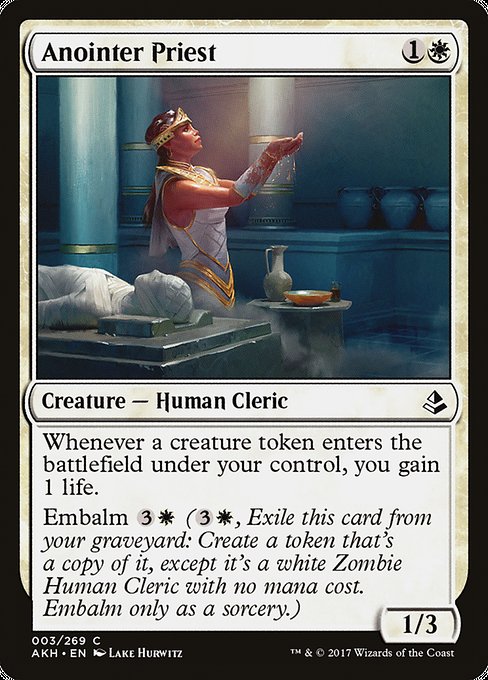
- Token synergies - cards that reward you for having creature tokens, like Anointer Priest (which gains you life whenever a token enters).
- Zombie synergies - embalmed tokens gain the Zombie type, so they plug into Zombie tribal payoffs.
- Sacrifice outlets - if a creature is going to be sacrificed anyway, embalm ensures you still get value from the card.
- Graveyard enablers - cards like Embalmer's Tools make embalm activations cheaper, smoothing out the mana cost.
Playing against Embalm
The most direct answer to embalm is exile effects. Destroying a creature doesn't permanently answer it if the embalm ability is still waiting. Exiling it does. Prioritise exile removal - Path to Exile, Anguished Unmaking, or graveyard-sweeping effects - if your opponent has creatures with embalm you can't afford to face twice.
If you can't exile the creature, try to interact with it while it's still on the battlefield before it ever hits the graveyard. A creature that never dies is one that can never be embalmed.
Format check: Embalm is legal in any format where the individual cards are legal. Most embalm cards are from Amonkhet (AKH) and Hour of Devastation (HOU), sets that have rotated out of Standard long since. They're currently playable in Pioneer, Modern, Legacy, Vintage, Commander, and Limited formats that include those sets.
Notable cards with Embalm
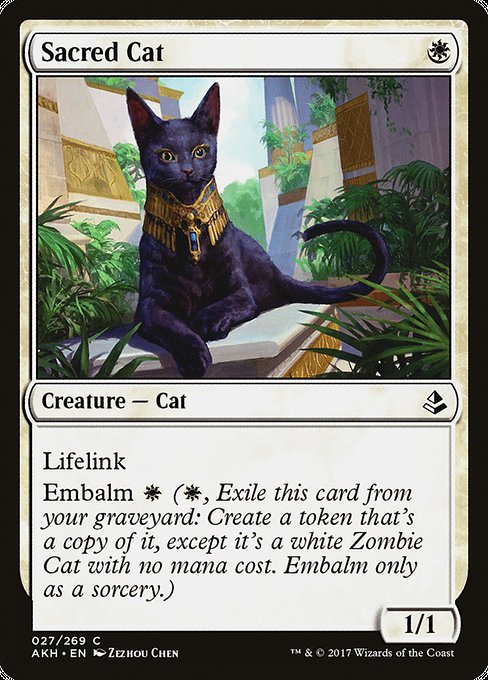
Sacred Cat
The most accessible embalm creature, and a great illustration of how the mechanic works. A 1/1 with lifelink for {W} is modest, but embalming it for {3}{W} gives you a second 1/1 lifelink Zombie Cat token - plenty of life gained over the course of a game, especially in token-heavy or lifegain builds.
Anointer Priest
A {1}{W} 1/3 that gains you 1 life whenever a creature token enters. It has embalm itself ({3}{W}), which means embalming it gives you life, and then the embalmed token generates life for every other token you make afterwards. In token-flooded decks, this card snowballs quickly and was a real force in its Standard environment.
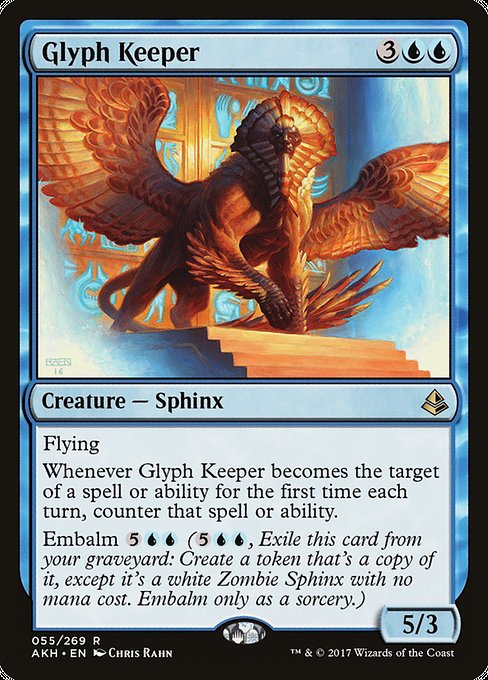
Glyph Keeper
A {3}{U}{U} Sphinx with flying and a triggered ability that counters the first spell or ability to target it each turn. Embalming it for {5}{U}{U} gives you an evasive, hard-to-interact-with flying threat. The embalm cost is steep, but a 5/3 flyer that's resistant to removal is a meaningful late-game finisher.
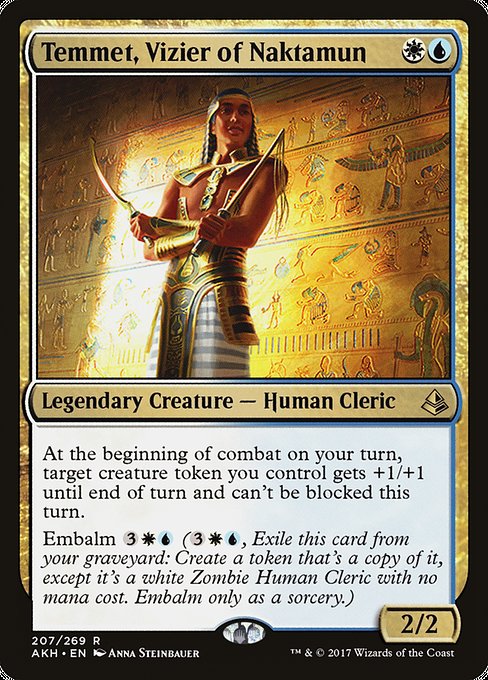
Temmet, Vizier of Naktamun
A Legendary {W}{U} 2/2 with embalm {3}{W}{U}. At the beginning of combat, Temmet gives a creature token +1/+1 and makes it unblockable for the turn. He synergises directly with embalmed tokens, which is thematically perfect. In Commander, he led his own token-based deck.
Embalmer's Tools
Not a creature with embalm itself, but a strong support card for the mechanic. This {2} artifact reduces the activation cost of creature card abilities in the graveyard by {1} - that includes embalm costs. It also lets you tap an untapped Zombie to mill a card, helping you fill your graveyard with more embalm targets. A genuinely useful piece in dedicated embalm or Zombie decks.
Naktamun (Planechase)
The Amonkhet plane card for Planechase play has a wild effect: every creature card in your graveyard gains embalm, with an embalm cost equal to its mana cost. It's a situational, chaotic effect that only comes up in Planechase games, but it's a fun nod to the mechanic's home plane.
The history of Embalm
Embalm's origins go back to a discarded mechanic called Mummify, which was designed for Amonkhet but never released. Mummify was a graveyard mechanic that eventually evolved into what we now know as embalm - the design team refined the concept until it felt both mechanically clean and deeply connected to the set's Egyptian-inspired flavour.
Embalm was introduced in Amonkhet (AKH) in 2017. The set leaned hard into the idea of afterlife and death as transitions rather than endings, and embalm was the mechanical expression of that theme. To reinforce the flavour, Amonkhet included a physical token card for each embalm creature, depicting the mummified form - though these tokens weren't required for play.
The mechanic was a success, and Wizards expanded on the concept in Hour of Devastation (HOU) the same year, introducing Eternalize. Eternalize works similarly to embalm - exile the card, make a token - but the token is always a 4/4 black Zombie in addition to its other types, rather than a copy of the original's stats. Eternalize is the "bigger, darker" version of embalm, fitting Hour of Devastation's tone as Amonkhet falls to Nicol Bolas's schemes.
Embalm hasn't appeared on new cards outside of Amonkhet block, but the support card Cursecloth Wrappings (printed later) can grant embalm to any creature card in your graveyard, showing that the mechanic still has design space worth exploring.